



















- Best of All
- Best Miami Luxury Condos
- Most popular
- Relocating to Miami
- Private Schools
- Investments
- Gated communities
- Waterfront information
- Luxury homes
- Luxury Condos
- New Construction Condos in South Florida
- Independent Pre-Construction condo reviews for Miami
- Independent Pre-Construction condo reviews for Fort Lauderdale
2024 Miami Real Estate Predictions and Forecast
Miami Real Estate Warnings: Will the Market show any Correction?
Introduction
All real estate markets do not continuously appreciate without pause. They experience periods of adjustment immediately after periods of extreme growth. As astounding as property appreciation in Miami between 2021 and 2023 has been, over the last six months, we have seen some slowdown. This is not only normal but actually healthy as other aspects of the buyer’s market (such as earnings) need to catch up. In Miami, this incredible appreciation period has arguably led many sellers to become over-confident, hopeful that ‘trees will grow to the sky’ and overestimate their property values as well as over-estimate buyer confidence without factoring some of the economic ‘braking’ mechanisms, such as interest rates.
Real estate professionals are often accused of overly positive hyperbole. Touting phrases like “it’s always a good time to buy”. At DSG, we prioritize honesty. If you’ve watched any of my videos, podcasts, or reports, you’ll know I’m not one to shy away from the tougher conversations. In this report we endeavor to look at the head-on reality; we discuss both the drawbacks and opportunities. Let’s begin with discussing the warning signs the market is showing us. Highlighted throughout this report in the RED font are the key warnings that we want to bring to consumers’ attention – both buyers and sellers. With that said, despite concerns in certain sub-markets and products, we are very optimistic for the Miami market in the longer term (2025 and beyond). We’ll explore lucrative opportunities later in this report, but first, we’ll provide advice aimed at safeguarding your wealth as much as growing it.
What to Expect from our Miami Real Estate Predictions
Our Miami Real Estate Forecast for 2024 is discussed in 10 individual points. Outlined below are the 10 key Miami real estate predictions, forecasts, and trends for 2024. Some points give light to opportunity and some give reference to warning. These 10 points are all part of the big picture and we will expand upon them in separate blogs, videos, and podcasts in the upcoming weeks.
In red we highlight the dangers as we see them for both buyers and sellers. Some of these are economic factors while others are psychological factors that are equally important when strategizing. Regardless, we hope that you will read this and appreciate that our knowledge and understanding of the market is of significant benefit to you in your particular process. So please consider using my service as a buyers agent or a sellers agent to make your next move, and feel free to call me to discuss.
Our commitment to clients emphasizes advice that is honest, quantifiable, and actionable. These insights are intended to benefit both buyers and sellers at local, national, and international levels. Each point is open to further elaboration, and we plan to delve deeper into these topics through our YouTube channel and Instagram. Throughout the year, we’ll track these predictions as market conditions, awareness, and economic factors like elections, interest rates, exchange rates, and stock and bond markets evolve. Probably the biggest conversation, or at least the one that everything else is currently revolving around is the current real estate paradox between buyers and sellers. Most prevalently seen in the luxury sector.

What is the current Miami Real Estate Paradox and why is it so important that you understand it?
The real estate paradox we talk about is with sellers who are not overly motivated to sell and buyers who don’t feel overly motivated to buy. This has created a ‘stand off’ in a number of markets and can well explain why we are seeing this slow down in sales with a lower number of transactions by Quarter. The reasons for this behaviour is well illustrated below in the drawing. Several variables are at play that could break this stale mate situation and we go into that with the report. Changes in Interest rates, CD returns (short term bonds yields), the urgency of migrating wealth and other asset value changes, all will play their role either short term or long term.
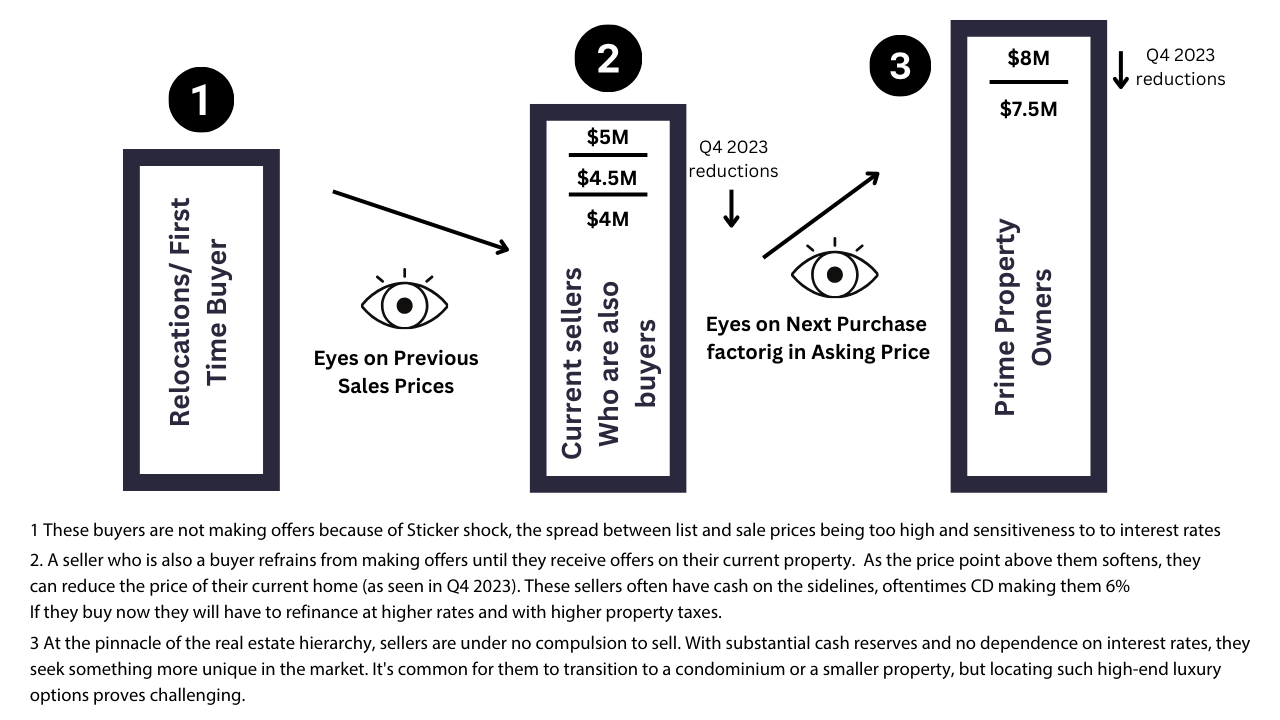
Buyer Psychology Associated with the Miami real estate paradox: Economic and psychological factors significantly impact the real estate market, especially in luxury property sales. Potential buyers hesitate due to observed price declines, anticipating further reductions, leading to caution and delayed decision-making. The lack of sales serves as a cautionary indicator, dissuading immediate offers.
Seller Psychology Associated with the Miami real estate paradox: At the same time, certain luxury and even not so luxury sellers deem their property exceptional and resist following market trends. However, those choosing to reduce prices are individuals serving as both sellers and buyers. They evaluate the market, noting declines in property prices, and believe they can obtain a better deal for their next home. This dual role increases their motivation to sell, driven by the opportunity to acquire a new home that has piqued their interest.
Buyers will need to appreciate that ‘replacement’ cost for many buyers is higher than ever. As property taxes will no doubt go up for that person and mortgage payments will mean substancial monthly cost increases.
Migrating buyers who are new to this market will look at sold listings, where the limited number of sales and lower dollar-per-square-foot values strongly influence their decision-making. They hesitate due to the shock of prices and the disparity between sales and asking prices. This hightlights a prevailing real estate paradigm that appears to be a significant takeaway in 2024.
1. Miami Real Estate Predictions | Prices coming down for Buyers in 2024. Overall… NOT LIKELY!
2. Are Miami Luxury properties Overvalued? In many cases: No. In some cases… Absolutely!
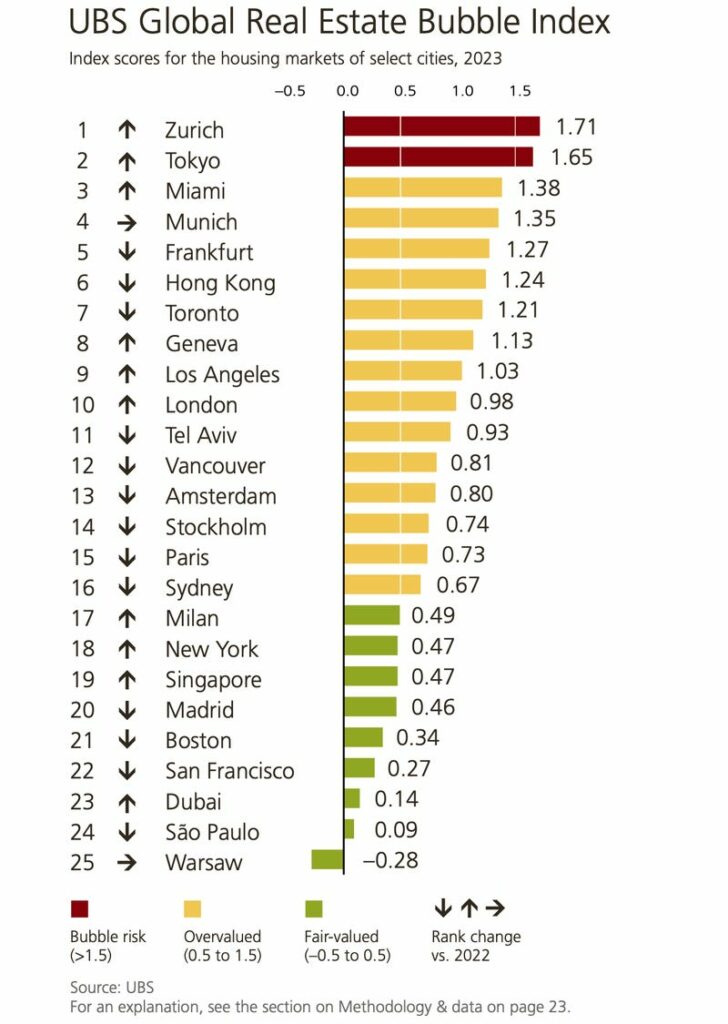
It’s hard NOT to think that when you consider the incredible appreciation on homes and most importantly when we are seeing a slew of properties attempting to eclipse the ‘record prices for the neighborhood’ even in the face of the new higher interest rates. Miami tops the list of overvalued housing markets in the U.S., ranking third globally in the 2023 Real Estate Bubble Index by UBS.. The city’s rapid price surges (40% in two years) and a high price-to-rent ratio contribute to this ranking. Studies from FAU and FIU place Miami among the top 15 most overvalued U.S. cities, emphasizing a potential premium paid by buyers.
However, to assume that all markets and all properties are systemically overpriced and that you are buying at ‘the top of the market’ would be a HUGE mistake. Arguments against overvaluation point to a stabilization trend, strong demand driven by lifestyle and job market appeal, and a limited housing supply preventing substantial price declines. Some proponents argue that Miami’s underlying fundamentals suggest very strong long-term price appreciation, mitigating short-term fluctuations. Despite high prices, a shift in Q1 2024 sees some sellers adopting a more pragmatic approach by reducing prices, allowing potential trade-up buyers to do the same. Systemic migration is still an overruling and all powerful influence in both the short and long term market views. Ignore these at your peril.
*Contributing Minds: Eli Beracha, Ana Bozovic and Craig Studnicky
3. Which Miami product will sell better in 2024. Condos or Homes?
When asked, ‘Which Miami Real Estate markets will be better and which will do worse in 2024? We say this….Consider the real estate paradox of buyers not wanting to pay top dollar and sellers not needing to sell and consider the Condo market and the housing market separately. Migration is systematically impacting both markets, but its effects are particularly pronounced in primary markets, as that is the primary focus of attention for those buyers who want a permanent residence in Miami. Acquiring new products or securing prime locations remains challenging. Primary product has traditionally been in the form of single family homes, but with the advent of large 3-5 bedroom Condos in Miami, many migrating buyers are looking at the ‘vertical living options’. Ultimately, success hinges on factors like location and pricing, with both avenues having the potential to excel depending on market conditions. New luxury condos are thriving due to a severe shortage of inventory. Prominent resale projects like Park Grove exemplify this trend, poised for success due to their quality and favorable location. The same happens in the housing market where location and finishes are the predetermining factors for buyers.
Secondary markets, where buyers don’t need to buy will most likely have a much worse time. As there is no direct or immediate pressure to buy (like kids going to the local school). Any seller fishing top dollar in a secondary market will most likely be met with deathly silence. We are already seeing this trend start to occur.
Finally on this point, it is worth mentioning that the much older Condos are going to have a more difficult time selling in Miami this year, and with so many pre 1990 Condo buildings in Miami experiencing sky rocketing assessments and HOA fees we anticipate corrections in a number of pockets on Miami beach and into Sunny Isles. We dive deeper into this point further down the report.
*Contributing Minds: Ana Bozovic and Craig Studnicky
4 Specific Miami neighborhoods that we expect to see corrections most occurring.

Primary markets such as Coral Gables, Pinecrest, and Coconut Grove outperform more investor-driven markets and are VERY unlikely to see systematic corrections of any kind. They may, however, seem individual corrections for overpriced properties.
5. Insurance premiums and HOA Fee hikes will ‘shake out’ many property owners.
Nearly two years ago we accurately predicted that the greatest challenge to South Florida home buying and selling was the insurance premium changes. Please check out our initial podcast with Hugo Garcia, a gentleman who used to work for the insurance companies and now battles them in court for settlements to policies!
Along with the rising costs of the insurance, which went up 30% in 2023, is the increase in HOA fees for many condo owners (particularly older condos). Although these can be enticing, they can become a poisoned chalice. We have warned owners of older homes in the flood zone and owners of older condos to be aware of this. If you are a home owner and you have not fully processed the gravity of this situation, allow me to provide a free consultation on where this is going.
Stay tuned for our follow up Podcast interview with Hugo Garcia which will happen in April, where we discuss the current 2024 state of the insurance market and what it means for your insurance premiums!!!
*Contributing Minds: Hugo Garcia
5 B. Older Condos should in many cases, be avoided are they go through major assessments with age.
With the 40 year assessment age coming down to 25 years, there are many condos who will experience crippling assessment costs on top of rising HOA fees caused by insurance premiums. Many of these buildings are inhabited by old retired couples and singles and with the rising inflation not offset up earning, you can imagine how these costs start to eat into their retirement savings and put pressure on these sellers. The reality is that although some of these condos could seem like an attractive deal, the real consequence can be dire if pool areas, terraces and the such are closed for long periods of time all while work is being done to bring the condo up to code. This can make some of these older condos unsellable.
6. They are still coming!!! Moves to Miami underway… underestimate at your own peril.
One of the most powerful forces that we believe will dwarf short term ‘murmurs’ in the buying and selling cycles of Miami real estate, is the huge migration of companies to South Florida.
So much press has been put out there in regards to the movement of business to South Florida. The ‘black swan’ event that was COVID has had real long term consequences. Although we have experienced the migration of many families and professionals, the re-establishment of major corporate headquarters takes time. In fact, it takes much longer than one might anticipate. While 176 companies have expressed the intention to move into Miami, only a handful have completed the relocation. Many more companies are in the process of moving, and once they do, the pace of migration is expected to accelerate. The delay is partly attributed to the fact that the new Class ‘A’ buildings required for these companies are still under construction or have not begun. We discussed these migration patterns in this article.
Our go to expert in this conversation is Ana Bozovik who runs Ana’s Analytics. We will be touching base with her in May to get an up to date look on the business migration phenomenon and where it is in the process.
*Contributing Minds: Eli Beracha, Ana Bozovic and Craig Studnicky

7. Real Urban and economic challenges will impact some Miami Markets as we experience ‘growing pains’. This can also spell opportunity for investors.
Every surge in growth brings along its own set of challenges, and Miami is no stranger to this reality. The rapid expansion comes with its share of difficulties that we must confront. The expansion of freeways is underway, but it has led to heavier traffic. School capacities are stretched thin, reflecting a shortage of available spots. Interestingly, the attrition rates are minimal, with less than 1% of the population leaving Miami, indicating that financial resources are staying within the city. This low attrition makes the likelihood of a correction or collapse highly improbable. Instead, it positions Miami to become more robust and resilient in the face of these challenges.
With that said some markets are going to experience challenges (like Brickell) where commuting becomes more problematic and times to get from home to office stretch further. If you are a buyer trying to figure out where to live, please call me for a consultation so I can explain the ‘big difference’ between living 1/2 miles in either direction and how that could increase time to school or home by as much as 15 minutes!
Another challenge for businesses moving to Miami with those who are employing some younger more entry-level staff is the higher cost of living. If you are an employer and are trying to figure out where to be, you need to consider the higher cost of living and rent acrosss parts of the city. It has been reported that Miami has the highest rate of inflation in the US.
With that said for investors this could spell opportunity as we see many workers start to move out further afield to buy homes and ’emerging neighborhoods’ start to develop even quicker in 2024. If you believe as we do that if emerging neighborhoods where you can still get a nice home under $1m or $1.5m. are doing well now, imagine how it will be when rates drop toward the end of 2024! We expect another spike in my prediction. Call me again, if you want to discuss the details of these emerging neighborhoods.
*Contributing Minds: Craig Studnicky
8. The Elephant in the Room! High interest rates will slow down some buyers, but not for long.
There is still so much cash floating around the system. The buyers are out there, just waiting for the right property. But as mentioned above in the real estate paradox they do not want to overpay and most certainly don’t want to meet an ‘aspirational sellers’ expectations of setting a new record in the market. Most certainly, working-wealthy buyers are being a little more aware of what they are paying.
In fact, I don’t believe it is interest rates that are creating ALL the issues on deal making in Miami in 2024, but more the appraisal process and the conservative nature of appraisers/banks is playing a huge role. They simply want to lend less. I encourage my sellers to be aware if this conservative nature and where possible take mortgage deals without appraisals or better yet cash deals. For my buyers… I flip the narrative and push for appraisals as it becomes a very useful negotiation tool down the line.
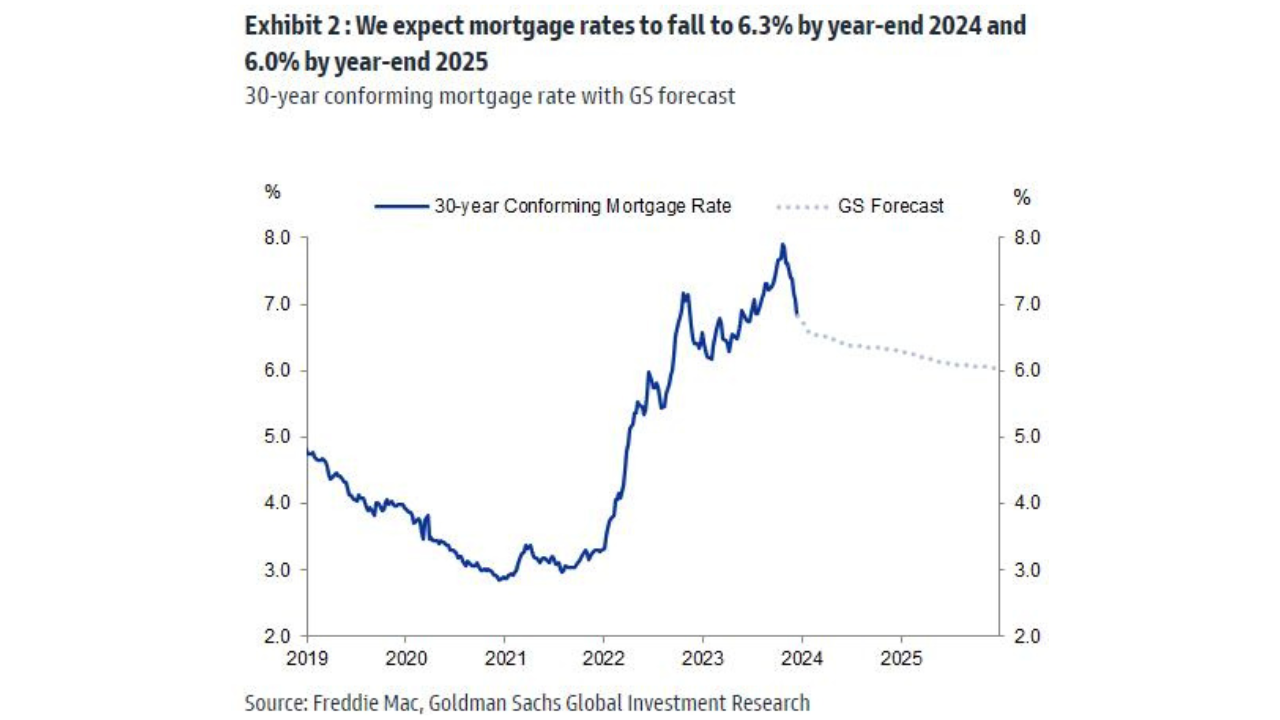
It is believed that the Federal Reserve might start reducing interest rates in 2024. Reduced interest rates will change buyer’s (and sellers) mindsets and result in the following:
- Short-term bonds will yield a lower percentage.
- Mortgage costs will decrease.
- Confidence in the market will rise, attracting more buyers.
- People who had funds on the sidelines may reconsider short-term bonds and explore alternative investment direction including real estate.
Interest rates undeniably play a pivotal role in the real estate market. When these rates decrease, a substantial amount of sidelined cash is poised to enter the market, simultaneously bolstering confidence. As I often emphasize, “Marry the house, date the mortgage.” A decline in interest rates is likely to lead to heightened competition, potentially sparking a new surge in prices. You might wait for the rates to come down by half a percent, but once that happens prices are increasing by 10% given the increased demand.
*Contributing Minds: Eli Beracha and Craig Studnicky
9. We predict, a surprisingly higher number of ‘well’ negotiable deals in plain site!
Having sold real estate for over 15 years I have experienced the ups and downs of the Miami real estate market and can tell you that in some years the ‘asking price is the selling price’. This very much happened in 2021. I do not believe that this is the case in 2024. I have had many conversations with sellers agents who tell me that they have a hard time getting their sellers to adjust the listing price, but are very negotiable. This is very much true in the luxury sector of the market.
When being hired in the capacity of a buyers agent I can tell you that I have this year negotiated some staggering discounts for my clients. Well beyond their expectations. Deals, if out there, are in plain site! You just need to know the back stories and understand the opportunities that exist. Want to understand this more? Give me a call.
*Contributing Minds: David Siddons
10. Miami New Construction Condos will dominate much of the Luxury Condo sales in 2024. Record prices for Condos will occur highest in this product class.
With more and more focus on new construction condos, this remains a relevant topic. Buying an unfinished product, not knowing what you get yourself into, might lead to headaches along the road. Be it because you walked inside the sales center without buying representation or whether you were represented by an inexperienced agent, there are risks involved. We will present you with a podcast with one of Miami’s top developers and we will discuss how well built Miami condos are, and how to distinguish the good projects from the bad ones. In addition, we will discuss whether the current wave of condos is on track to be finished on time, the importance of construction loans, and how sales are going at Miami’s newest projects.
Certain projects I advise against, while others, particularly those in the realm of next-level luxury, I am confident will thrive. The emphasis remains on attracting luxury buyers who are less sensitive to interest rates but hold a bullish stance on the Miami real estate market and its future prospects. This positive sentiment suggests that luxury new construction projects are poised for success.
*Contributing Minds: Craig Studnicky and David Martin from Terra
11. Bonus Point! The noise created from the Election can change some behaviours.
Every election cycle I see buyer and seller behavior shift as we run up to the general election. I don’t expect it to be any different this time either. We are still some way away from that, but it will happen all at once, and very often we see less educated buyers and sellers sit around waiting to see who is the next president. They stay glued to the TV, seemingly paralyzed from taking any action at all. In truth, this behavior is non sensical and has little influence or bearing in the end of buying and selling real estate in Miami. Every time, we have a ‘wait and see attitude’ then it is business as usual. I implore readers to not get caught up in this circus and look at the REAL long term influences of the market.
*Contributing Minds: Eli Beracha
Contributing Minds
We spoke to the following experts to create our 2024 Miami Real Estate Predictions.
| Contributor | Position/Title | Link to related Articles | Associated Video |
| Craig Studnicky | CEO at ISG World | Content | |
| Eli Beracha | Professor of Real Estate and Finance at FlU Director, Tibor and Sheila Hollo School of Real Estate Hollo Research Fellowship | Content |
 |
| Ana Bozovic | Founder of Analytics.Miami | Content |
 |
| Hugo Garcia | Managing Shareholder at Florida General Counsel | Content |
 |
| David Martin | CEO of Miami-based development firm Terra | Content |
 |
Schedule a Call with David
Schedule a call to discuss the Miami Real Estate Predictions or any other questions you might have.
FAQ
These are the most commonly Miami Real Estate Related questions
What should relocation buyers know before buying real estate in Miami?
HOME BUYERS
Relocation buyers looking at homes in Miami should understand that choosing the right house is less about the property itself and more about location, schools, and long-term value. Many buyers make the mistake of focusing on price or finishes, while the real driver of value is the neighborhood and micro-location. Older homes often represent better value, but may also be part of a future redevelopment cycle. Newer homes command premiums, but don’t always sell faster if pricing is ahead of the market. Commute time, school access, and community dynamics are critical and often underestimated. The key is to evaluate homes not just as lifestyle purchases, but as long-term assets within a very localized market.
Sources:
https://luxlifemiamiblog.com/relocating-to-miami/
https://luxlifemiamiblog.com/relocating-to-miami-with-a-family/
CONDO BUYERS:
Relocation buyers should understand that Miami is a highly segmented, building-driven market, not a uniform one. Pricing can vary significantly between similar properties depending on building quality, layout, and financial health. Many buyers assume newer construction equals better investment, but that is often not the case. Factors like HOA fees, reserves, and rental policies can materially impact long-term value and liquidity. Negotiation opportunities often exist, especially in slower segments, but require precise market knowledge. The key is to evaluate micro-markets and individual buildings, not just neighborhoods or price per square foot.
Sources:
https://luxlifemiamiblog.com/miami-real-estate-market-report/
https://luxlifemiamiblog.com/new-construction-miami-guide/
What are the best areas for relocating families with children
For families relocating to Miami with young children, the most recommended neighborhoods are Coral Gables, Coconut Grove, and Pinecrest. Coral Gables offers the best balance of top schools, safety, and long-term value. Coconut Grove is ideal for younger families seeking walkability, greenery, and a lifestyle-driven environment. Pinecrest provides larger homes, excellent schools, and better value for space, making it ideal for growing families. The key driver across all three is access to strong schools and primary residential stability. Relocation decisions are less about new construction and more about long-term livability and resale strength.
Sources:
https://luxlifemiamiblog.com/best-neighborhoods-miami/
https://luxlifemiamiblog.com/what-are-the-best-family-neighborhoods-in-miami-in-2023/
Are new construction condos in Miami a good investment?
New construction condos in Miami can be a good investment—but only if you understand that not all buildings perform the same. According to the David Siddons Group, many buyers assume “new = better,” but in reality, performance depends on pricing, layout, building quality, and long-term demand. Some new developments set future price benchmarks and can drive long-term appreciation, especially in top-tier projects. However, many are priced aggressively at launch, and buyers relying on marketing instead of data often overpay.
The market is highly segmented, meaning two new buildings next to each other can perform very differently.
The best opportunities typically come from selecting the right building early or negotiating correctly in later phases.
In short: new construction is not automatically a good investment—it becomes one only with building-level analysis and disciplined entry pricing.
Sources:
https://luxlifemiamiblog.com/how-to-buy-a-luxury-condo-in-miami/
https://luxlifemiamiblog.com/category/independent-new-construction-condo-reviews/
https://luxlifemiamiblog.com/beyond-clickbait-real-insights-into-miamis-luxury-condo-market/
Why is buying a Miami condo riskier than buyers think?
Buying a Miami condo is often riskier than buyers expect because the true risks are at the building level—not visible in the listing price. Many buyers focus on finishes and views, while overlooking HOA reserves, insurance exposure, and potential special assessments. In reality, two identical units in different buildings can perform completely differently over time. Rising HOA fees and stricter regulations are also increasing the true cost of ownership, especially in older buildings. Liquidity can be affected by factors like financial health, rental policies, and ongoing repairs. The key risk is not the condo itself—but buying into the wrong building without proper due diligence.
Sources:
https://luxlifemiamiblog.com/how-to-buy-a-luxury-condo-in-miami/
https://luxlifemiamiblog.com/miami-condo-market-risks/
What are Miami's Safest Areas?
Which Miami Areas Still offer Great Value (Budget Friendly alternatives to Coral Gables and Pinecrest)
If you’re looking for better value than Coral Gables or Pinecrest, the answer (in true Siddons style) is not “go cheaper”—it’s go one layer outside the obvious markets.
The strongest value plays are:
- Schenley Park → closest substitute to Coral Gables at ~20% discount while maintaining similar character and location
- Biltmore Heights → almost identical feel to the Gables but ~25–30% cheaper on a $/SF basis
- Glenvar Heights → central location with larger lots and ~25% pricing advantage vs South Miami/Gables
- Baptist / Galloway (Kendall) → Pinecrest-style living (space, schools, land) at up to ~30% lower pricing
The pattern is consistent:
👉 Buyers are shifting west and slightly off-market to gain land, scale, and pricing efficiency. You don’t find value by going to a “cheaper neighborhood”—you find it by identifying adjacent micro-markets that offer the same lifestyle fundamentals without the brand premium.
Sources:
https://luxlifemiamiblog.com/best-value-neighborhoods-miami/
https://luxlifemiamiblog.com/category/miami-neighborhoods/
Is NOW a good time to buy in Miami?
Are Miami real estate prices going down in 2026?
No—but that’s the wrong way to look at it. Miami is not one market anymore, so prices are not moving in one direction. In 2026, the market is split into two: ultra-luxury, scarcity-driven areas (like waterfront and top-tier neighborhoods) are still holding or even rising, while mid-tier condos and oversupplied segments are flat or correcting. What we’re seeing is price divergence, not a crash—some properties are gaining value while others are quietly adjusting downward. Rising inventory and more selective buyers are putting pressure on pricing in certain segments, especially older condos or buildings with weaker fundamentals.
At the same time, global wealth and cash buyers continue to support pricing at the top end of the market. So the real answer: prices aren’t broadly dropping—they’re being repriced based on quality, location, and supply.
Should I buy a house or a condo when relocating to Miami?
The decision comes down to lifestyle first, investment second—and most relocation buyers get that backwards. If you want space, privacy, schools, and long-term family living, a single-family home in areas like Coral Gables or Coconut Grove is typically the stronger choice. If you prioritize walkability, low maintenance, and proximity to business districts, a condo in Brickell or waterfront markets makes more sense.
From an investment perspective, homes tend to be more stable, while condos are more building-dependent and cyclical. Most relocation clients underestimate how much building quality, HOA structure, and future costs impact condo performance. The right answer isn’t “house vs condo”—it’s which asset fits your lifestyle AND holds value within its micro-market.
How do I choose the right Miami neighborhood for my lifestyle?
Why are Miami condo prices so different between buildings?
Miami condo pricing varies widely because value is determined at the building level, not just by location. Two buildings next to each other can have major differences in financial health, reserves, HOA fees, and management quality. Buyers also pay premiums for better layouts, views, amenities, and newer construction—but not all “new” buildings perform equally. Factors like rental policies, upcoming assessments, and building reputation can significantly impact resale value. This is why price per square foot alone is misleading in Miami’s condo market. The real driver of value is how that specific building competes within its micro-market over time.
Sources:
https://luxlifemiamiblog.com/how-to-buy-a-luxury-condo-in-miami/
https://luxlifemiamiblog.com/category/independent-new-construction-condo-reviews/
WHY WORK WITH DAVID? THINGS YOU SHOULD KNOW...
For all our analytics we are agents driving some very unique and advanced tech. We Provide a granular and custom experience that empower our clients with the insight and tools to understand the most complex behaviors of any local markets.
-
Analytical
Over 100 reports produced to date
-
Knowledgeable
Over 1800 published articles and counting


Related Articles
![Aventura luxury condo market 2026 [June]: What Sellers and Buyers Need to Know Right Now](https://luxlifemiamiblog.com/wp-content/uploads/2026/06/Pricing-39.png)
Aventura luxury condo market 2026 [June]: What Sellers and Buyers Need to Know Right Now
Bal Harbour & Surfside Real Estate Market Q1 2026

Coral Gables Real Estate Market Q1 2026
Kendall Luxury Real Estate Market Update Q1 2026
Miami Real Estate Market Report Q1 2026: The Two-Market Reality Driving Prices

Sunny Isles Real Estate Market Q1 2026

Pinecrest Real Estate Market Update Q1 2026
Aventura Real Estate Market Report Q1 2026

Brickell Real Estate Market Report Q1 2026
Coconut Grove Real Estate Market Q1 2026 (Updated April 2026)

South of Fifth Real Estate Market Report Q1 2026
Miami Real Estate in 2025: 10 Defining Lessons Buyers, Sellers, and Investors Can’t Ignore

The Myth of the Miami Real Estate Bubble: What the UBS Report Gets Wrong — with Analyst Ana Bozovic

Best and Worst Performing Condos in Coconut Grove in 2025
Please fill in your details and David Siddons will contact you

Search related videos

Are St. Regis Sunny Isles Residences Worth the Brand Premium?
Coral Gables Market Report 2025: What the Headlines Aren’t Telling You!
How David Siddons’ Power Team Drives Miami’s Luxury Market
Mid‑Year 2025 Coconut Grove Report: The Truth About What’s Selling Now
Brickell Mid‑Year Market Report 2025 | Is Brickell’s Luxury Market in Trouble?
Pinecrest Mid-Year Market Report 2025 | What’s Selling, What’s Sitting & Why
Miami Beach Condo Market Mid-Year Report 2025 | What Buyers & Sellers Need to Know
How to Lose $1M in The Miami Condo market | Top Mistakes That Cost Miami Condo Buyers Millions
The Well Project EXPOSED Coconut Grove’s Hottest Units
Miami Real Estate in 2025 Is NOT What You Think 😱 | Midyear Must Knows for Buyers & Sellers!
7 Things You Should Never Say to a Real Estate Agent in Miami!
Landmark Victoria Park Residence in Fort Lauderdale: Inside 420 NE 11th Ave 🌴✨
Luxury Living on 2355 S. Miami Ave | Fully Furnished 4-Bed Home w/ Resort-Style Pool 🏊
Is Mandarin Oriental Residences Miami a Smart Condo Investment? Prices, Floorplans, Views & Finishes


- Get our Newsletter
- Subscribe
- No Thanks
Get the latest news from Miami Real Estate News
Close
Edit Search
Close
2 of 14
Share this property
Recomend this to a friend, just enter their email below.
Close
Your email was sent successfully
Close
 COMPARE WITH CONDOGEEKS