
















- Best of All
- Best Miami Luxury Condos
- Most popular
- Relocating to Miami
- Private Schools
- Investments
- Gated communities
- Waterfront information
- Luxury homes
- Luxury Condos
- New Construction Condos in South Florida
- Independent Pre-Construction condo reviews for Miami
- Independent Pre-Construction condo reviews for Fort Lauderdale
The Decisions That Set Your Miami Condo’s Price, Years Before You Ever See It
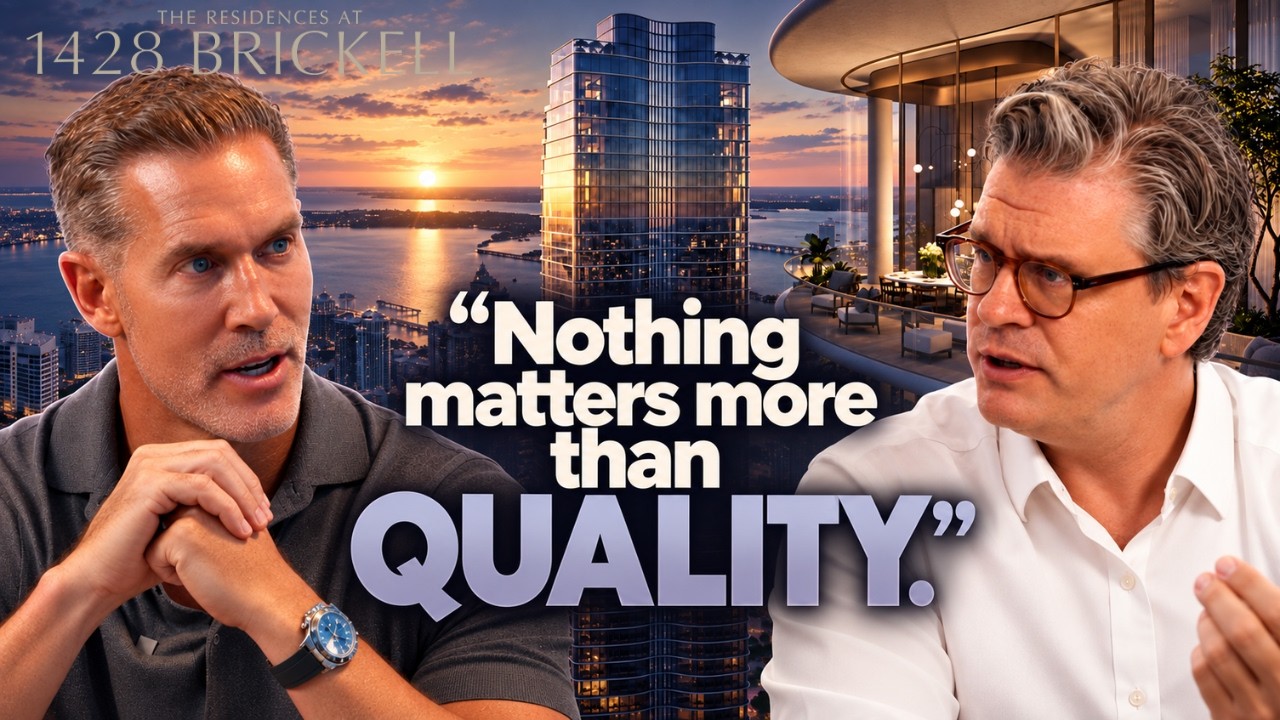
On this episode of Better Decisions, I sat down with Jay Parker, CEO of Douglas Elliman Florida and head of its new development division, for a rare look behind the decisions that shape Miami’s most ambitious projects. Jay’s team is currently guiding roughly $30 billion in new development across South Florida. During our conversation, he revealed that a new beachfront condominium in pre-development is projected to exceed $10,000 per square foot, with units starting in the mid-$20 millions and reaching $30 million-plus.
But the number is not the real story. How you get there is. Long before the first rendering or sales gallery, developers, lenders, architects, and brokers are making decisions about unit mix, ceiling heights, terraces, density, and pricing that ultimately determine whether a project succeeds. For anyone buying, selling, or investing in Miami new construction, understanding those decisions—and who makes them—can mean the difference between capturing the upside and missing it.
From $1,000 a Foot to $10,000: A 20-Year Repricing of Miami
Twenty years ago, Apogee on Miami Beach’s South of Fifth launched with talk of $1,000 a square foot, a number Jay recalls people considering “just unbelievable” at the time, with three and four million dollar price tags that felt enormous. A few years later, Jay brought several Miami Beach projects to market at what was then considered an unheard-of price for this market, $3,000 a square foot. Douglas Elliman’s late chairman and Jay’s mentor, Howard Lorber, made a comment that has stuck with him ever since: if you wanted to sell at $3,000 a foot, look to New York, where comparable product was already commanding six and seven thousand dollars a foot.
Today, that equation has flipped entirely. South Florida is now the hottest market. Today, $3,000 a square foot in Miami would itself be considered a deal, given how far prices have climbed since. Park Grove opened in the $1,400 to $1,500 a square foot range under developer David Martin, and its top sale has recently approached $4,000 a square foot.
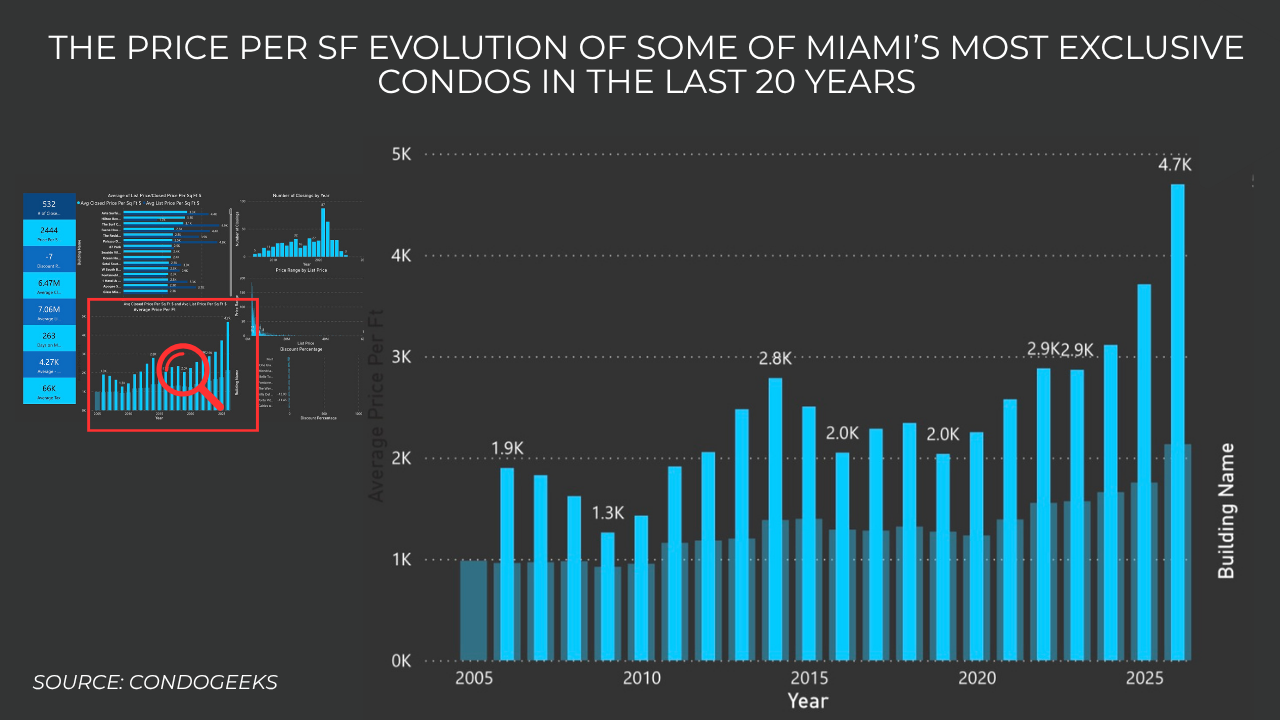
Now Jay is pointing to a new ceiling. He’s currently working on a project he isn’t ready to name publicly, but he described the site in detail: a low-density beachfront parcel with an exceptional southern and southwestern exposure and effectively nothing left to be developed to its south. It carries what he called an incredible brand associated with it, one that brings legacy, history, pedigree, and lifestyle. Pointing to scarce, ultra-exclusive addresses like Indian Creek Island and La Gorce Island, Jay said scarcity at this level creates demand on its own, and that combination is why he expects the building to price in excess of $10,000 a square foot, with units starting in the mid-$20 millions to $30 million-plus for roughly 4,000 square feet, once it is fully priced.
This is not gradual drift. It is a repricing of the entire Miami luxury tier inside a single real estate cycle, and Jay was careful to note that scarcity, not branding alone, is what is driving it.

The Single Biggest Lever on Price Per Square Foot
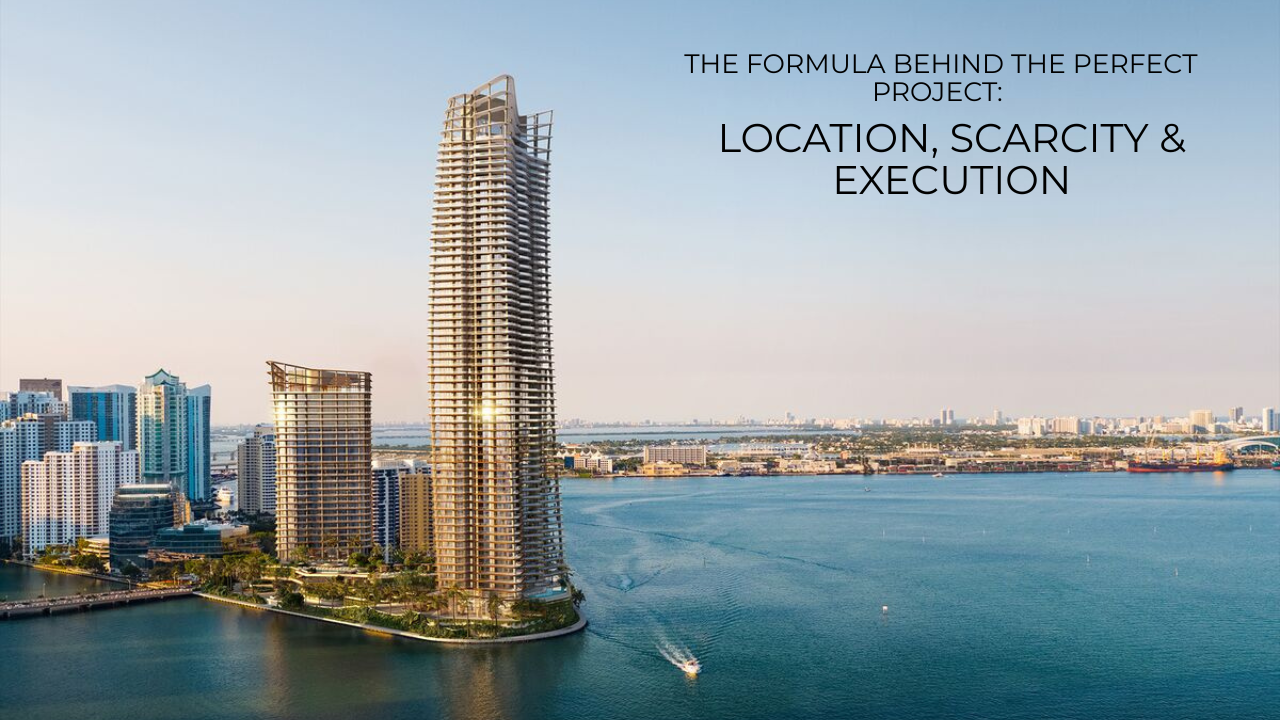
When it comes to determining how much a new development can command per square foot, the conversation quickly came back to one factor above everything else: location. Before unit count, ceiling heights, terraces, amenities, or even the brand enter the equation, the fundamentals of the site set the ceiling. In Florida, the most valuable projects tend to share a few characteristics: oceanfront positioning, unobstructed views, and low density. Scarcity creates demand before anything else is added.
That makes brand less powerful than many buyers assume. A recognizable name can support pricing, but the real premium comes when it represents a genuine hospitality experience rather than simply a name attached to a building. Terraces follow a similar principle. Bigger does not automatically mean better. Once a terrace accommodates dining, lounge seating, and an outdoor kitchen, additional square footage may add little value. At higher elevations, the distinction becomes even more important: a generous terrace on a low-rise building can extend the living space, while an uncovered terrace sixty stories up, exposed to wind and mechanical equipment, may be far less usable. The question is not simply “How big is the terrace?” but “How will the owner actually use it?”
That is something Jay’s design team considers with the project architect long before plans are finalized—separating features that look impressive on a floor plan from those that create real value. Ultimately, there is no single lever behind price per square foot. Location, scarcity, unit mix, ceiling height, terrace usability, and brand work together to determine where a development can realistically land in the market, long before the first unit is offered for sale.
The Pricing Decisions Start Before the Sales Gallery
By the time a sales gallery opens, many of the most important pricing decisions have already been made. Developers often bring brokers into the conversation before the land even closes to determine unit sizes, buyer profiles, live-work components, and which amenities will actually add value rather than consume sellable space.
Development marketing goes well beyond creating a sales campaign. Douglas Elliman’s development marketing team, which includes architects working alongside each project’s design team, weighs decisions buyers rarely see: where the gym should sit, whether an indoor lap pool makes sense for the target buyer, and how large a terrace needs to be before additional square footage stops adding value.
The bigger question is always: How far can this particular market stretch for this particular product? That means evaluating the location, scarcity of comparable properties, brand, and expected buyer profile against what buyers have actually paid nearby—not simply what a spreadsheet suggests.
Agent feedback provides the final reality check. A proposed $4,500-per-square-foot price may work on paper, but will the buyer pool actually pay it? And does the resulting total price make sense for the unit and location? Those conversations can confirm the strategy—or force a developer to rethink it—before a single price reaches the sales sheet.
Why Early Buyers Can Capture the Biggest Upside
The initial pricing strategy is often intentionally conservative for another reason: developers need velocity as much as they need margin. Selling early helps demonstrate demand, support construction financing, and establish a track record for the project. As inventory is absorbed and buyers continue to demonstrate their willingness to pay, prices can then move upward.
Miami has provided some striking examples. Jay pointed to Miami Beach projects that launched around $2,500 to $3,000 per square foot and ultimately approached nearly twice those levels as construction neared completion and demand continued to outpace the original underwriting.
There is an interesting dynamic behind that strategy: new developments don’t necessarily sell from the cheapest units upward. They often sell from the top down. Trophy residences can attract buyers early, establishing a new benchmark for the building and giving the developer room to reprice the remaining inventory.
For buyers, that creates an important takeaway. The earliest buyers aren’t simply getting the lowest price. They are getting first access to the best inventory before the market has had a chance to establish where the ceiling really is. As those anchor residences disappear and new benchmarks are established, the cost of entry can change dramatically.
You Just Learned Why Timing Beats Everything. Let's Talk About Yours.
The buyers who land the best units at the best basis are the ones already in the room before pricing goes public, at this project and whatever comes next. If you want that kind of early visibility into Miami's luxury pipeline, tell us what you're watching for and we'll flag it before it's public.
Get Early Access to What's Coming
Email: [email protected]
Call or Text: 305.508.0899
The Shift From Investors to End Users, and What It Means for Product
One of the more significant changes Jay Parker points to is who is actually buying. Going back to the early 2010s, South Florida’s new development buyer pool leaned heavily on investment-class purchasers and second or third homes. Today, the majority are primary residents: empty nesters, relocators, and single-family homeowners in Coral Gables, Coconut Grove, and Miami Beach who have watched their properties appreciate into the tens of millions and now want a turnkey alternative that matches the quality of life they already have, without giving up space or amenities.
That shift has changed the product itself. Chef’s kitchens are now being built at the scale of a full residential kitchen rather than a display feature, because most meals in these homes are genuinely prepared by staff. Units are trending larger, not smaller, and developers are increasingly willing to combine two units into one to accommodate buyers who want more space than the original floor plan offered, a flexibility that is far easier in a 100-unit boutique building than in a 600-unit tower with rigid, duplicated floor plates.
What Luxury Will Actually Look Like by 2030
By 2030, “luxury” will have to mean more than high ceilings, good views, and a long amenity list. At the top of the market, those are already becoming table stakes. The real differentiators will be quality, light, space, scarcity, and execution. Buyers are becoming more sophisticated about how a residence actually lives. They look closely at floor plans, room proportions, closets, indoor-outdoor flow, and what can be customized. Technology will become more integrated and less visible, while craftsmanship will matter more than ever: perfectly matched stone, precise millwork, soundproofing, and finishes that are as well installed as they are expensive. The luxury of 2030 will ultimately be less about what a building promises and more about how well it delivers.
The Warning Signs Behind Risky Projects
Where the Next Repricing Is Already Starting
Geography still sets the ceiling. Oceanfront, low-density, unobstructed sites in Miami Beach and the barrier islands anchor the entire $10,000 per SF conversation, and locations like Continuum South of Fifth or Apogee remain, in Parker’s words, simply irreplaceable. But the next wave of appreciation is already visible in less obvious corridors. North Beach, anchored by the Witkoff s Ocean Terrace project, is being built as a full ecosystem the way the Four Seasons Surfside redefined that neighborhood a decade ago. North Bay Village, with sightlines comparable to Star Island and the Venetian Islands, is still pricing in pockets under $1,000 a square foot. Edgewater’s 29th Street corridor near Villa Miami is filling in decades of infill almost overnight. And the same demand is now spilling north into Fort Lauderdale and Palm Beach, where single-family prices have already broken records that would have seemed impossible five years ago.
How Miami Still Stacks Up Against the World’s Priciest Cities
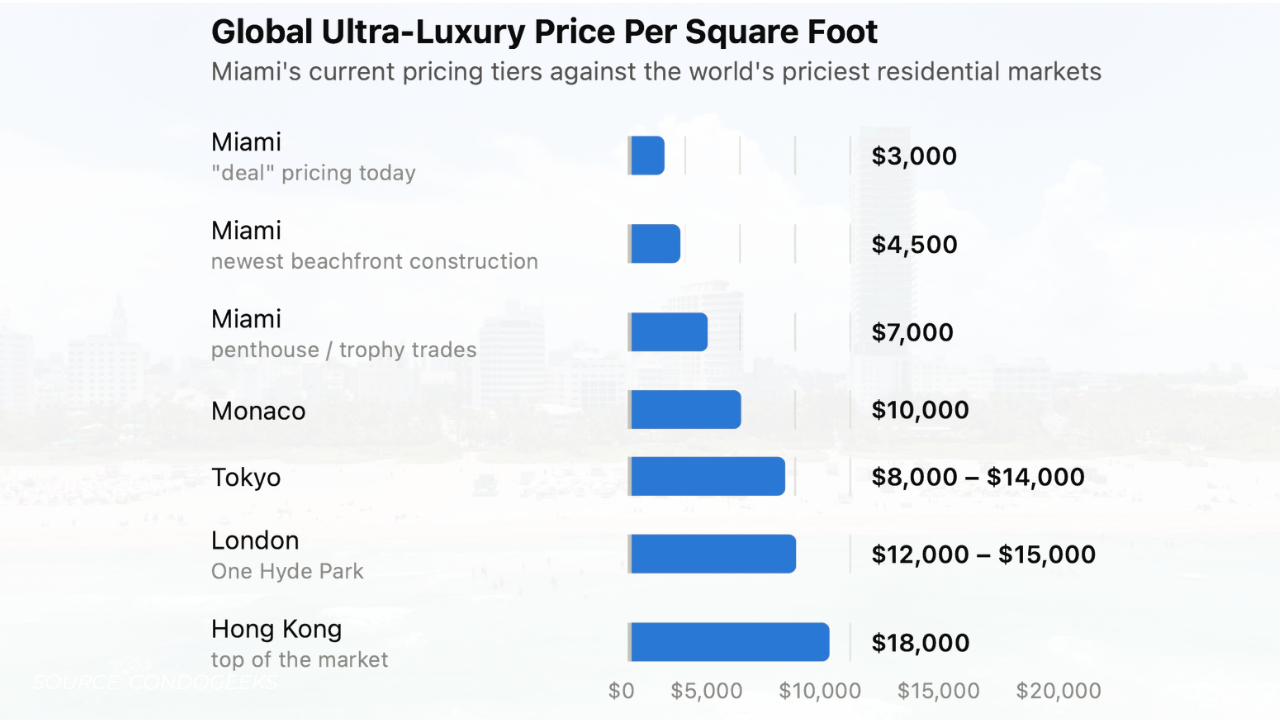
Even at $10,000 a square foot, Miami is not the most expensive market in the world. It is catching up to one. Parker cites Hong Kong’s Peak trading near $18,000 a square foot, London’s One Hyde Park in the $12,000 to $15,000 range, Tokyo between $8,000 and $14,000, and Monaco around $10,000. Miami’s one-off penthouse trades have reached $6,000 to $7,000 a square foot, and, more tellingly, entire buildings are now beginning to trade systematically at $4,500 a square foot rather than that number being reserved for a single trophy unit at the top of a tower.
That gap between Miami and the world’s established wealth capitals is the opportunity, and it is being measured, not guessed at. Parker points to roughly 180 centi-millionaires currently based in Miami, compared with close to 400 in the San Francisco Bay Area, alongside an estimated 17 billionaires already calling South Florida home. Demand from ultra-high-net-worth buyers is already here in force. The supply of trophy product built to absorb it is not, and that imbalance is precisely what allows a developer to price a scarce, well-located building the way you would price a rare asset rather than a commodity.
The David Siddons Group Point of View
Our position: in a market where 180 centi-millionaires already live here, where global wealth capitals price two to four times higher per square foot, and where the buyer pool has permanently shifted from investors to primary residents, buyers who wait for the sales gallery to open are buying at the top of a curve, not the bottom of one. The right move for a serious buyer is to get into the room before the room, through a brokerage that already is.
That is precisely the access the David Siddons Group provides. We work directly with developers during land acquisition and pre-development, which means our clients see pricing, unit selection, and off-market opportunities before they are ever publicly released, and we can tell you honestly which projects and corridors have the fundamentals Parker described, and which do not.
If you want to know which pre-launch projects and undervalued corridors fit your goals right now, and get a personalized breakdown of where Miami’s next price jump is likely to happen, reach out to the David Siddons Group for a private consultation. We will walk you through the current pipeline, the price-per-square-foot trajectory we are tracking in each neighborhood, and how to position yourself before the numbers move again.
I’m easy to reach. Call or text me directly at 305.508.0899, email me at [email protected], or grab a time on my calendar below.
FAQ
These are the most commonly Miami Real Estate Related questions
Why are Miami condo prices reaching $10,000 per square foot?
A new beachfront project now in pre-development is projected to price above $10,000 per square foot, according to Douglas Elliman Florida CEO Jay Parker. The site combines low density, an exceptional southern and southwestern exposure, and effectively nothing left to develop to its south, the kind of scarcity that Parker says creates demand on its own, independent of brand or amenities.
What is the single biggest factor that determines a condo's price per square foot?
Location. Jay Parker was direct that oceanfront, unobstructed sites with low density set the ceiling before unit count, ceiling height, terrace ratios, or brand ever enter the conversation.
Why do developers set pricing before the sales gallery even opens?
Developers bring brokers in before land even closes to test unit size, buyer profile, and which amenities add real value. Douglas Elliman’s development marketing team, working alongside each project’s architect, weighs decisions like where a gym should sit or how large a terrace needs to be, all before a single price reaches a sales sheet.
Do the earliest buyers get the lowest price?
Yes, on a price-per-square-foot basis. Miami Beach projects that launched at $2,500 to $3,000 a square foot have nearly doubled that rate by the time construction neared completion, so buyers who commit near launch are locking in a meaningfully lower psf than buyers who wait.
How does Miami compare to other luxury markets like Monaco or Hong Kong?
Even at $10,000 a square foot, Miami isn’t the most expensive market in the world, it’s catching up to one. Hong Kong’s Peak trades near $18,000 a square foot, London’s One Hyde Park runs $12,000 to $15,000, Tokyo ranges $8,000 to $14,000, and Monaco sits around $10,000. Miami’s whole-building trades are just beginning to reach $4,500 a square foot.
What warning signs suggest a condo project might not get built?
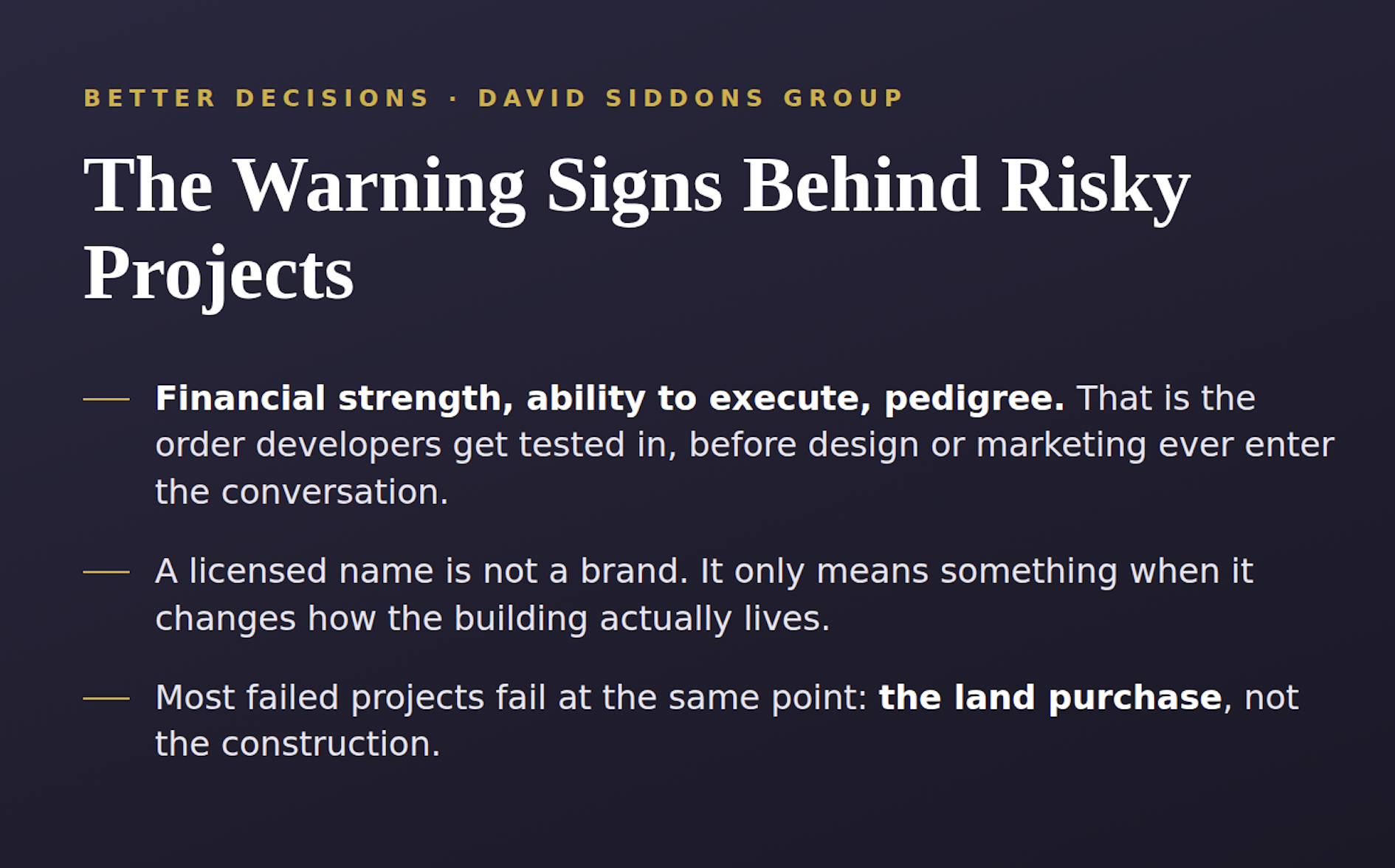
Jay Parker pointed to two common root causes: the developer overpaid for the land, or misjudged whether the market was ready for the product. He also cautioned that a licensed brand name alone doesn’t create value, it only matters if it delivers a genuine hospitality experience inside the building.
Has Miami's condo buyer pool changed in recent years?
Yes. Through the early 2010s, buyers leaned heavily investor-class. Today the majority are primary residents, empty nesters and relocators who already own multimillion-dollar homes in Coral Gables, Coconut Grove, and Miami Beach. That shift has pushed developers toward larger units, full-scale chef’s kitchens, and combining floor plans to fit buyers who want more space.
How can I get access to Miami's next $10,000-a-square-foot project before it's publicly priced?
The David Siddons Group works directly with developers during land acquisition and pre-development, which means clients see pricing and unit selection before it’s released publicly. Schedule a call or reach out directly to get on the early list.
WHY WORK WITH DAVID? THINGS YOU SHOULD KNOW...
For all our analytics we are agents driving some very unique and advanced tech. We Provide a granular and custom experience that empower our clients with the insight and tools to understand the most complex behaviors of any local markets.
-
Analytical
Over 100 reports produced to date
-
Knowledgeable
Over 1800 published articles and counting


Related Articles

The Real Estate Team Behind the Agent: Why Systems Matter More Than Star Power
The Decisions That Set Your Miami Condo’s Price, Years Before You Ever See It
Miami Zoning Laws Explained: What Every Buyer Must Know Before You Purchase
Miami’s New Construction Condo Boom Comes With Risks Most Buyers Never Ask About
Best Neighborhoods to Invest in Miami 2026: Where Smart Money Is Really Buying and What the Headlines Miss

Selling Your Home in Miami?

The Long Game of Investing in Miami Real Estate (2026 Guide)

Real Estate Investing in 2026: Why the Old Strategies No Longer Work

What the Top 1% Do Differently — Lessons from Hosting the World’s Biggest Stars
From Law to Business Leadership: Inside John Ruiz’s Rise Amid Miami’s Wealth Migration Boom

When Grief Meets Real Estate: Avoiding Costly Probate Mistakes in Miami
How The Well & Coconut Grove Are Redefining Wellness Real Estate in Miami

The Visionary Architect of Instant Luxury: How Paulo Bacchi Reshaped Miami Luxury Living

The Rise of Miami’s Most Disruptive New School | 2 Hours of Academics, 10x Faster Results
Please fill in your details and David Siddons will contact you

Search related videos

Are St. Regis Sunny Isles Residences Worth the Brand Premium?
Coral Gables Market Report 2025: What the Headlines Aren’t Telling You!
How David Siddons’ Power Team Drives Miami’s Luxury Market
Mid‑Year 2025 Coconut Grove Report: The Truth About What’s Selling Now
Brickell Mid‑Year Market Report 2025 | Is Brickell’s Luxury Market in Trouble?
Pinecrest Mid-Year Market Report 2025 | What’s Selling, What’s Sitting & Why
Miami Beach Condo Market Mid-Year Report 2025 | What Buyers & Sellers Need to Know
How to Lose $1M in The Miami Condo market | Top Mistakes That Cost Miami Condo Buyers Millions
The Well Project EXPOSED Coconut Grove’s Hottest Units
Miami Real Estate in 2025 Is NOT What You Think 😱 | Midyear Must Knows for Buyers & Sellers!
7 Things You Should Never Say to a Real Estate Agent in Miami!
Landmark Victoria Park Residence in Fort Lauderdale: Inside 420 NE 11th Ave 🌴✨
Luxury Living on 2355 S. Miami Ave | Fully Furnished 4-Bed Home w/ Resort-Style Pool 🏊
Is Mandarin Oriental Residences Miami a Smart Condo Investment? Prices, Floorplans, Views & Finishes


- Get our Newsletter
- Subscribe
- No Thanks
Get the latest news from Miami Real Estate News
Close
Edit Search
Close
2 of 14
Share this property
Recomend this to a friend, just enter their email below.
Close
Your email was sent successfully
Close
 COMPARE WITH CONDOGEEKS