

















- Best of All
- Best Miami Luxury Condos
- Most popular
- Relocating to Miami
- Private Schools
- Investments
- Gated communities
- Waterfront information
- Luxury homes
- Luxury Condos
- New Construction Condos in South Florida
- Independent Pre-Construction condo reviews for Miami
- Independent Pre-Construction condo reviews for Fort Lauderdale
What Miami Real Estate NOT to buy!
The Condos and Homes That Have Cost Buyers Millions
Miami real estate is one of the most sought after markets in the world, and that is exactly why it is also one of the easiest markets to overpay in. Every week, buyers with the resources to purchase anywhere in the world call the David Siddons Group about a unit or a home that looked perfect online and turned out to carry a red flag that would have cost them six or seven figures at resale.
Most real estate content, including a lot of our own, focuses on where to buy. This is the conversation we have privately with clients before they wire a deposit: what not to buy, and why. For a buyer protecting a significant asset, that conversation is worth more than any listing photo.
Want the short version before you keep reading? Call David Siddons directly at +1.305.508.0899 or email [email protected] before you go under contract on anything in this article. A 15 minute conversation before you sign is cheaper than a lawsuit or a stalled resale after.
Five Mistakes That Quietly Erode a Condo’s Value
Generic or overhyped buildings.
In submarkets like Brickell, newer towers increasingly look and feel interchangeable, with little to separate one from the next in quality or long-term value. Branded residences carry the same risk in a different package. Some, like Porsche Design Tower, deliver on the brand promise. Others simply charge a premium for a name. David’s own advice to clients: “just because it’s branded doesn’t mean it’s better. Don’t buy the renderings, buy the reality.” That warning now applies to a newer wave of car and fashion branded towers as well, including projects like Mercedes-Benz Places and Dolce & Gabbana Residences, where DSG’s internal development scoring flags the same brand-over-substance risk we saw play out at Porsche Design Tower.
Ignoring the owner-to-renter ratio
This is the single most overlooked metric on a condo disclosure, and it is the one we check first. Rental-heavy buildings run more volatile through a downturn and tend to appreciate slower than owner-occupied ones. “In buildings with a high percentage of renters, property values are often tied directly to rental income potential,” David notes, “and short-term rentals sound sexy, until they aren’t.” The contrast is stark: Park Grove in Coconut Grove, an end-user-heavy community, has appreciated up to 250% over the past decade, while several rental-heavy Brickell buildings have barely moved.
Buying the wrong line
. Inside a good building, a bargain price is usually telling you something. It often means a compromised layout, wasted square footage, or a view with no protection from future construction. “Once a view is gone, values rarely recover,” and that is not a figure of speech, it is what we see in resale comps every quarter.
Skipping the building’s financial health.
Before you buy, ask for the reserve study, the litigation history, and what is planned on the empty lot next door. “Once a building gets a reputation for lawsuits, construction issues, or underperformance, it’s incredibly hard to shake,” David says, and that reputation shows up in your resale value long after the issue is fixed.
Need a second opinion on a specific unit before you commit? Send us the building and line and we will tell you, honestly, whether it is a hold or a pass.

Miami’s 14 Worst-Performing Condos, by the Numbers
This is not a subjective list. Every building below is backed by DSG’s own transaction data and public sales records, the same data we would show you privately before you make an offer.
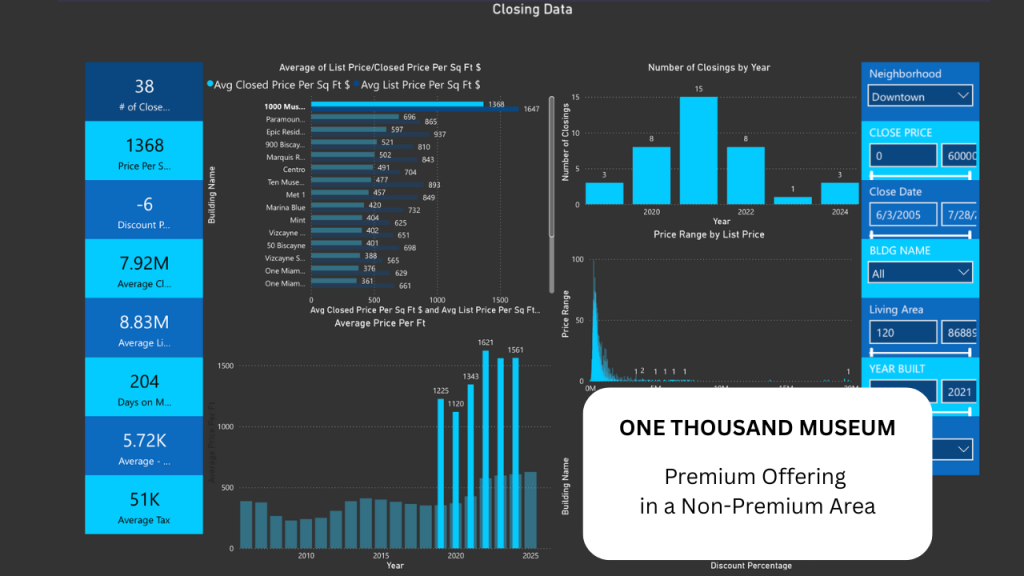
- One Thousand Museum – Premium pricing in a location that has not kept pace. Four-bedroom units trade at $6M to $7M, yet only 16 other sales above $4M closed in the building over the past year.
- Paramount World Center – Built more for EB-5 investors than end users. 75 units are currently on the market, 60% of them listed for over six months, against only 16 sales in the past year.
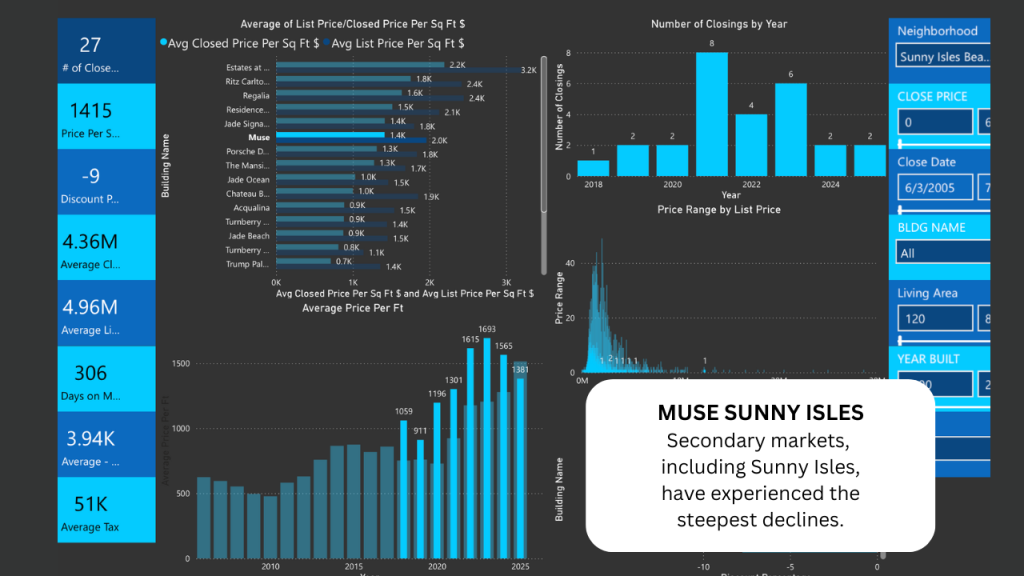
- Muse, Sunny Isles – A textbook example of a secondary market giving back its gains. Pricing launched near $1,100/SF in 2018, peaked around $1,600/SF in 2022 to 2023, and has since settled back to roughly $1,380/SF.
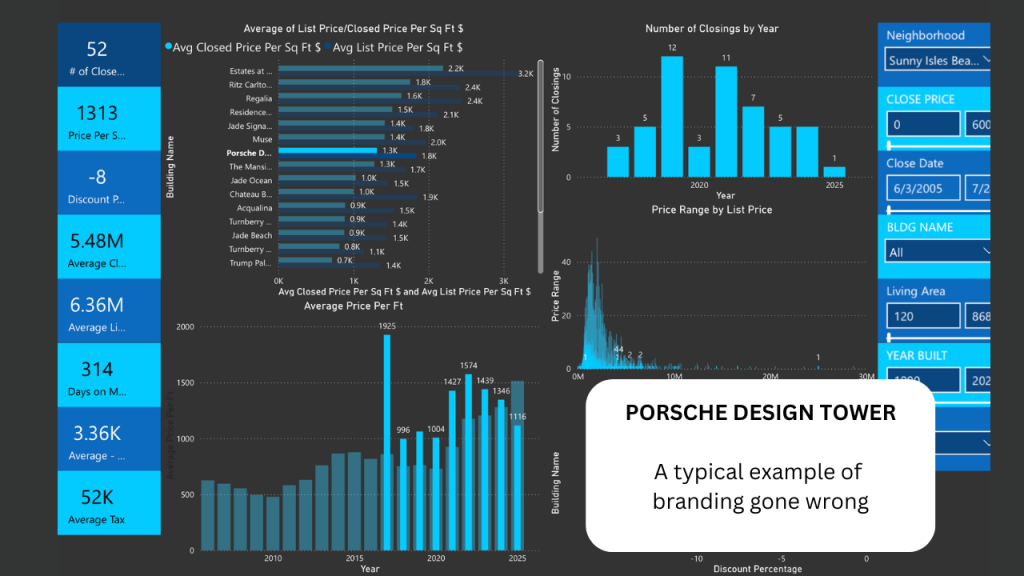
- Porsche Design Tower – Branding gone wrong. Pricing has fallen from roughly $2,000/SF to $1,200/SF, and 31 units, 25% of the tower, are currently for sale.
- Residences by Armani/Casa – Several floor plans were never well designed to begin with. Only 25% of the building sold within its first two years, and pricing has shown no appreciation in four years.
- Regalia, Sunny Isles – Never resonated with true luxury buyers. It has carried the highest average discount from asking price in the market, roughly 15% over the past two years.
- Faena House – A cautionary tale on carrying costs. Values have slipped from about $3,200/SF in 2022 to roughly $2,750/SF in 2025, as HOA fees surged 50% to 60%.
- Arte Surfside – Launched during the pandemic at a premium it has not been able to hold in the resale market since.
- Icon Brickell – Aging construction now requiring major repairs, with HOA fees up 50% and rental prices down 5% to 10% since 2022.
- Kenilworth, Miami Beach / Bal Harbour – A 1970s-era building trading around $550/SF today, essentially flat with where it stood back in 2014 to 2015. A full decade of zero appreciation.
- Nine at Mary Brickell – Generic construction with a heavy short-term rental base. Pricing has moved from $462/SF in 2015 to about $550/SF today, only 16% appreciation over ten years.
- RISE at Brickell City Centre – Marketed as luxury, priced and built like a commodity. Now around $785/SF, down 10% from its 2023 peak, with no appreciation since 2021.
- 321 Ocean, South Beach – Carries one of the highest HOA burdens on the beach, which continues to weigh on resale demand.
- Aston Martin Residences – 94 of the building’s 391 units, roughly a third of the entire tower, are currently listed for sale. That kind of concentrated inventory puts direct downward pressure on every other seller’s price.
For context, buildings that reward owners the way Miami’s best real estate should, Palazzo del Sol on Fisher Island, One Park Grove in Coconut Grove, and the Surf Club Four Seasons in Surfside among them, have posted some of the highest price-per-square-foot closings in the city this year. If you want to see the full list of buildings we are actively recommending to clients right now, not just the ones to avoid, call David at +1.305.508.0899.
Save Time. Get the Full Rundown.
Skip the Research. Call David Siddons Directly.
One conversation gets you the honest read on the specific building, line, or home you are considering, before you go under contract.
Two More Filters Before You Sign
Overlooked unit features. High ceilings, corner exposures, real balconies, and protected water or skyline views hold value. Small, awkward floor plans and token balconies do not, and they compete against a far larger pool of similar units when it is time to sell.
Future-proofing. Look past the unit and into the building’s financial health, upcoming assessments, and anything planned on adjacent lots. As David puts it bluntly about developer economics across the current pipeline: “some developers are building at cost. It’s a high-risk gamble, because if sales slow, the margins can evaporate overnight.” That risk gets passed to the next owner if you are not paying attention now.
Bottom line: the difference between a condo that appreciates and one that quietly drains your equity is not luck. It is location quality, building composition, ownership mix, and resale potential, verified before you buy, not discovered after.
What Not to Buy When It Comes to a Miami Single-Family Home
The same discipline applies to houses, and the mistakes here are often more expensive because the numbers are bigger.
Skipping the comparative market analysis.
Paying more per square foot than recent, truly comparable sales is one of the most common and costly errors we see, even from buyers working with an agent, if that agent never ran the numbers. Overpay in a seller’s market and you feel it the moment you try to exit in a buyer’s one. Consult our current Miami market reports, or call David directly for an up-to-date read before you write an offer.
Falling for the finish, not the bones.
Miami’s spec-home market moves fast, and a flawless kitchen can distract from a home that was never comparable to what it is priced against. David has seen this cost clients directly: “one of my clients is currently dealing with this, and it’s a nightmare, termites, poor flooring, bad wiring, and even mold hidden behind cosmetic fixes.” As the husband of a well-known Miami interior architect and designer, David tells the difference between genuine luxury craftsmanship and a surface-level renovation faster than almost anyone in this market, and that eye is what protects your offer price. “Give me a call, and I can look into the home for you and come take a closer look.”
Ignoring flood risk and construction quality.
Certain pockets of Miami-Dade carry real flood exposure, verifiable on FEMA flood maps and FIU’s storm surge modeling, and should be approached with clear eyes, not just a good feeling about the block. Separately, homes built to true hurricane standards, impact windows, storm shutters, reinforced roofs, hold value through a storm season that homes without them do not. One detail buyers consistently underweight: homes on busy through-streets can sell for roughly 30% less than comparable properties on quiet or cul-de-sac streets in the same neighborhood. It is an easy thing to miss on a first showing and an expensive thing to discover at resale.

A Direct Line to David Siddons
David Siddons has built his reputation on one principle: complete honesty with clients, even when it costs a sale. We would rather earn a referral five years from now than a quick commission today, and that is exactly why this list exists.If you are actively considering a property anywhere on this page, or anywhere in Miami-Dade, do not go under contract without a second, unbiased set of eyes on it first. Call or text David Siddons at +1.305.508.0899 Email [email protected]. A short call now is how you protect a seven or eight figure decision later.
FAQ
These are the most commonly Miami Real Estate Related questions
What are the worst-performing condos in Miami right now?
Based on DSG’s own transaction data, the weakest performers include One Thousand Museum, Paramount World Center, Muse Sunny Isles, Porsche Design Tower, Residences by Armani/Casa, Regalia, Faena House, Arte Surfside, Icon Brickell, Kenilworth, Nine at Mary Brickell, RISE at Brickell City Centre, 321 Ocean, and Aston Martin Residences. Several have posted flat or negative price-per-square-foot growth over the past two to ten years, and a few, like Aston Martin Residences, currently have a third or more of their units listed for sale at once, which puts direct downward pressure on every owner’s price.
Why does the owner-to-renter ratio matter when buying a Miami condo?
Rental-heavy buildings tend to be more volatile in a downturn and appreciate slower than owner-occupied buildings, because unit values become tied to rental income potential rather than lifestyle demand. Park Grove in Coconut Grove, an end-user-heavy community, has appreciated up to 250% over the past decade, while several rental-heavy Brickell buildings have barely moved in the same period. Always ask for a building’s current owner-occupancy percentage before you make an offer.
Are branded residences in Miami a safe investment?
Not automatically. Some, like Porsche Design Tower, deliver on the brand promise, but others charge a premium for a name without the quality or resale demand to back it up, and Porsche Design Tower itself has since fallen from roughly $2,000/SF to $1,200/SF. The same brand-over-substance risk now shows up in newer car and fashion branded towers, including Mercedes-Benz Places and Dolce & Gabbana Residences. A recognizable name is not a substitute for due diligence on the building’s fundamentals.
Is it a mistake to buy a home on a busy street in Miami?
Often, yes, at least at full asking price. Homes on busy through-streets typically sell for roughly 30% less than comparable homes on quiet or cul-de-sac streets in the same neighborhood, which means overpaying for one caps your own appreciation before you even close. It is easy to overlook road noise during a showing and expensive to discover the discount later at resale.
How do I check flood risk before buying a home in Miami?
Start with FEMA’s flood maps for the specific address, then cross-reference FIU’s storm surge modeling for that block, not just the general neighborhood. Pair that with a hard look at construction quality, impact windows, storm shutters, and a reinforced roof hold value through hurricane season in a way an older, unprotected home simply does not.
What should I look for in a Miami spec home before buying?
Look past the finishes. New spec homes can distract buyers with high-end kitchens and fresh paint while hiding real issues like termites, poor flooring, or bad wiring behind cosmetic fixes, the kind of problem David has personally seen cost a client after closing. A comparative market analysis against genuinely similar homes, not just similarly new ones, is the only way to know if the price matches the actual quality.
How can David Siddons help me avoid a bad Miami real estate purchase?
Call or text David directly at +1.305.508.0899, or email [email protected], before you go under contract on any condo or home in Miami-Dade. DSG will run a real comparative analysis, check the building’s owner-to-renter ratio and financial health, or take a closer look at a specific home, before you commit, not after.
WHY WORK WITH DAVID? THINGS YOU SHOULD KNOW...
For all our analytics we are agents driving some very unique and advanced tech. We Provide a granular and custom experience that empower our clients with the insight and tools to understand the most complex behaviors of any local markets.
-
Analytical
Over 100 reports produced to date
-
Knowledgeable
Over 1800 published articles and counting


Related Articles
EDITION Residences Miami Edgewater
Galloway Glen Real Estate 2026: What Homes Sell for in This Kendall Neighborhood
St. Regis Bahia Mar Penthouse Review: A $22M Fort Lauderdale Sky Home at Half the Price of Miami
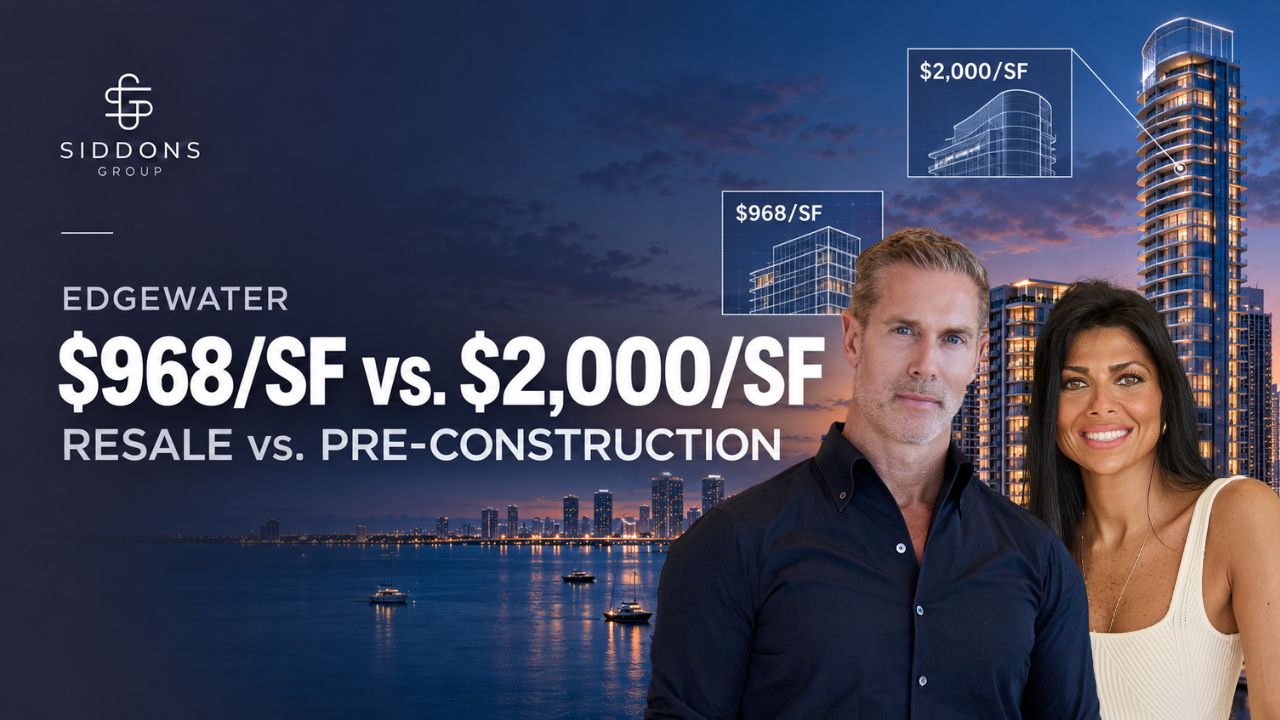
Edgewater Miami Condo Market 2026: $1M+ Resale at $968 a Foot vs. $2,000 for Pre-Construction
Buying or Selling a Condo in Litigation in South Florida: Red Flag or Opportunity?
The 2028 Brickell Condo Cliff: Which Buildings Are at Risk and Where Smart Money Is Moving

Should You Stage Your Home Before Selling? What 1,266 Agents and Two Studies Found
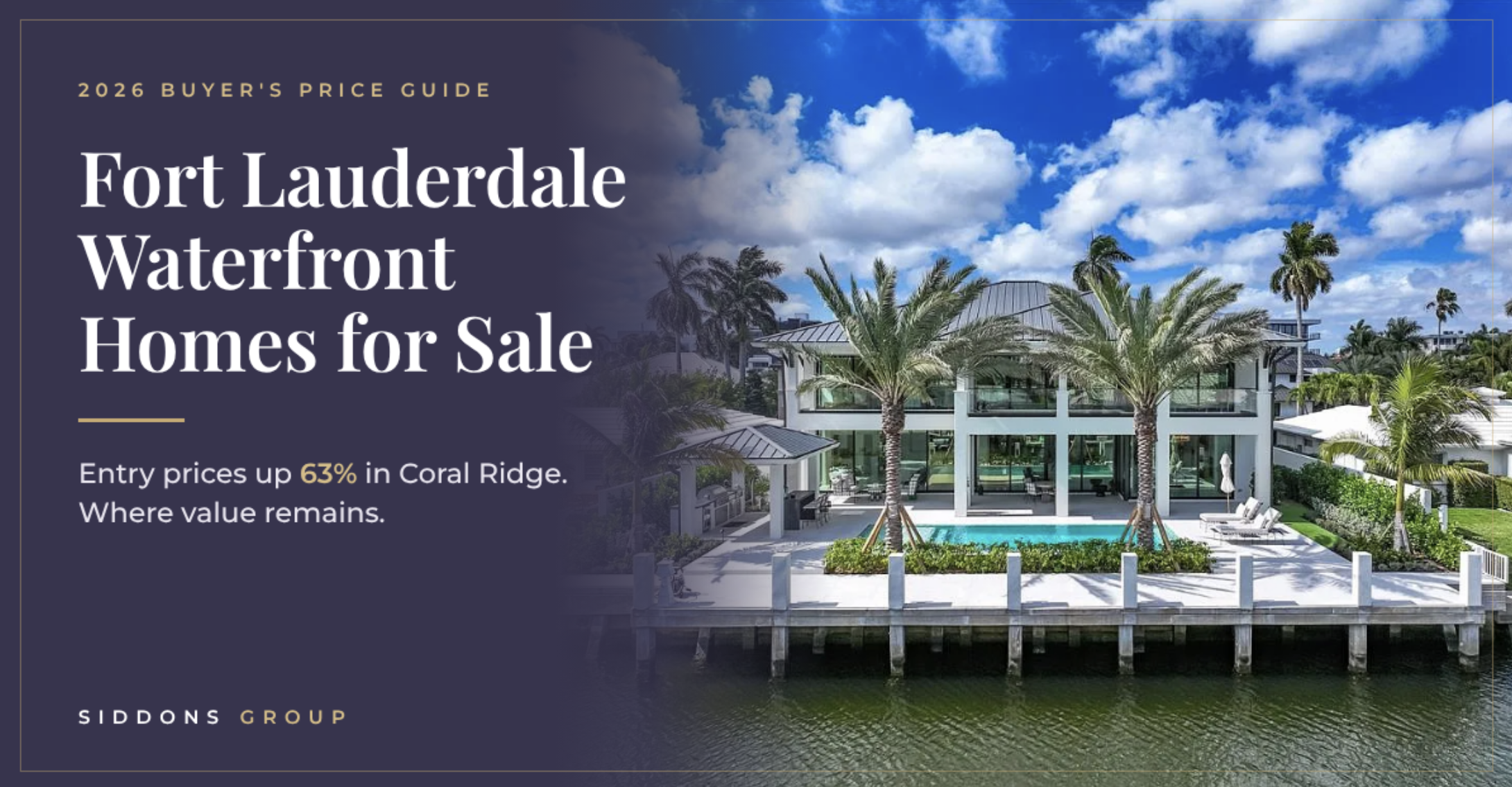
Fort Lauderdale Waterfront Homes in 2026

Greenview at Presidential Aventura
The Best Real Estate Agent in Ponce Davis
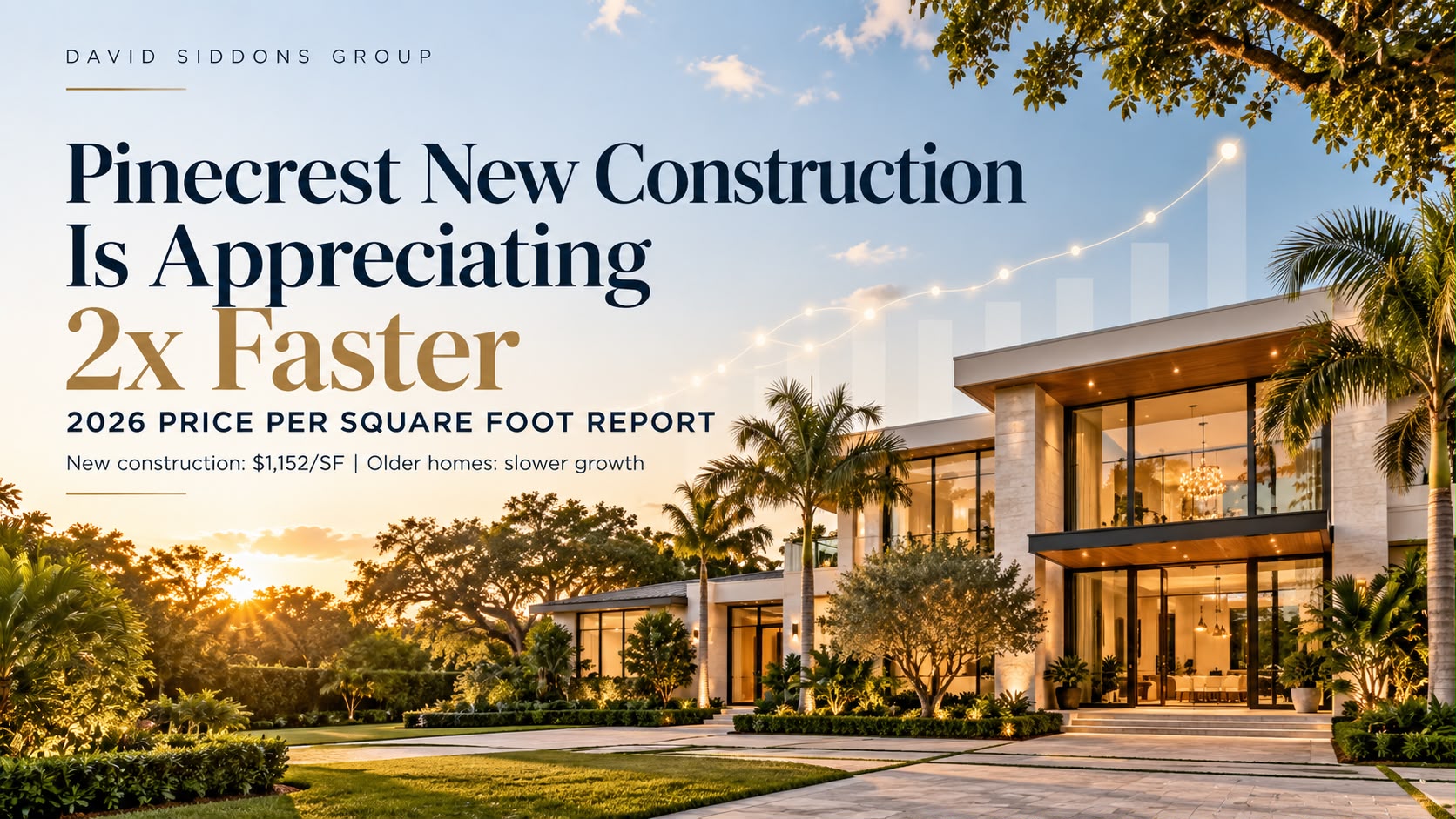
Pinecrest New Construction Is Appreciating 2x Faster Than Older Homes
Inside 1428 Brickell: Why Ytech Skipped the Hotel Brand to Build Brickell’s Best Finishes
Brickell’s Office Boom: What It Means for Luxury Housing in Coral Gables and Coconut Grove
Palmetto Bay Land Values Are Rising. Is Your Home Worth More as Land?
Please fill in your details and David Siddons will contact you

Search related videos

Are St. Regis Sunny Isles Residences Worth the Brand Premium?
Coral Gables Market Report 2025: What the Headlines Aren’t Telling You!
How David Siddons’ Power Team Drives Miami’s Luxury Market
Mid‑Year 2025 Coconut Grove Report: The Truth About What’s Selling Now
Brickell Mid‑Year Market Report 2025 | Is Brickell’s Luxury Market in Trouble?
Pinecrest Mid-Year Market Report 2025 | What’s Selling, What’s Sitting & Why
Miami Beach Condo Market Mid-Year Report 2025 | What Buyers & Sellers Need to Know
How to Lose $1M in The Miami Condo market | Top Mistakes That Cost Miami Condo Buyers Millions
The Well Project EXPOSED Coconut Grove’s Hottest Units
Miami Real Estate in 2025 Is NOT What You Think 😱 | Midyear Must Knows for Buyers & Sellers!
7 Things You Should Never Say to a Real Estate Agent in Miami!
Landmark Victoria Park Residence in Fort Lauderdale: Inside 420 NE 11th Ave 🌴✨
Luxury Living on 2355 S. Miami Ave | Fully Furnished 4-Bed Home w/ Resort-Style Pool 🏊
Is Mandarin Oriental Residences Miami a Smart Condo Investment? Prices, Floorplans, Views & Finishes


- Get our Newsletter
- Subscribe
- No Thanks
Get the latest news from Miami Real Estate News
Close
Edit Search
Close
2 of 14
Share this property
Recomend this to a friend, just enter their email below.
Close
Your email was sent successfully
Close
 COMPARE WITH CONDOGEEKS