- Best of All
- Best Miami Luxury Condos
- Most popular
- Relocating to Miami
- Private Schools
- Investments
- Gated communities
- Waterfront information
- Luxury homes
- Luxury Condos
- New Construction Condos in South Florida
- Independent Pre-Construction condo reviews for Miami
- Independent Pre-Construction condo reviews for Fort Lauderdale



















The Report That Exposed Miami’s Condo Market
The Real Story Behind Miami’s Best and Worst-Performing Condos
Miami’s condo market isn’t as simple as it looks. Some towers continue to break records, while others quietly stall, leaving buyers exposed to million-dollar mistakes. A recent Real Deal article spotlighted Miami’s Best and Worst-Performing Condos drawing from our in-depth report that revealed which buildings are truly holding value and which are slipping. This isn’t about hype or sales spin. It’s about hard data, clear patterns, and the insights buyers and sellers need to make smarter, safer decisions in one of the country’s most volatile real estate markets.
Beyond the Hype: Why We Take a Data-First Approach to Miami Condos
The goal was never to target developers or create clickbait, it was about letting the numbers speak. Too often, real estate commentary is filled with hype, where every building is pitched as “amazing” just to push a sale. This report took the opposite approach: an honest look at which condos are underperforming relative to price per square foot. That doesn’t mean a building is “bad”—in fact, for buyers, a dip in values can signal opportunity if a property is trading well below the market. It’s also important to note that performance isn’t just building-by-building, but sometimes line-by-line, with certain layouts commanding premiums that others in the same tower can’t match. By focusing on the data, the intent was to cut through the noise, avoid the pitfalls, and help buyers and sellers spot real patterns in a market where avoiding downside risk often matters more than chasing big wins.
Which Condos were Exposed as the Worst Performing Condos in Miami?



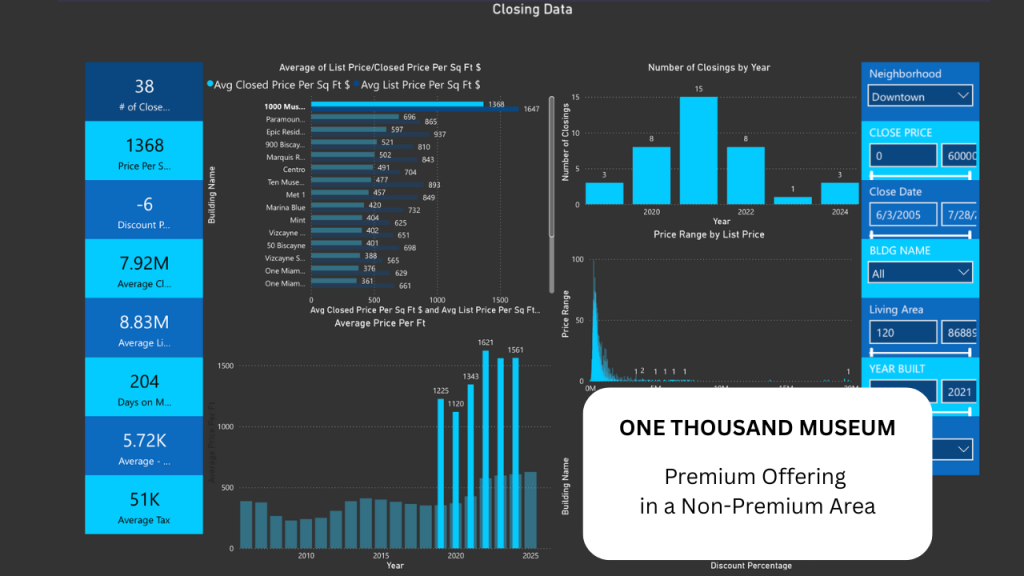
- ONE THOUSAND MUSEUM | Four-bedroom residences here typically trade between $6M and $7M, in a market that recorded only 16 other sales above $4M over the past year, most of them within the Aston Martin Residences.
- PARAMOUNT WORLD CENTER | There are a staggering 75 units for sale at this project of which 60% has been on the market for over half a year already. A sharp contrast to just 16 sales in the past year.
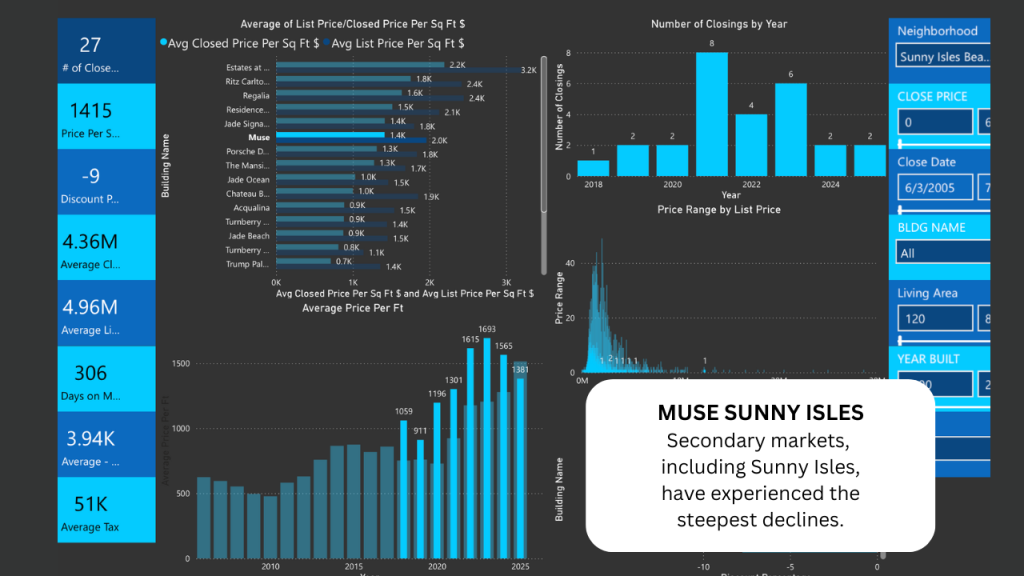
- MUSE SUNNY ISLES | Muse began selling at around $1,100 per SF in 2018. After a brief peak in 2022–2023 at approximately $1,600 per SF, prices have now settled back to about $1,380 per SF.
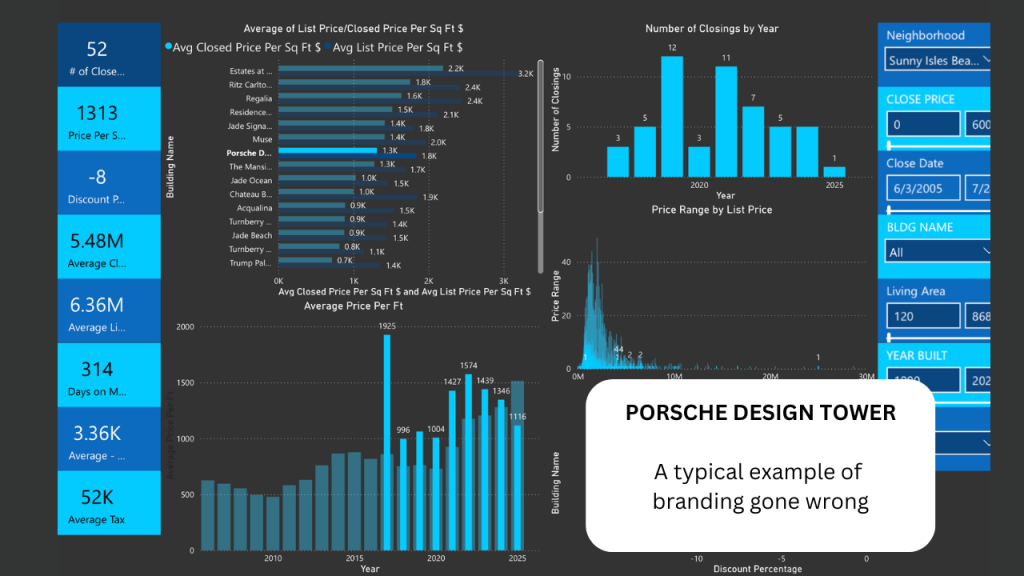
- PORSCHE DESIGN TOWER | Porsche’s resale drop is rare; from about $2,000 after launch to $1,200 per SF nowadays. Today, 25% of the tower (31 units) is for sale, with 60% listed for over six months.
- AR MANI CASA| 25% of the condo sold within two years of launch, a red flag. Even more unusual for this market, it hasn’t appreciated at all in the past four years.
- REGALIA, Sunny Isles | The Sunny isles Condo that sees the highest percentage of discounts from its asking price. On average 15% discount was given in the last 2 years.
- FAENA HOUSE | Over the past four years, values have fallen from $3,200 in 2022 to $2,750 in 2025, while HOA fees have surged 50–60% in the
- ICON BRICKELL | While HOA fees have risen 50%, rental prices are down 5% from 2024 and 10% from their 2022–2023 levels.
- KENILWORTH Bal Harbour | Current values at the condo are about $550 per SF, the same as in 2014–2015, showing no appreciation over the past decade.
- NINE AT MARY BRICKELL | Prices are now about $550 per SF — only 16% higher than the $462 per SF seen in 2015.
- RISE Brickell City Center | Current values sit at $785 per SF, down 10% from the 2023 peak, with no appreciation recorded since 2021.
- ASTON MARTIN RESIDENCES | 94 out of 391 condo units are currently for sale, 33% of the building. This unusually high inventory puts significant downward pressure on market values & buyer perception.
The Real Metrics Behind Miami’s Best and Worst-Performing Condos
When we looked deeper into why certain Miami condos underperformed, clear patterns emerged. It wasn’t about headlines or “vibes” — it was data. Days on market, cumulative not reset; historical price-per-square-foot trends; the size of discounts from original asking prices; and how much inventory hit the market all told the real story. Add in high HOA fees, rising carry costs, and the financial strain of older buildings, and the picture became even sharper. Some developers argue that heavy resale inventory is normal for new buildings, but the difference is whether units trade above their original purchase prices or far below them. In short, it’s the fundamentals — pricing, inventory pressure, and hidden costs — that separate a condo performing well from one that quietly drains value.

The Hidden Truth About HOA Fees and Condo Carry Costs
One of the most overlooked factors in Miami’s condo market is the true cost of ownership. The HOA fees and carry costs that can make or break a building’s appeal. While developers often present early estimates, those numbers can shift dramatically once control turns over to the homeowners’ association and real costs come into play. Insurance premiums, reserves, and maintenance obligations frequently drive fees higher than buyers expect, especially in older or highly amenitized buildings. For savvy buyers, the question isn’t whether fees exist. It’s whether they’re realistic and sustainable. A building that underestimates these costs may look attractive upfront, but eventually the truth surfaces, and fees spike. In a city crowded with new and aging towers, separating healthy HOAs from ticking time bombs has become one of the most important parts of making a smart condo decision.
When the Hype Fades: What the Data Really Reveals About Miami’s Best and Worst-Performing Condos
The data shows us a truth that glossy marketing can’t hide: some condos shine long after delivery, while others fade once the hype wears off. Developers sell out and move on, but buyers are left with the realities of lawsuits, rental restrictions, inflated projections, and oversupplied markets. Time and again, we see the same patterns—investor-heavy buildings that stumble once units flood the rental pool, or generic product that depreciates like a mass-produced car. By contrast, rare, well-designed product with enduring demand, like the Surf Club, continues to thrive. The lesson is simple: history doesn’t repeat, but it rhymes. Ignore the past, and you risk repeating costly mistakes. Study the patterns, and you can separate the true winners from the properties destined to underperform.

Neighborhood Pressures, Market Cycles, and the Power of Reputation
Not every condo’s struggles come down to the building itself, sometimes it’s the neighborhood that sets the tone. Take Sunny Isles, for example: a market driven heavily by foreign buyers and second-home investors. When currencies weakened and owners needed quick liquidity, many rushed to sell, and values suffered. Contrast that with Coconut Grove, where condos are largely purchased by end-users downsizing from homes. With limited zoning and fewer buildings, demand remains steady, even when broader markets wobble.
Older building stock adds another layer of pressure, especially in parts of Miami Beach, where higher maintenance costs weigh on resale values. Meanwhile, investor-heavy neighborhoods like Brickell and the urban core often live and die by the rental market, creating volatility when too many units hit the market at once.
But the biggest factor isn’t just math, it’s reputation. Once a building gets a reputation for lawsuits, construction issues, or underperformance, it’s incredibly hard to shake. Buyers remember, agents whisper, and the market applies a discount that no amount of fresh paint or rebranding can erase. Some properties, like Apogee or Continuum, have proven they can weather any cycle. Others get stuck with a label they can’t escape—reminders that in Miami real estate, perception can be just as powerful as fundamentals.
The Formula Behind Miami’s New Construction Condo Success—and Failure
In Miami’s new development market, the margin between success and failure is razor-thin. Some developers are building at cost, essentially selling units for what it costs to construct them and betting on unsold inventory to carry the profits later. It’s a high-risk gamble, because if sales slow or the market shifts, those margins can evaporate overnight. Others face financing delays or even stall on paying commissions. Subtle signals that raise bigger questions about stability and execution.
At the same time, the flood of short-term rental products shows how uneven the playing field has become. A few projects thrive, while many others struggle to differentiate themselves, weighed down by oversupply or weak strategy. Contrast that with the rare “unicorns” like the Four Seasons or Aman Miami: these projects launch quietly, with little public marketing, but ride on quality, exclusivity, and reputation to set record-breaking prices per square foot.
The lesson is clear: new condo success isn’t just about delivering glass and concrete. It comes down to strategy, financial strength, developer credibility, and the ability to create genuine scarcity in a crowded market. Projects that master this formula win big; those that don’t risk becoming cautionary tales.
Cutting Through the Hype: Where Miami’s Condo Market Truly Delivers
Miami’s condo market isn’t one uniform story, it’s a patchwork of highs and lows. While some areas are slow, others, like Coconut Grove, are thriving, with new construction outselling resales three to one. Projects such as The Well and the Four Seasons Grove show strong demand from local buyers downsizing from houses but unwilling to leave the neighborhood they love. Grove’s appeal is real: a lush, walkable community with restaurants, marinas, and a laid-back, authentic vibe. That stands in stark contrast to glossy renderings that overpromise—depicting crystal-blue seas and endless greenery where the reality is busy streets and dense development. The truth is, Miami has both: towers weighed down by hype that doesn’t match reality, and timeless buildings like Apogee, Continuum, Park Grove, and Fisher Island that consistently prove their value. In a crowded market, separating marketing fantasy from genuine livability has never been more important.
The Key Condo Stories to Watch in the coming months
As 2025 rolls forward, one of the biggest stories in Miami real estate is which new condo projects will make it, and which ones may stall out. Reporters are closely watching developments that appear to be on hold, struggling with financing, or resorting to “fake” groundbreakings to project momentum. Some projects push dirt around without securing full funding, while others delay commission payments, raising questions about stability. In a market with rising construction costs and slower sales, the difference between a project that survives and one that folds often comes down to financing strength, sales velocity, and whether a developer can weather delays without abandoning the deal. These are the questions shaping the next cycle and the ones buyers, investors, and agents alike should be asking now.
Backlash Aside, Honest Reporting Builds Better Buildings
Reporting on these issues hasn’t always been popular, but ignoring them doesn’t make the problems go away. When stories like the “sinking buildings” piece or the recent condo performance reports hit the press, reactions were mixed. Some dismissed the findings, others bristled at the negative attention, yet many developers quietly reached out to learn from the feedback. That’s the point: honest reporting isn’t about tearing projects down, it’s about making the market smarter and the product better. Still, Miami real estate suffers from short memory , past lawsuits, construction flaws, and broken promises often get buried under fresh marketing campaigns. Unless these conversations continue, the same mistakes repeat, and buyers pay the price. Transparency may sting in the short term, but in the long run it builds trust, accountability, and stronger buildings.
Final Words regarding Miami’s Best and Worst-Performing Condos
At the end of the day, Miami’s condo market isn’t just about glossy brochures or headline-grabbing sales — it’s about understanding the numbers, the patterns, and the truths that shape long-term value. Honest reporting and open dialogue may ruffle feathers, but they help buyers avoid costly mistakes and push developers to deliver better product.
If you’re considering buying or selling in Miami, don’t settle for surface-level marketing. Reach out for a data-driven, candid conversation about which condos are truly performing — and which ones aren’t. Better decisions start with better information. Call me directly at 305.508.0899 or schedule a private consultation today.
FAQ
These are the most commonly Miami Real Estate Related questions
What should relocation buyers know before buying real estate in Miami?
HOME BUYERS
Relocation buyers looking at homes in Miami should understand that choosing the right house is less about the property itself and more about location, schools, and long-term value. Many buyers make the mistake of focusing on price or finishes, while the real driver of value is the neighborhood and micro-location. Older homes often represent better value, but may also be part of a future redevelopment cycle. Newer homes command premiums, but don’t always sell faster if pricing is ahead of the market. Commute time, school access, and community dynamics are critical and often underestimated. The key is to evaluate homes not just as lifestyle purchases, but as long-term assets within a very localized market.
Sources:
https://luxlifemiamiblog.com/relocating-to-miami/
https://luxlifemiamiblog.com/relocating-to-miami-with-a-family/
CONDO BUYERS:
Relocation buyers should understand that Miami is a highly segmented, building-driven market, not a uniform one. Pricing can vary significantly between similar properties depending on building quality, layout, and financial health. Many buyers assume newer construction equals better investment, but that is often not the case. Factors like HOA fees, reserves, and rental policies can materially impact long-term value and liquidity. Negotiation opportunities often exist, especially in slower segments, but require precise market knowledge. The key is to evaluate micro-markets and individual buildings, not just neighborhoods or price per square foot.
Sources:
https://luxlifemiamiblog.com/miami-real-estate-market-report/
https://luxlifemiamiblog.com/new-construction-miami-guide/
What are the best areas for relocating families with children
For families relocating to Miami with young children, the most recommended neighborhoods are Coral Gables, Coconut Grove, and Pinecrest. Coral Gables offers the best balance of top schools, safety, and long-term value. Coconut Grove is ideal for younger families seeking walkability, greenery, and a lifestyle-driven environment. Pinecrest provides larger homes, excellent schools, and better value for space, making it ideal for growing families. The key driver across all three is access to strong schools and primary residential stability. Relocation decisions are less about new construction and more about long-term livability and resale strength.
Sources:
https://luxlifemiamiblog.com/best-neighborhoods-miami/
https://luxlifemiamiblog.com/what-are-the-best-family-neighborhoods-in-miami-in-2023/
Are new construction condos in Miami a good investment?
New construction condos in Miami can be a good investment—but only if you understand that not all buildings perform the same. According to the David Siddons Group, many buyers assume “new = better,” but in reality, performance depends on pricing, layout, building quality, and long-term demand. Some new developments set future price benchmarks and can drive long-term appreciation, especially in top-tier projects. However, many are priced aggressively at launch, and buyers relying on marketing instead of data often overpay.
The market is highly segmented, meaning two new buildings next to each other can perform very differently.
The best opportunities typically come from selecting the right building early or negotiating correctly in later phases.
In short: new construction is not automatically a good investment—it becomes one only with building-level analysis and disciplined entry pricing.
Sources:
https://luxlifemiamiblog.com/how-to-buy-a-luxury-condo-in-miami/
https://luxlifemiamiblog.com/category/independent-new-construction-condo-reviews/
https://luxlifemiamiblog.com/beyond-clickbait-real-insights-into-miamis-luxury-condo-market/
Why is buying a Miami condo riskier than buyers think?
Buying a Miami condo is often riskier than buyers expect because the true risks are at the building level—not visible in the listing price. Many buyers focus on finishes and views, while overlooking HOA reserves, insurance exposure, and potential special assessments. In reality, two identical units in different buildings can perform completely differently over time. Rising HOA fees and stricter regulations are also increasing the true cost of ownership, especially in older buildings. Liquidity can be affected by factors like financial health, rental policies, and ongoing repairs. The key risk is not the condo itself—but buying into the wrong building without proper due diligence.
Sources:
https://luxlifemiamiblog.com/how-to-buy-a-luxury-condo-in-miami/
https://luxlifemiamiblog.com/miami-condo-market-risks/
What are Miami's Safest Areas?
Which Miami Areas Still offer Great Value (Budget Friendly alternatives to Coral Gables and Pinecrest)
If you’re looking for better value than Coral Gables or Pinecrest, the answer (in true Siddons style) is not “go cheaper”—it’s go one layer outside the obvious markets.
The strongest value plays are:
- Schenley Park → closest substitute to Coral Gables at ~20% discount while maintaining similar character and location
- Biltmore Heights → almost identical feel to the Gables but ~25–30% cheaper on a $/SF basis
- Glenvar Heights → central location with larger lots and ~25% pricing advantage vs South Miami/Gables
- Baptist / Galloway (Kendall) → Pinecrest-style living (space, schools, land) at up to ~30% lower pricing
The pattern is consistent:
👉 Buyers are shifting west and slightly off-market to gain land, scale, and pricing efficiency. You don’t find value by going to a “cheaper neighborhood”—you find it by identifying adjacent micro-markets that offer the same lifestyle fundamentals without the brand premium.
Sources:
https://luxlifemiamiblog.com/best-value-neighborhoods-miami/
https://luxlifemiamiblog.com/category/miami-neighborhoods/
Is NOW a good time to buy in Miami?
Are Miami real estate prices going down in 2026?
No—but that’s the wrong way to look at it. Miami is not one market anymore, so prices are not moving in one direction. In 2026, the market is split into two: ultra-luxury, scarcity-driven areas (like waterfront and top-tier neighborhoods) are still holding or even rising, while mid-tier condos and oversupplied segments are flat or correcting. What we’re seeing is price divergence, not a crash—some properties are gaining value while others are quietly adjusting downward. Rising inventory and more selective buyers are putting pressure on pricing in certain segments, especially older condos or buildings with weaker fundamentals.
At the same time, global wealth and cash buyers continue to support pricing at the top end of the market. So the real answer: prices aren’t broadly dropping—they’re being repriced based on quality, location, and supply.
Should I buy a house or a condo when relocating to Miami?
The decision comes down to lifestyle first, investment second—and most relocation buyers get that backwards. If you want space, privacy, schools, and long-term family living, a single-family home in areas like Coral Gables or Coconut Grove is typically the stronger choice. If you prioritize walkability, low maintenance, and proximity to business districts, a condo in Brickell or waterfront markets makes more sense.
From an investment perspective, homes tend to be more stable, while condos are more building-dependent and cyclical. Most relocation clients underestimate how much building quality, HOA structure, and future costs impact condo performance. The right answer isn’t “house vs condo”—it’s which asset fits your lifestyle AND holds value within its micro-market.
How do I choose the right Miami neighborhood for my lifestyle?
Why are Miami condo prices so different between buildings?
Miami condo pricing varies widely because value is determined at the building level, not just by location. Two buildings next to each other can have major differences in financial health, reserves, HOA fees, and management quality. Buyers also pay premiums for better layouts, views, amenities, and newer construction—but not all “new” buildings perform equally. Factors like rental policies, upcoming assessments, and building reputation can significantly impact resale value. This is why price per square foot alone is misleading in Miami’s condo market. The real driver of value is how that specific building competes within its micro-market over time.
Sources:
https://luxlifemiamiblog.com/how-to-buy-a-luxury-condo-in-miami/
https://luxlifemiamiblog.com/category/independent-new-construction-condo-reviews/
WHY WORK WITH DAVID? THINGS YOU SHOULD KNOW...
For all our analytics we are agents driving some very unique and advanced tech. We Provide a granular and custom experience that empower our clients with the insight and tools to understand the most complex behaviors of any local markets.
-
Analytical
Over 100 reports produced to date
-
Knowledgeable
Over 1800 published articles and counting


Related Articles
EDITION Residences Miami Edgewater
Galloway Glen Real Estate 2026: What Homes Sell for in This Kendall Neighborhood

St. Regis Bahia Mar Penthouse Review: A $22M Fort Lauderdale Sky Home at Half the Price of Miami
Edgewater Miami Condo Market 2026: $1M+ Resale at $968 a Foot vs. $2,000 for Pre-Construction

Buying or Selling a Condo in Litigation in South Florida: Red Flag or Opportunity?
The 2028 Brickell Condo Cliff: Which Buildings Are at Risk and Where Smart Money Is Moving

Should You Stage Your Home Before Selling? What 1,266 Agents and Two Studies Found
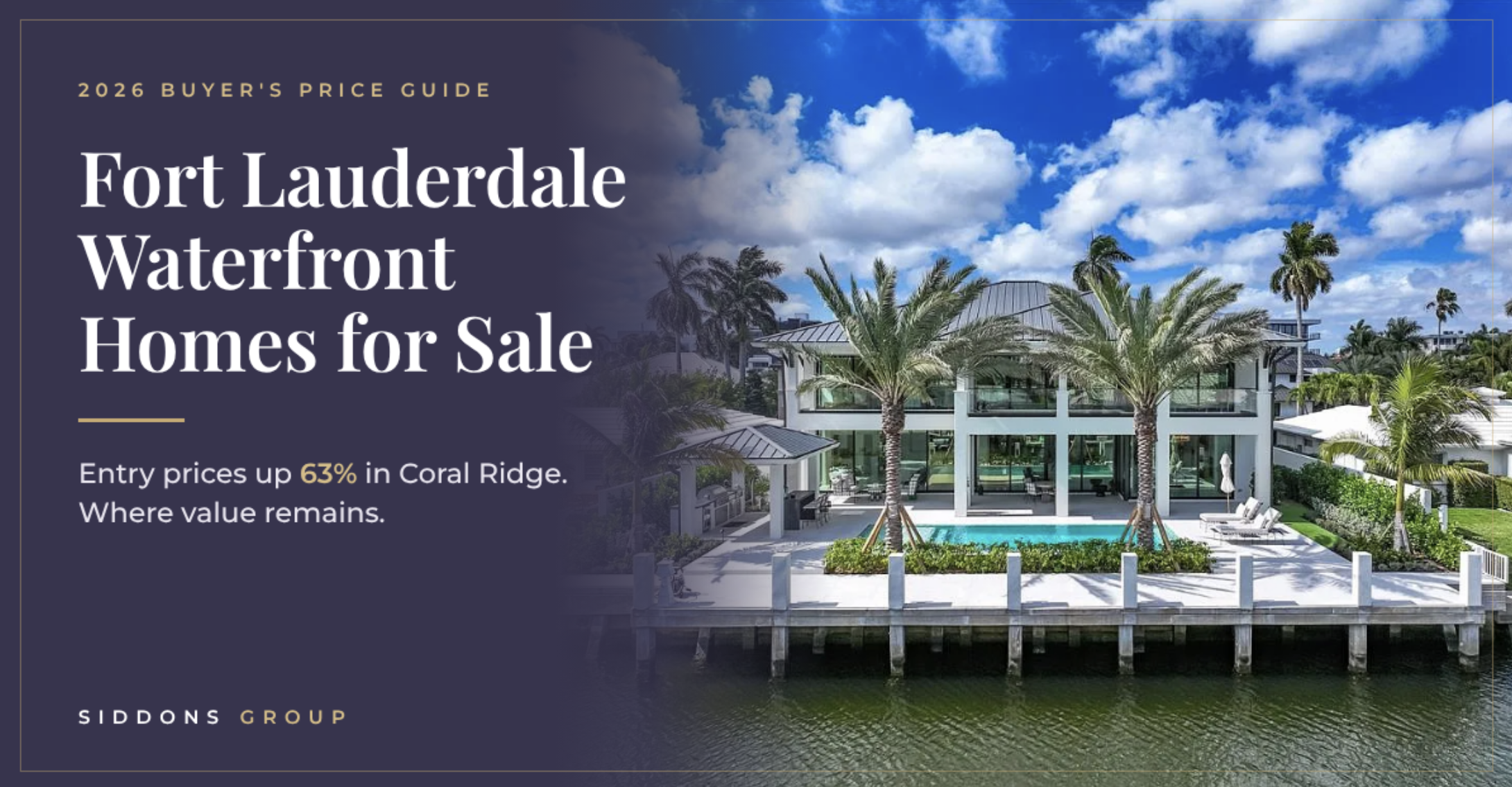
Fort Lauderdale Waterfront Homes in 2026

Greenview at Presidential Aventura

The Best Real Estate Agent in Ponce Davis
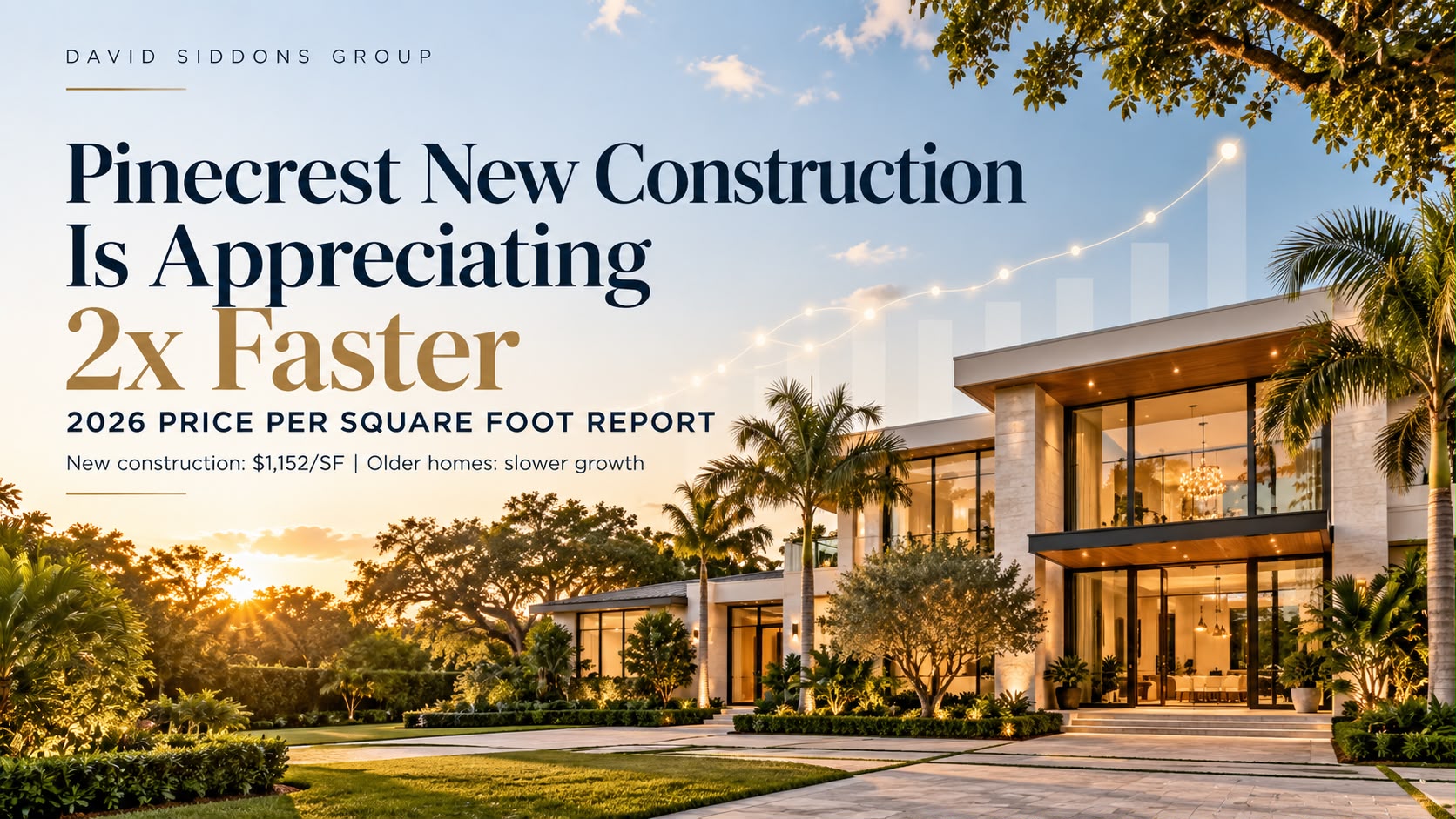
Pinecrest New Construction Is Appreciating 2x Faster Than Older Homes

Inside 1428 Brickell: Why Ytech Skipped the Hotel Brand to Build Brickell’s Best Finishes
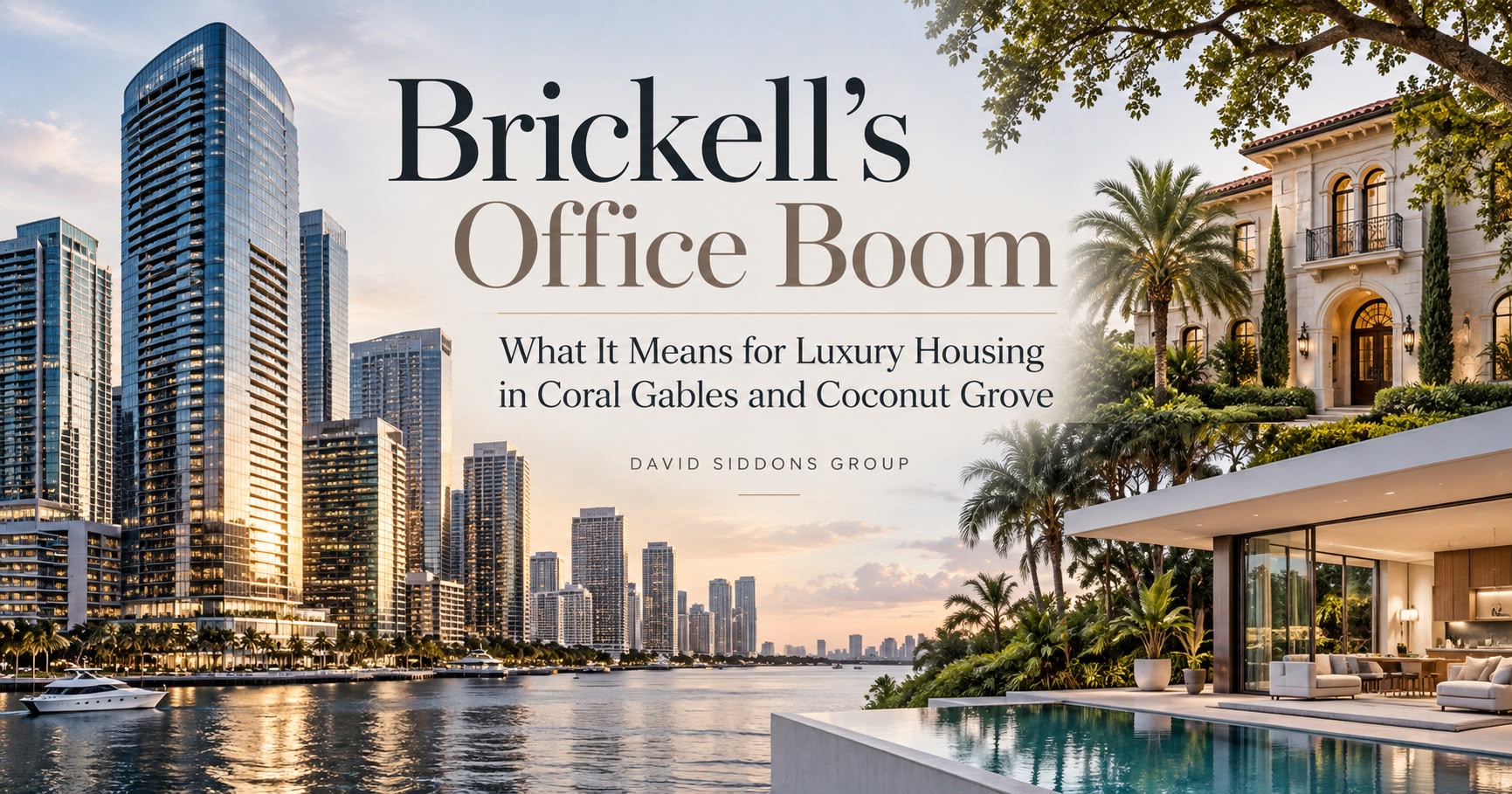
Brickell’s Office Boom: What It Means for Luxury Housing in Coral Gables and Coconut Grove
Palmetto Bay Land Values Are Rising. Is Your Home Worth More as Land?

Killian Drive: Kendall’s Luxury New Construction Corridor Hits $1,000/SF
Please fill in your details and David Siddons will contact you

Are St. Regis Sunny Isles Residences Worth the Brand Premium?
Coral Gables Market Report 2025: What the Headlines Aren’t Telling You!
How David Siddons’ Power Team Drives Miami’s Luxury Market
Mid‑Year 2025 Coconut Grove Report: The Truth About What’s Selling Now
Brickell Mid‑Year Market Report 2025 | Is Brickell’s Luxury Market in Trouble?
Pinecrest Mid-Year Market Report 2025 | What’s Selling, What’s Sitting & Why
Miami Beach Condo Market Mid-Year Report 2025 | What Buyers & Sellers Need to Know
How to Lose $1M in The Miami Condo market | Top Mistakes That Cost Miami Condo Buyers Millions
The Well Project EXPOSED Coconut Grove’s Hottest Units
Miami Real Estate in 2025 Is NOT What You Think 😱 | Midyear Must Knows for Buyers & Sellers!
7 Things You Should Never Say to a Real Estate Agent in Miami!
Landmark Victoria Park Residence in Fort Lauderdale: Inside 420 NE 11th Ave 🌴✨
Luxury Living on 2355 S. Miami Ave | Fully Furnished 4-Bed Home w/ Resort-Style Pool 🏊
Is Mandarin Oriental Residences Miami a Smart Condo Investment? Prices, Floorplans, Views & Finishes


- Get our Newsletter
- Subscribe
- No Thanks
Get the latest news from Miami Real Estate News
Edit Search
Recomend this to a friend, just enter their email below.
 COMPARE WITH CONDOGEEKS