































- Best of All
- Best Miami Luxury Condos
- Most popular
- Relocating to Miami
- Private Schools
- Investments
- Gated communities
- Waterfront information
- Luxury homes
- Luxury Condos
- New Construction Condos in South Florida
- Independent Pre-Construction condo reviews for Miami
- Independent Pre-Construction condo reviews for Fort Lauderdale
The 2020 Q2 and Q3 Miami Real Estate Report | The Miami Condo Market
Part 2. A Look back at the Miami Condo market during the last 6 months of COVID-19
Overview
This report will give you the best optics on the Miami condo market whether you are relocating, looking for a second residence or just looking for opportunity. This report will give you the insights of the market and will let you know at which price point it is safe to buy.
This report consists of 4 parts of which this is the second one. In this second part I go into further detail on how the Miami condo market has performed and how it differs from the single family home market. In part 1, myself and another market analyst who is also a real estate agent discuss the market before and during Covid, which will provide you with really good insights. In part 3 of the report we deep dive into the single family home market and we show how this market performs differently than the condo market. The last part is another interview, this time with South Florida’s top performing realtors including agents from Fort Lauderdale and Palm Beach.
The Miami Condo Market Before and After Covid-19
I wanted to start this report with making the following important note. Corona did not cause any of the market movements we have seen in the last 6 months, but rather accelerated the patterns we were already seeing in the market. There were clear signs of distress in some sub-markets while others saw signs of a bullish market. When Covid, with its radical uncertainty arrived, it just accelerated these trends. The Miami condo market has been seeing declined transaction volumes since 2013 and even before Corona we were seeing very high inventory levels. As always there are better performing sub-markets or price levels, but across the board the condo market was not a very strong market and has behaved completely different than the single-family home market.
The reason behind this is because the condo market is more of an investment market, one that relies heavily on outside money and is less of a necessity and more of a discretionary purchase. More on this topic can be read/heard in part 1 of this report in which I discuss the market and the difference between condos and homes with Ana Bozovic, a Miami Market Analyst.
Comparing Condo Sales to Single Family Home Sales per Price Range
Comparing Condo Sales to Home Sales per Price Range you can see that the condo market has suffered much more during these last 6 months than homes. While condo sales pre-dominantly decreased since the same period in 2019, home sales has been up. Therefore one needs to approach this market with caution and with the guidance of an industry expert.
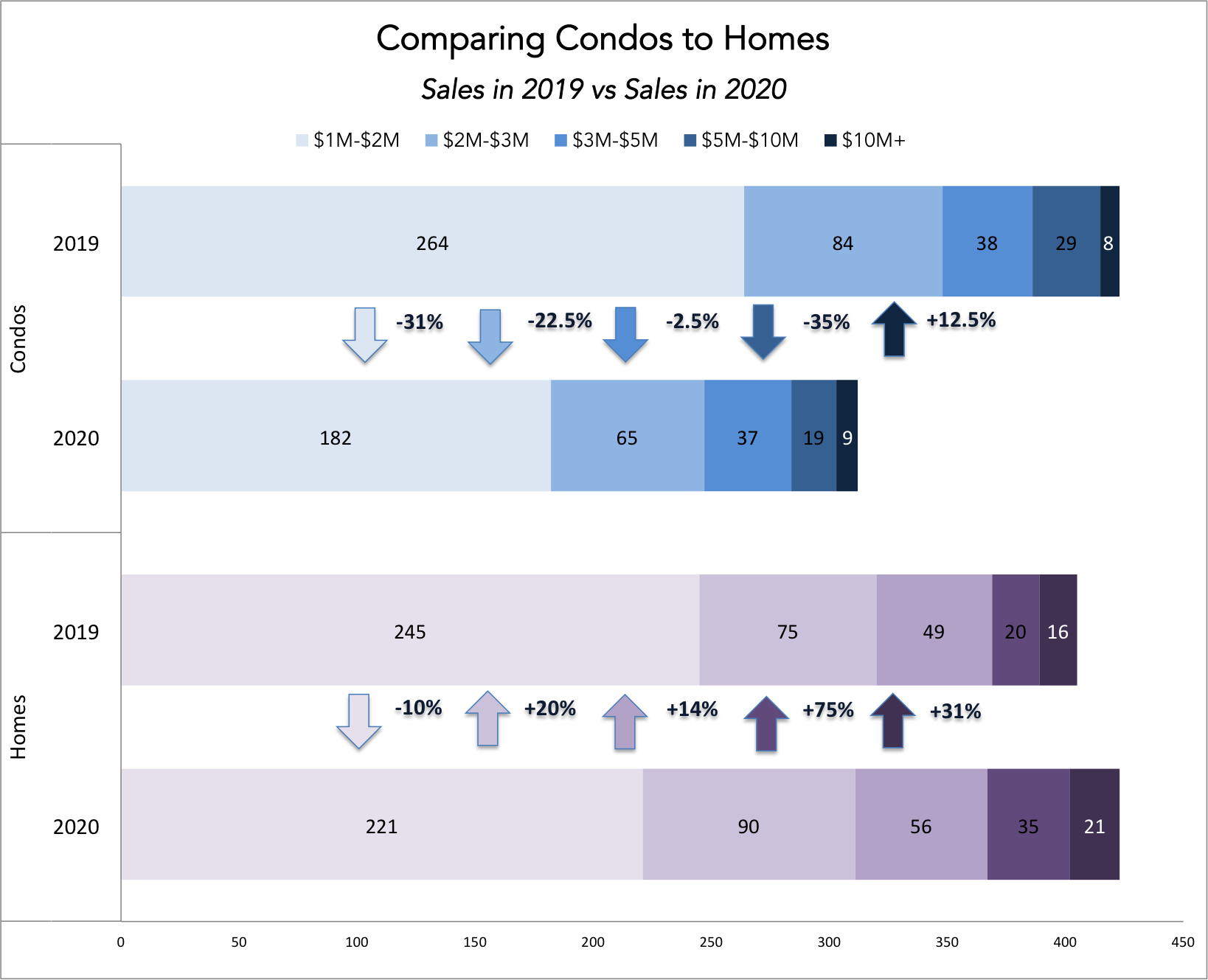
The $500K – $1M market is not showing here, but went down from 726 condos in 2019 to 442 condos in 2020, which is a 40% decrease in amount of sales.
Condo Sales in Miami’s Most Desired Residential Areas in during Covid compared to the same period in the year before
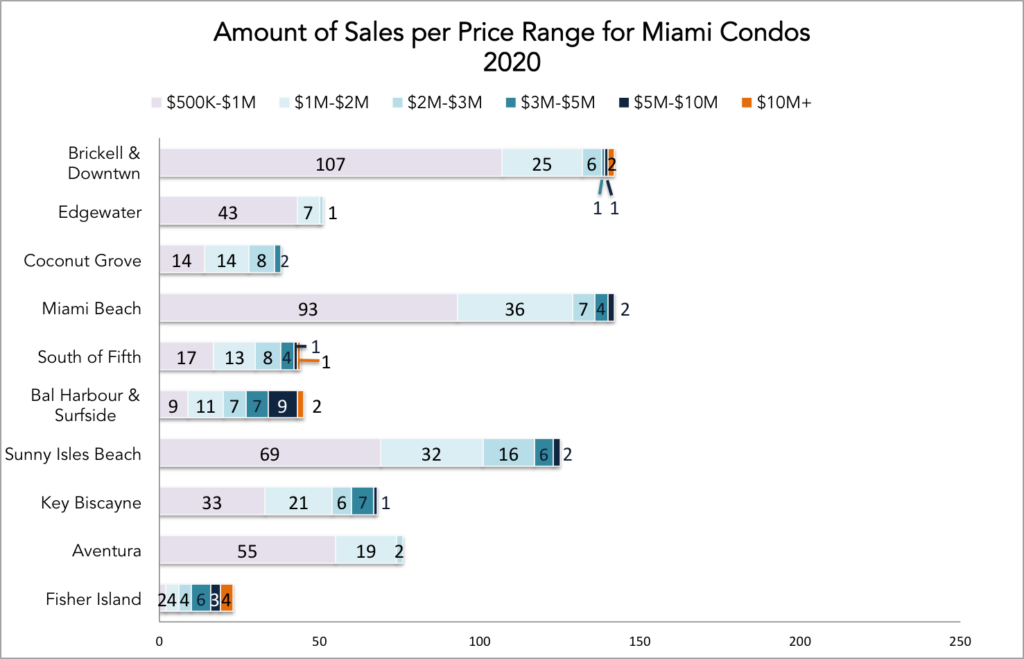
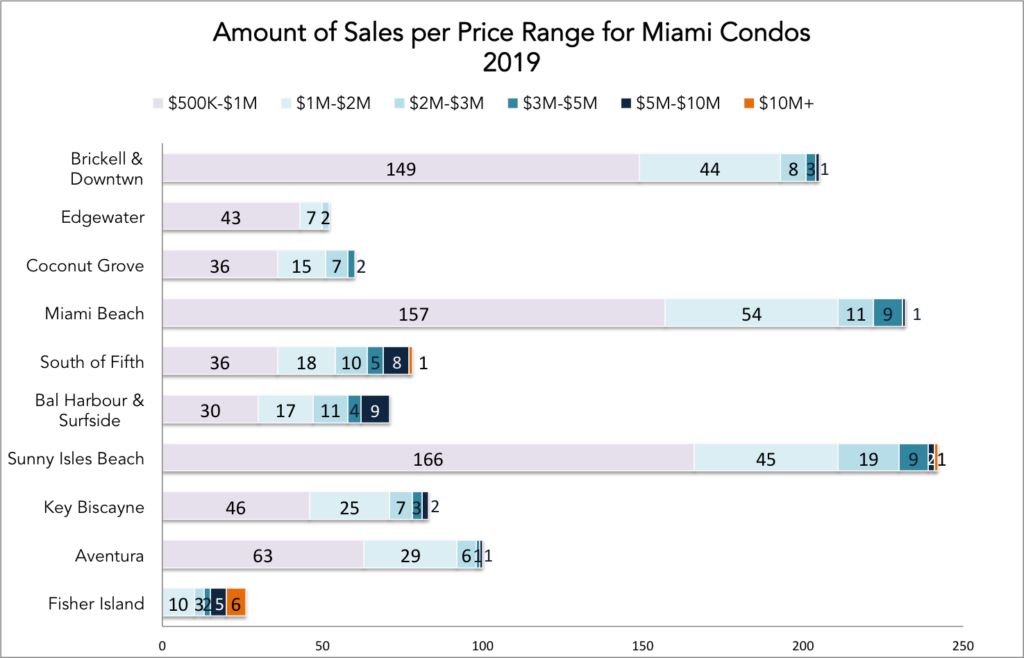
The amount of sales of Condos in Miami’s most desired residential areas in 2020 during Covid compared to the same period in 2019 (March 15-September 15). Swipe to the left to see the data of 2019 and see how there is a sales gap between 2019 and 2020.
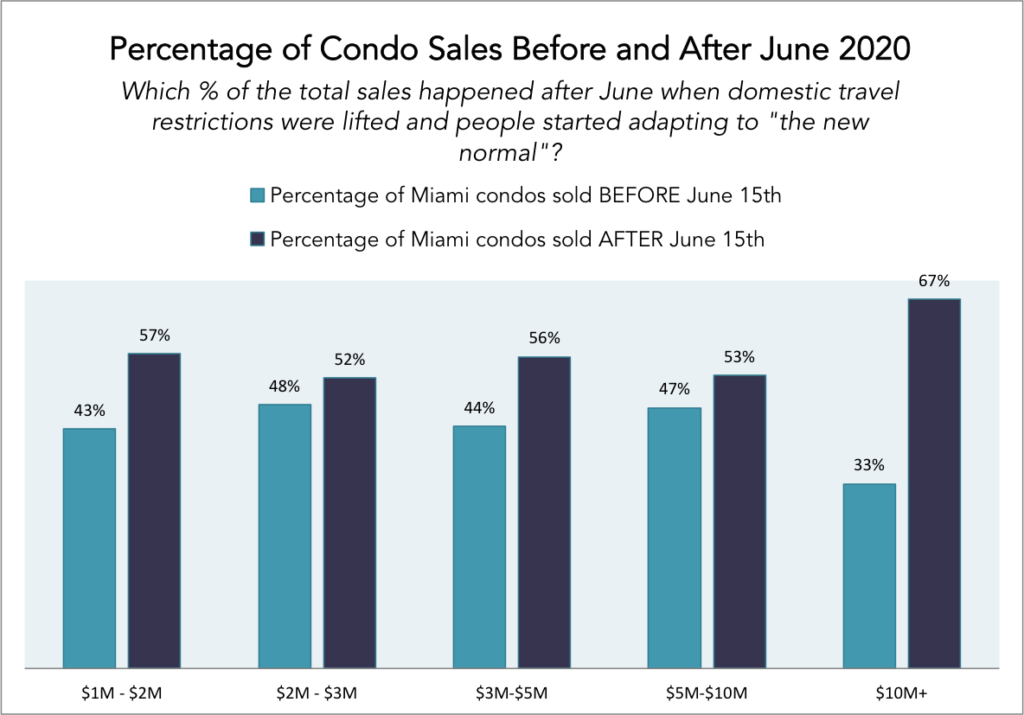
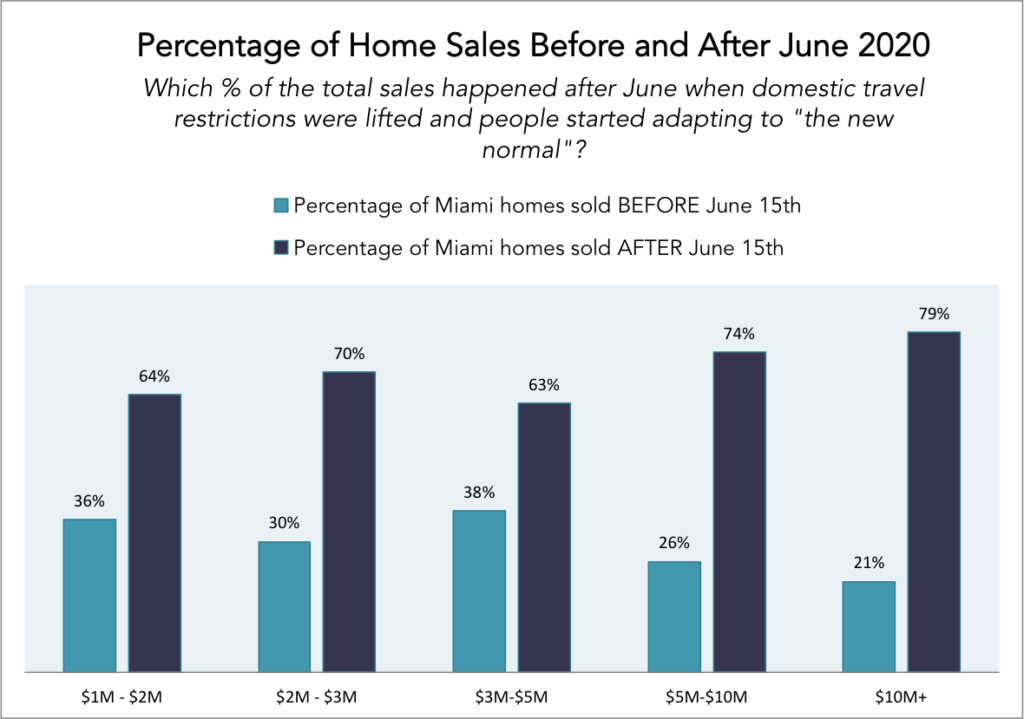
Percentage of Sales Before and After June 2020
Which % of the total sales happened after June when domestic travel restrictions were lifted and people started adapting to “the new normal”? Below you can see how condo sales did not pick up after travel restrictions were lifted and we settled into the new normal. The second picture depicts the single-family home market, which sees a clear jump in sales after the month of July.
A Deep Dive into the Different Price Ranges for Condos
The $1M-$2M Condo Market
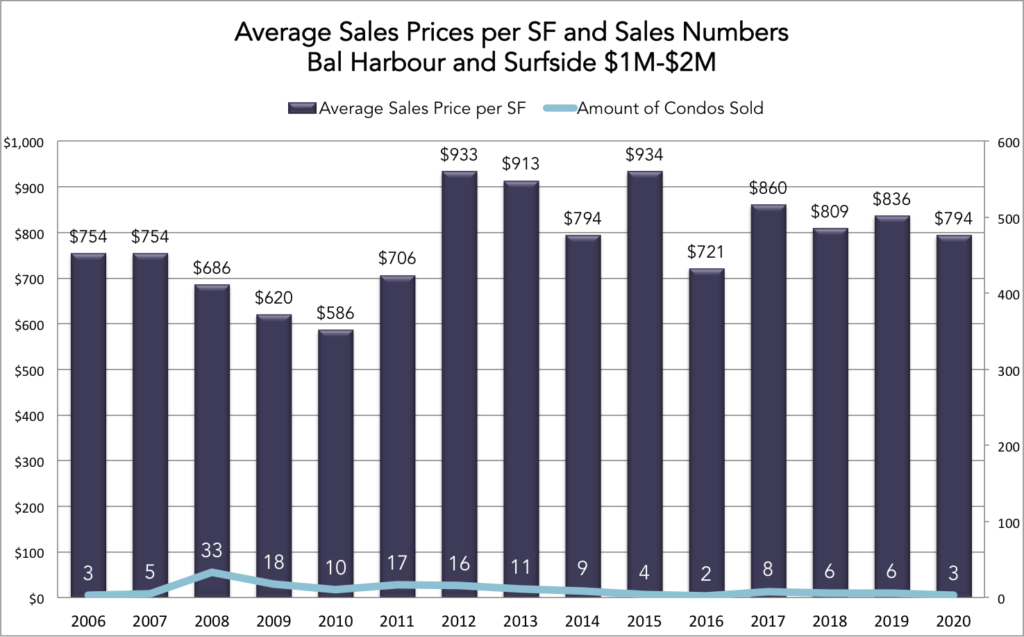
A market with a lot of listings and a limited amount of sales. At the time this study was conducted we recorded 1508 current active listings with 178 closed sales (between March 15 and September 15). That indicates a total of 50 months of inventory across the market. Most inventory sits in the greater Downtown area, which includes Brickell and Edgewater, while Sunny Isles and Aventura are also seeing a very high amount. Although none of these markets shows a very healthy amount of inventory, the Grove as well as the Beach show the most promising supply and demand relationship. This price range has 78 pending sales most in the Downtown area (18), Miami Beach (15), Sunny Isles (11) Bal Harbour & Surfside (7) and South of Fifth (5).
This market has suffered considerably from Covid-19. In 2019 we saw a total of 254 condos being sold in the city’s most desired areas while in 2020 in the same period we saw 178 condos being sold. That is a 30% decrease in sales. The highest decrease in sales was seen in Aventura, Miami Beach, Bal Harbour & Surfside as well as in Downtown. The Edgewater market on the other hand didn’t see a change in sales within this price range. While the single-family home market bounced back after travel restrictions were lifted and we settled into the new normal, the condo market did not see significantly higher numbers of sales after June.
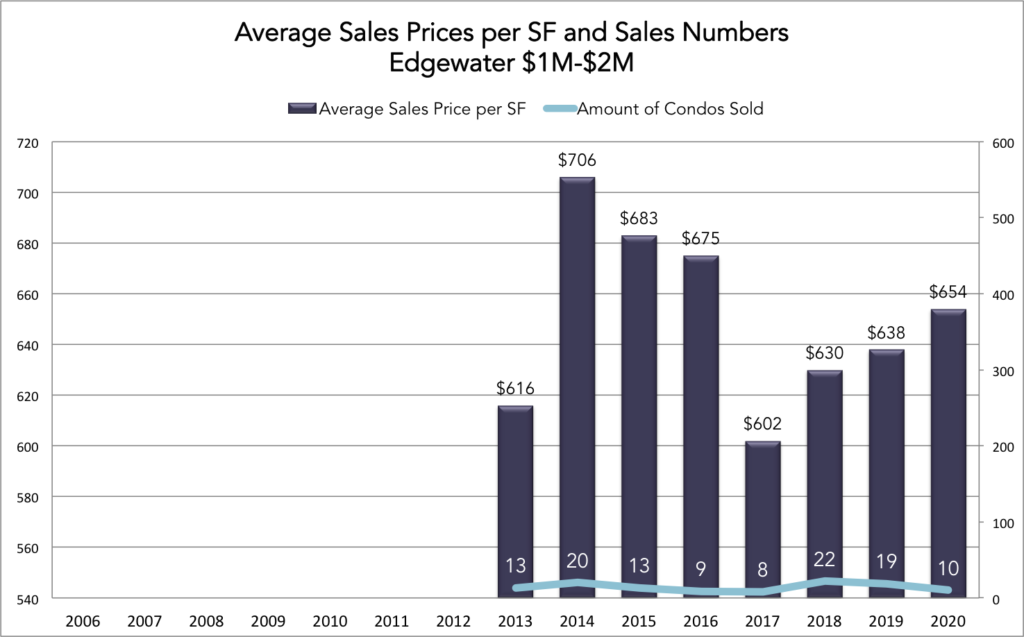
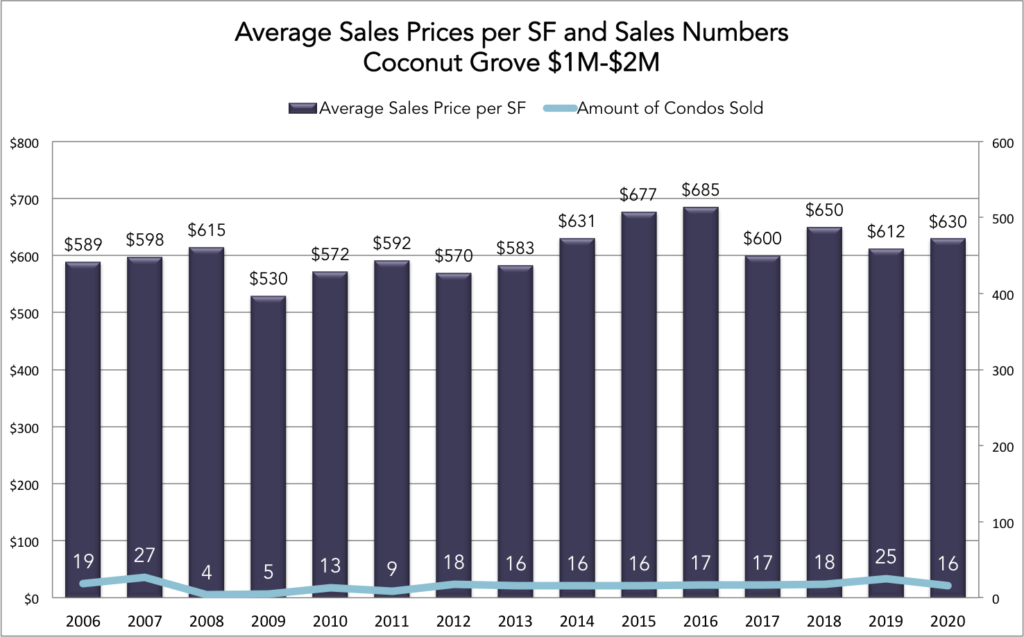
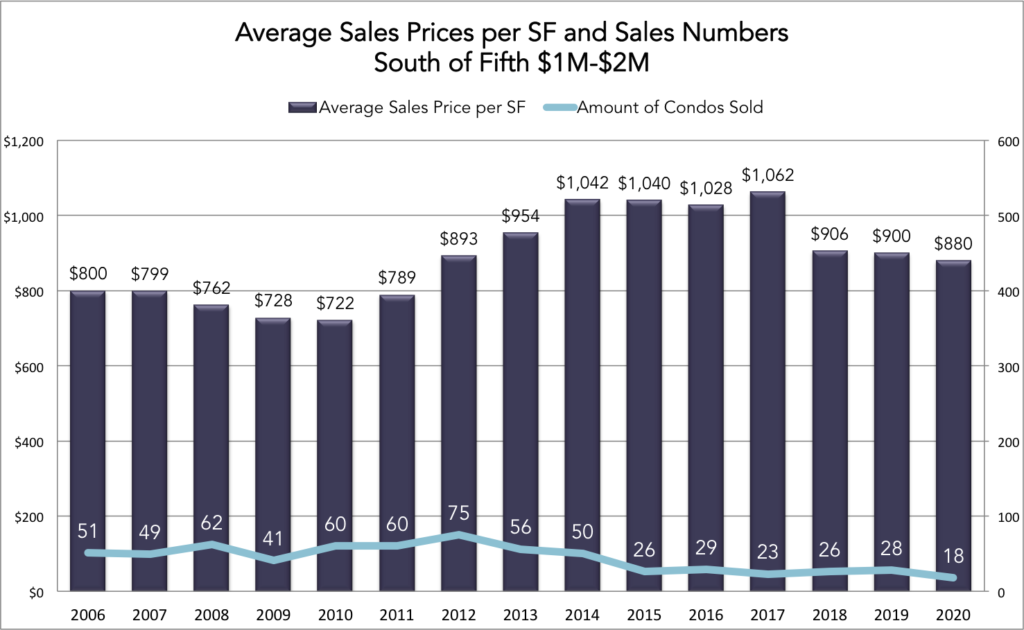
Have prices gone down? In the below graphs you see per Miami neighborhood was the prices have done in the last 15 years. Some areas saw price levels remain stable in 2020 while others saw a decline. High inventory and downward prices do not mean one should not buy. There is actually a lot of opportunity out there and the time to make great deals is now!
At what price point should you buy? As you will see in part 1 of this report, in which I speak with another market analyst, you have to look for the bottom prices of the previous cycle, which in the case of the Miami condo market is 2012. If you follow this rule you will be safe, assuming you buy a good quality property. As a safety net we look at prices achieved in 2012/2013. So once we reach these price levels it is safe to say you are buying at the bottom or near the bottom of the market. A good example here is the Miami Beach market. As you see today’s prices are around $961 per SF, which is equal to the prices achieved in 2012/2013. This does not mean that all properties at this price level are a good buy. This is the average price. Very well-finished ocean facing units will trade for more while fixer-up units should ask a lower price per SF. Will the market reach the prices achieved in 2008/2009? Most likely not, this was a real estate crash and a completely different situation than we are living in today. Also always remember the bottom of the market will always be slightly higher than the last lowest point.
Contact the David Siddons Group for more information about specific units or for a more personalized chat about investing in the Miami real estate market!
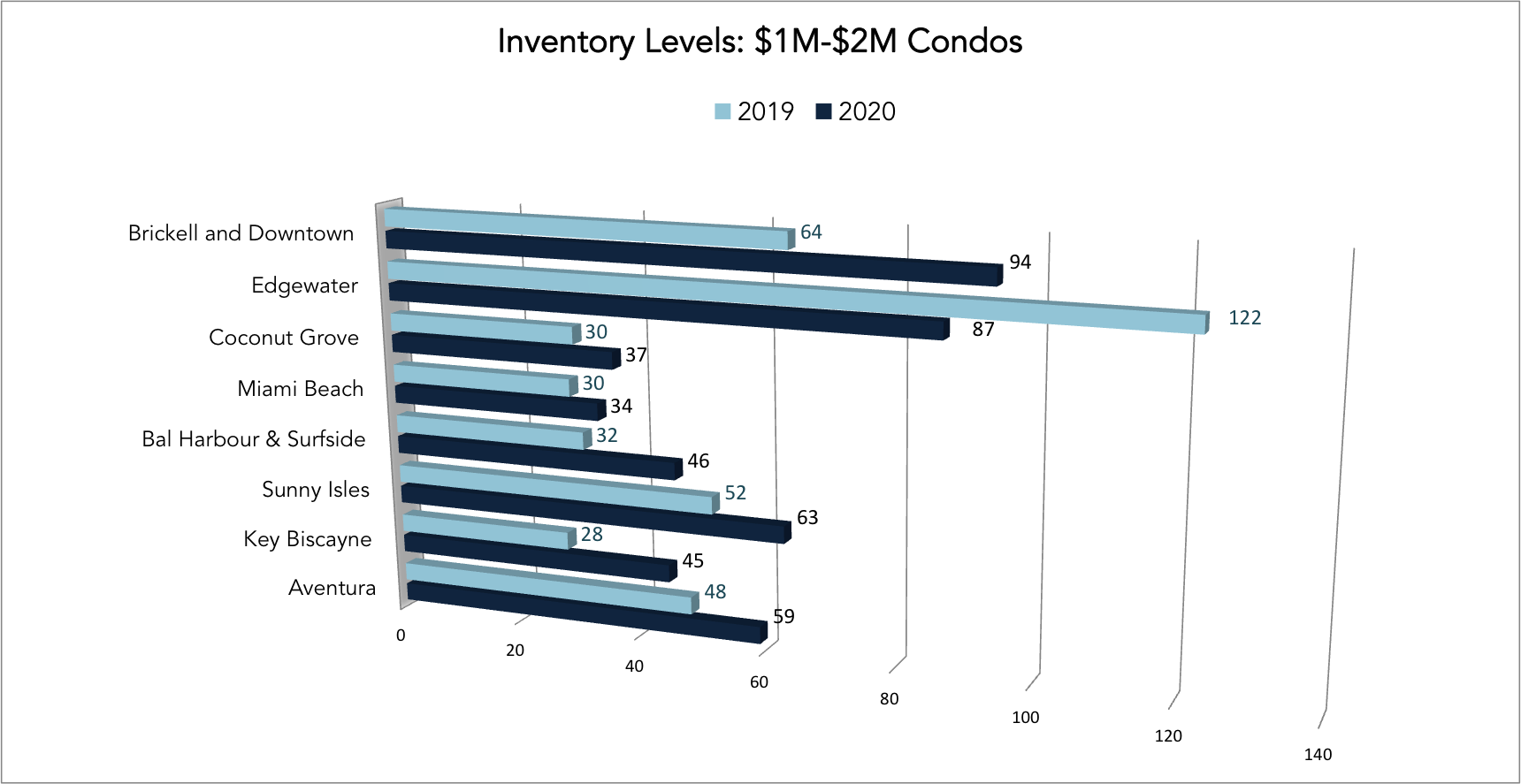
The $2M-$3M Condo Market
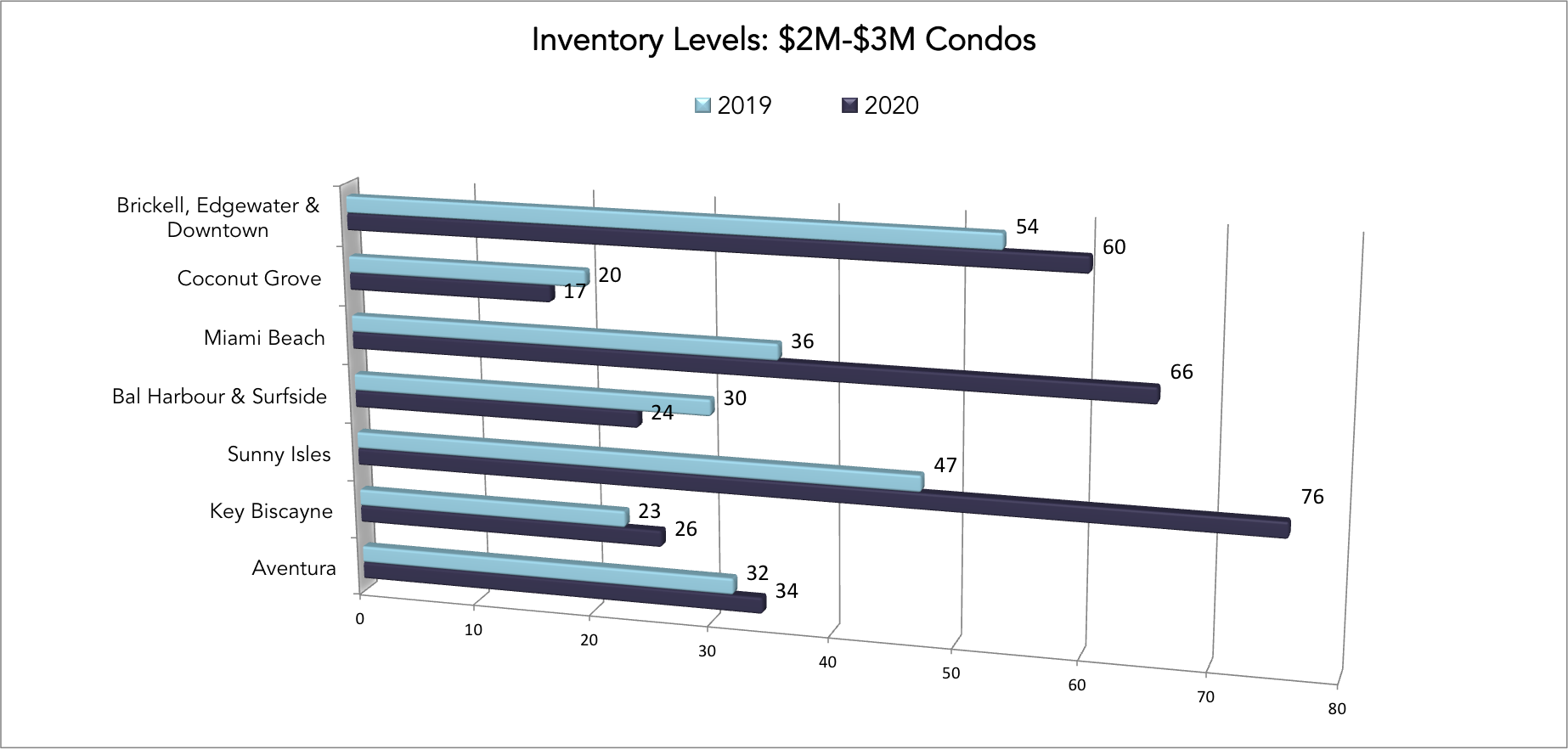
At the time this study was conducted we recorded 476 current active listings with 61 closed sales in the last 6 months. This is considered an unbalanced buyer’s market. Compared to last year we saw a 25% decline in sales. As this market is one that heavily relies on investor money and caters less to the local population, this market suffered considerably. Most inventory sits in the greater Downtown area, Miami Beach and Sunny Isles. There are 25 pending sales in this area most of which on Miami Beach (6), Sunny Isles (5) and the greater Downtown area (7).
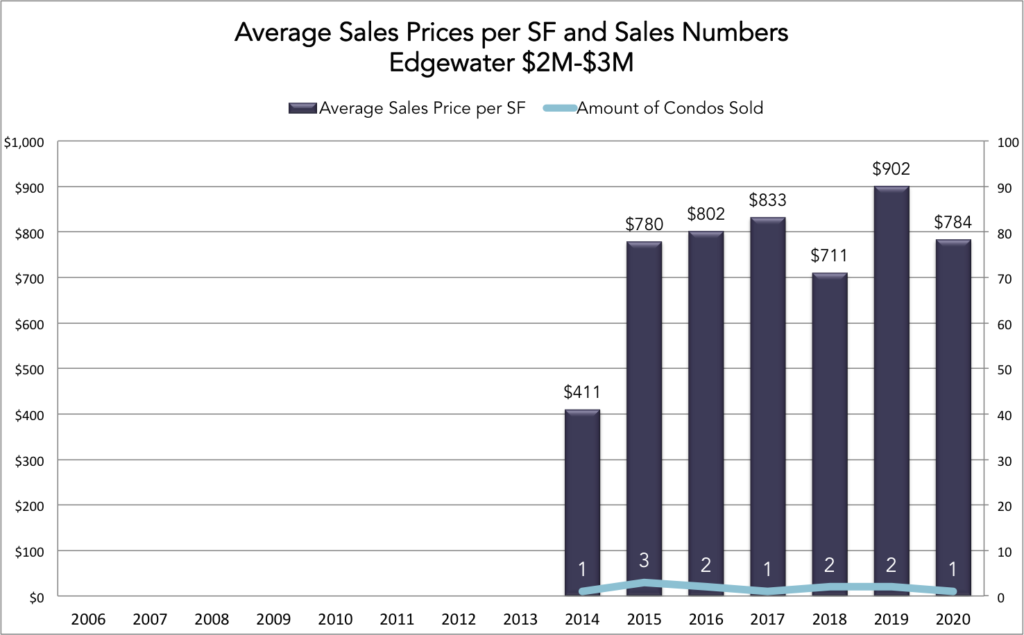
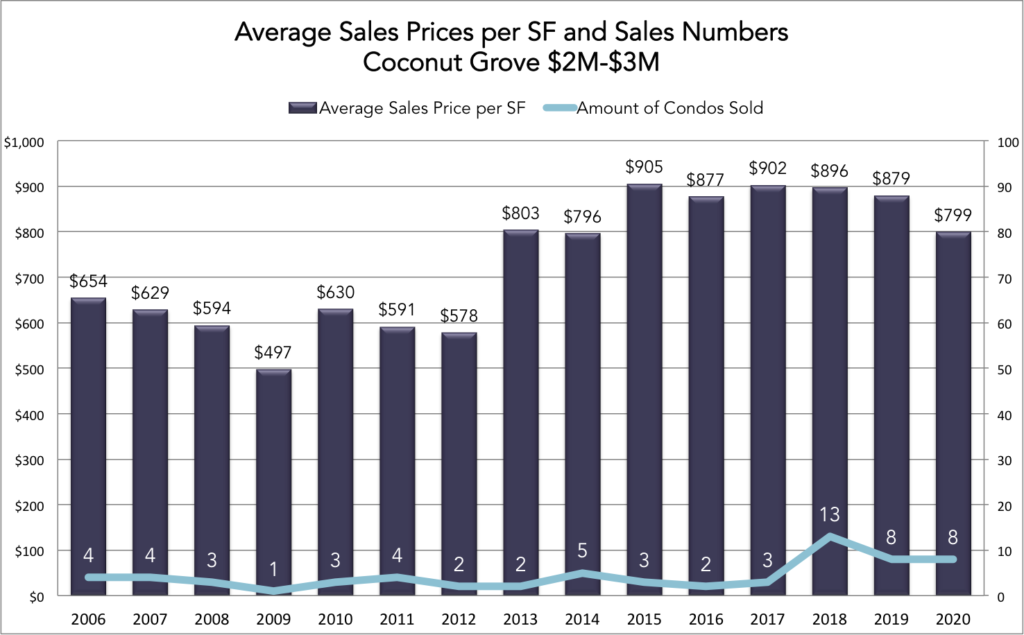
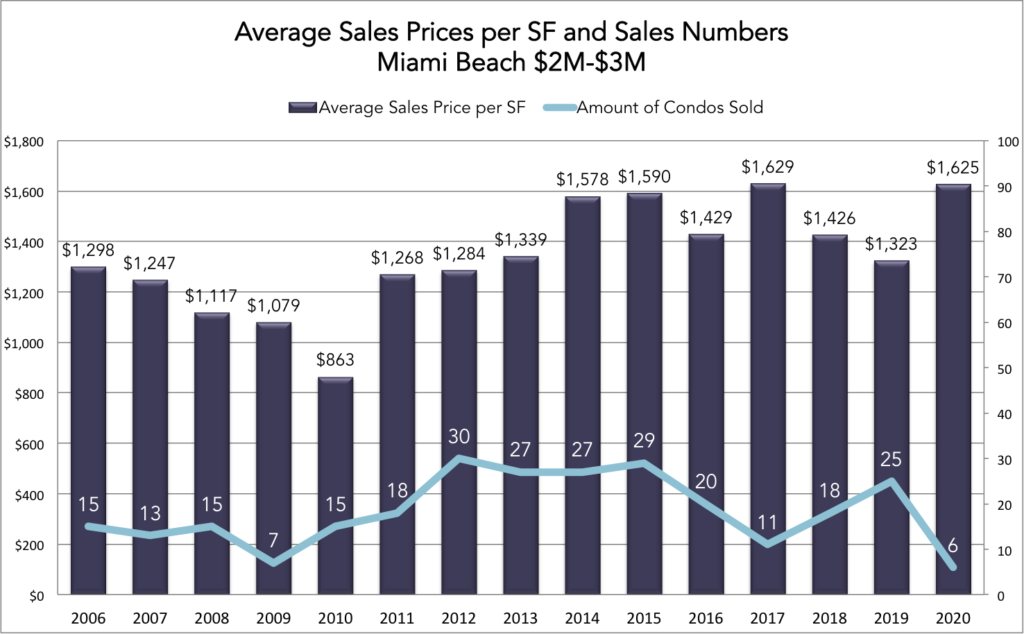
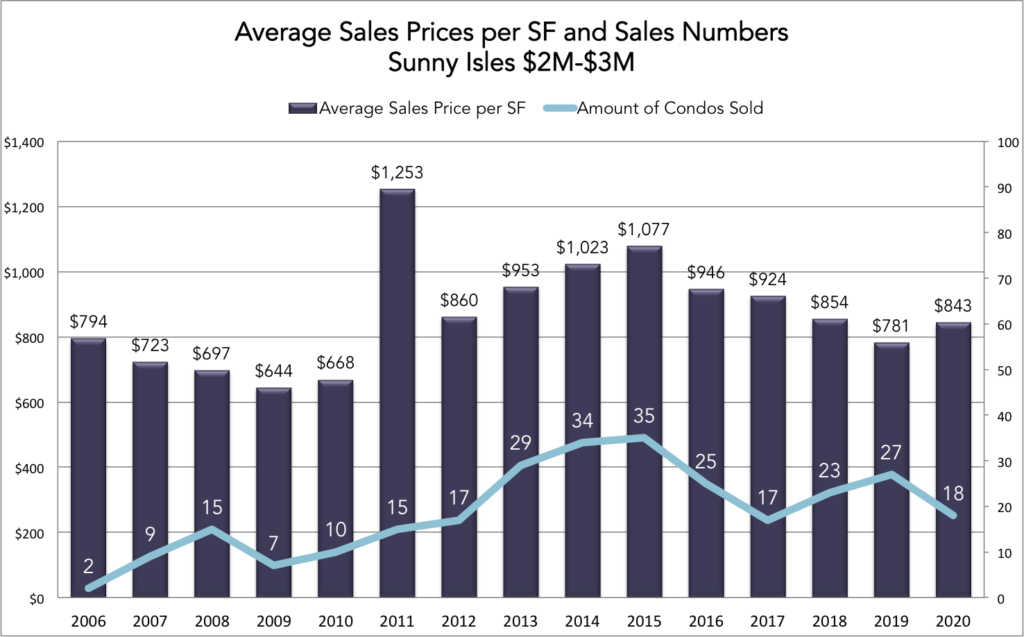
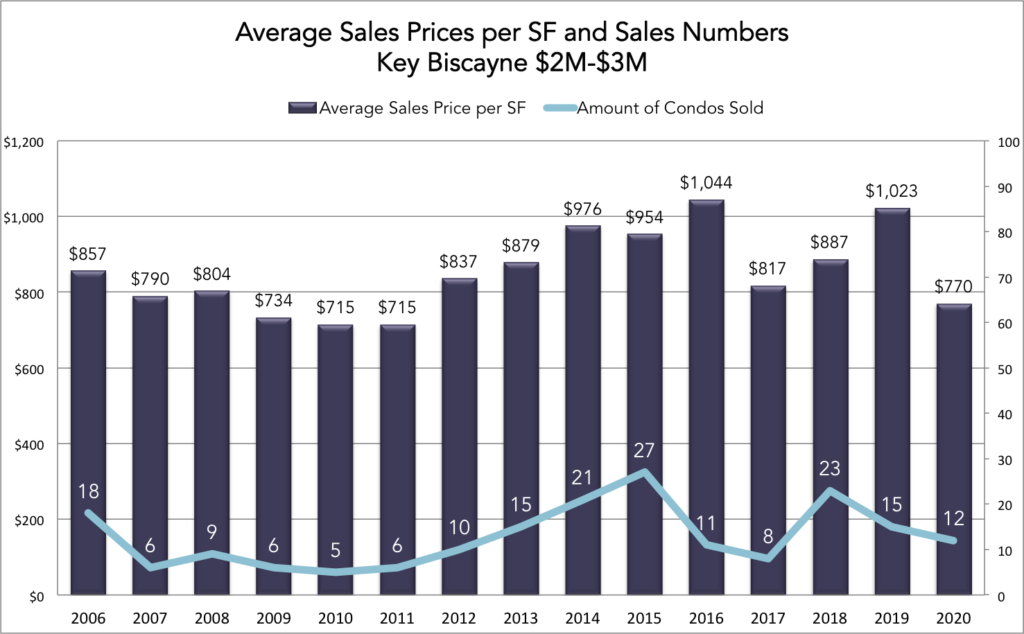
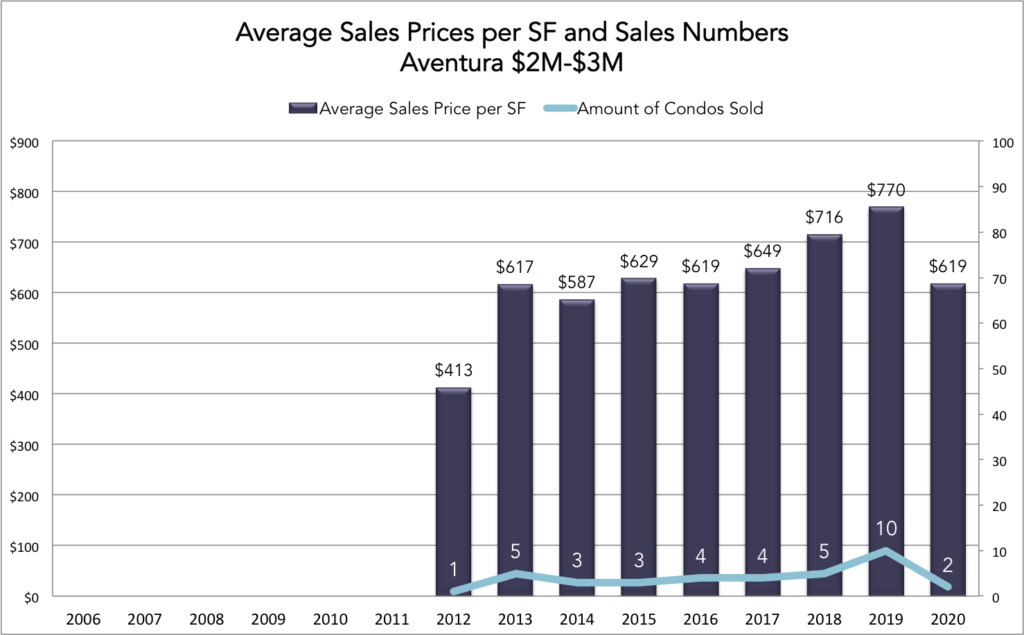
Have prices gone down? In the below graphs you see per Miami neighborhood what the prices have done in the last 15 years. Please also keep an eye out for the amount of sales. Some areas saw less than 5 sales in 2020, which can create outliners in the achieved average prices.
At what price point should you buy? As a general rule of thumb I follow the “2012/2013” rule. We use the prices achieved in these years as a safety net for good investments. These prices are close to the bottom prices of the last cycle and will be a good level to buy at, assuming you are looking at good quality units. In the below tables from our brand new Condo Geeks Analytical tool, you can see the historic prices per SF and per area and you will see what price levels were achieved at the bottom of the market during the last cycle. This is extremely helpful to get a better estimate of what you should be paying today to be close to the bottom of the market.
Good deals can be had in any of these markets as long as you buy the right line in the right condo for the right price. Which ones are those? Here is where you should call me for more information at 305.508.0899
The $3M-$5M Condo Market
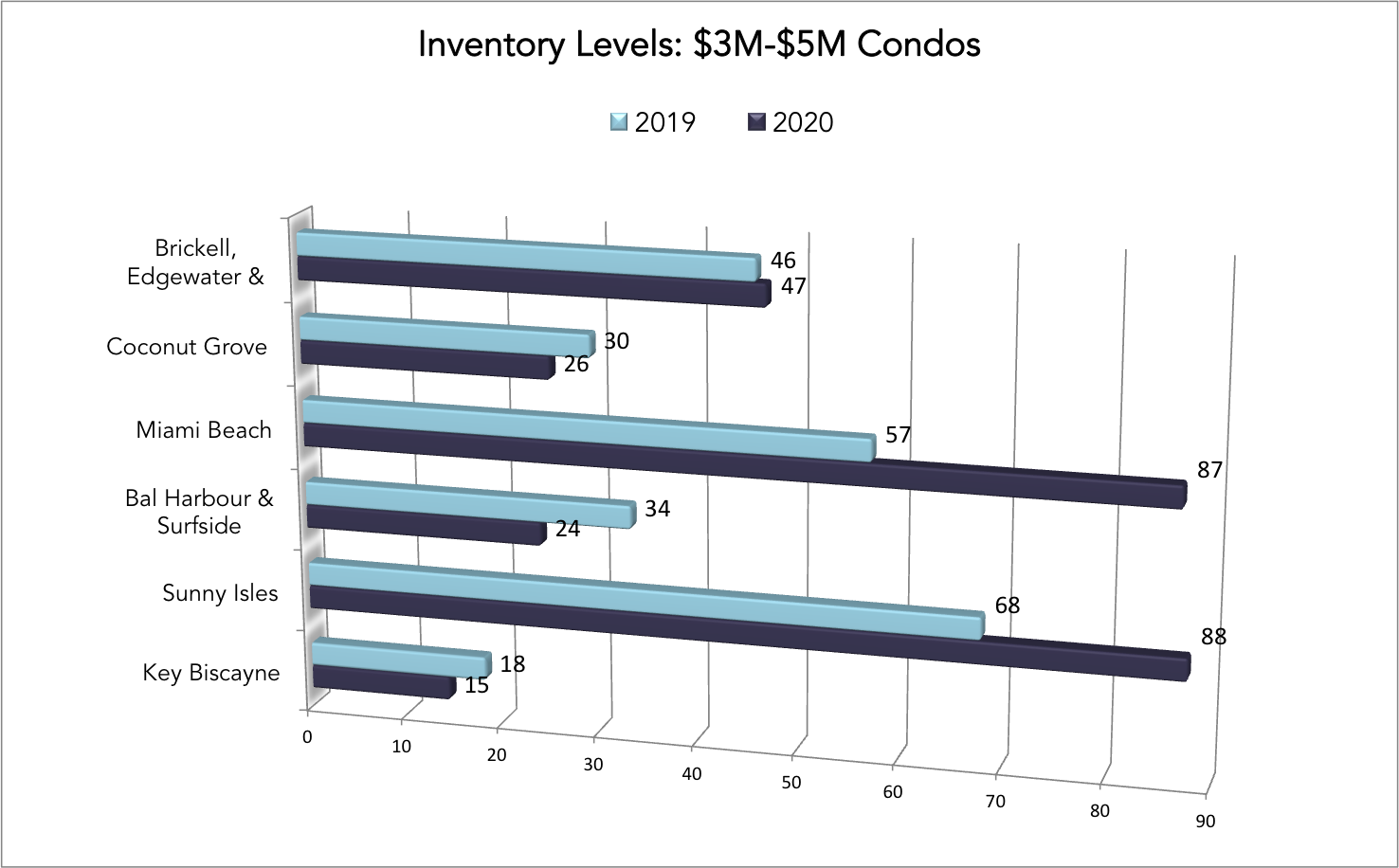
The smallest change happened in this market which went from 38 sales in 2019 to 37 sales in 2020; a 2.5% decline in sales. With 392 active listings and 31 sales in the last 6 months you can tell this market is unbalanced. The highest inventory levels can be found again in the greater Downtown area, Miami Beach and Sunny Isles. There are 16 pending sales in this price range, most in the greater Downtown area Miami Beach and Sunny Isles.
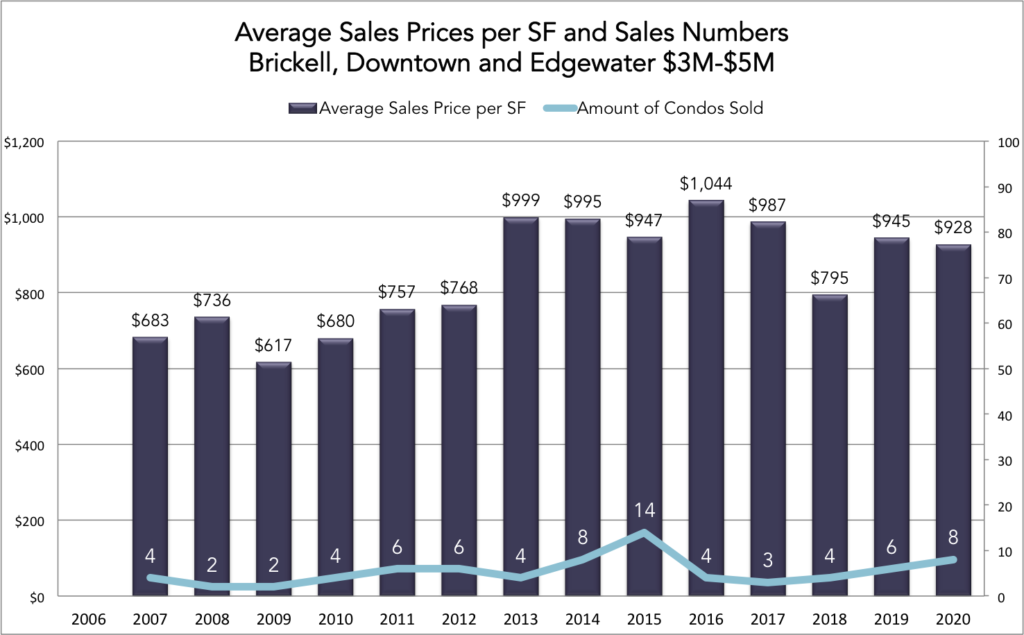
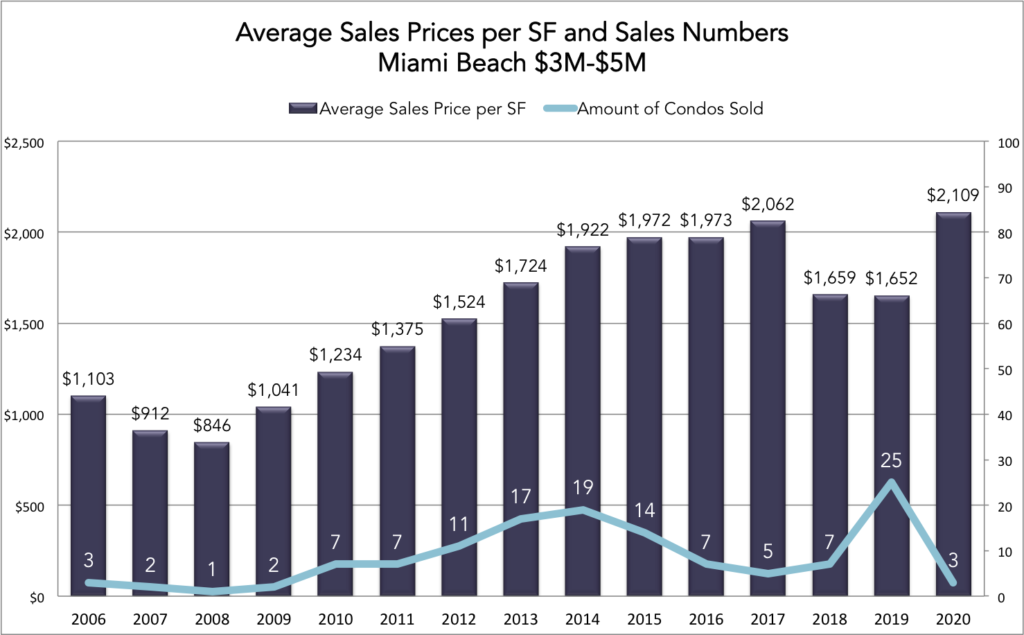
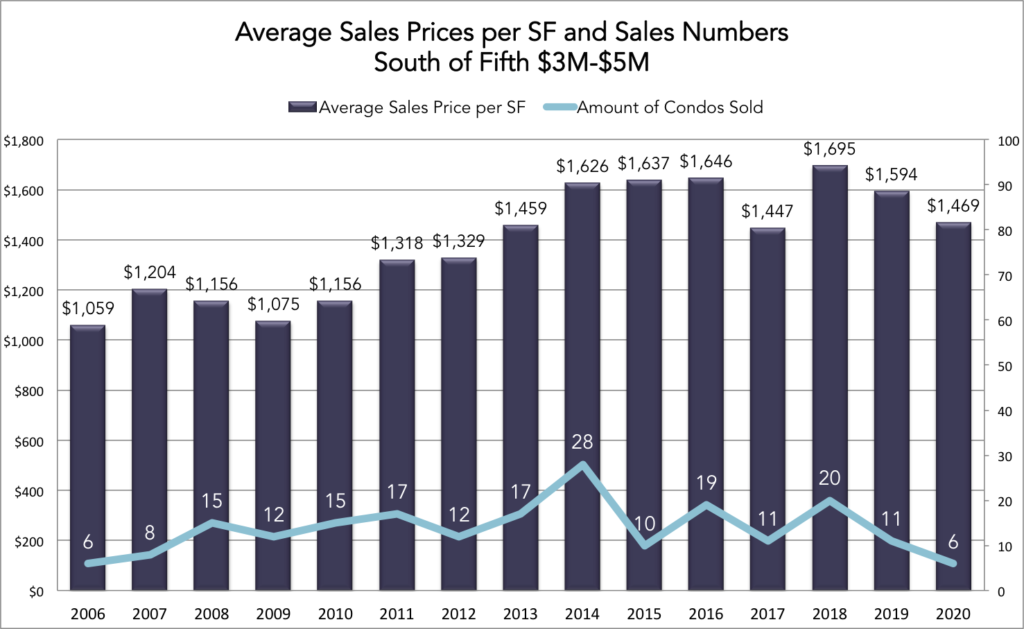
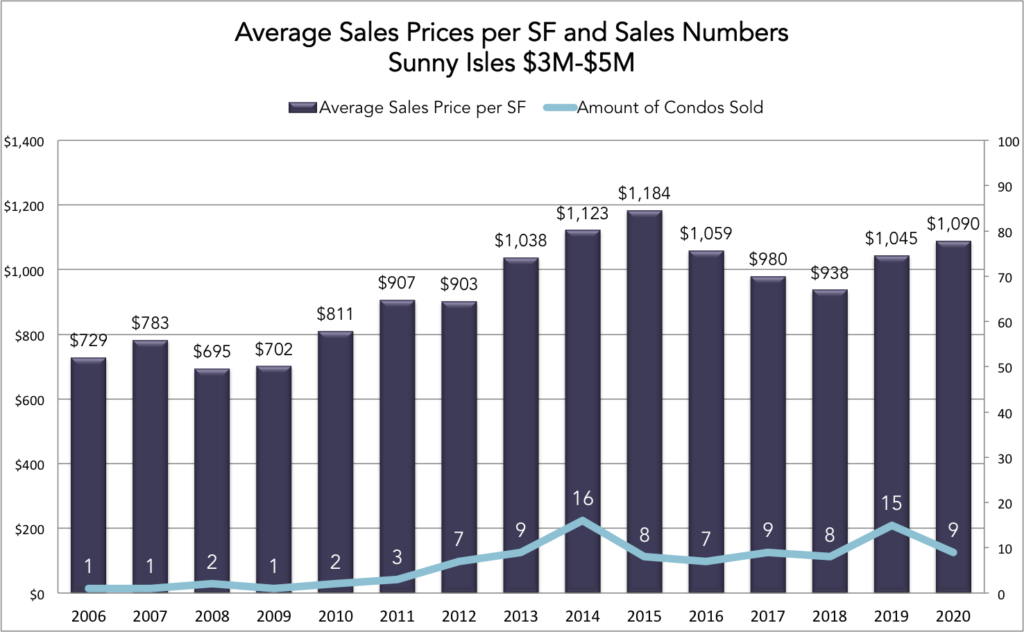
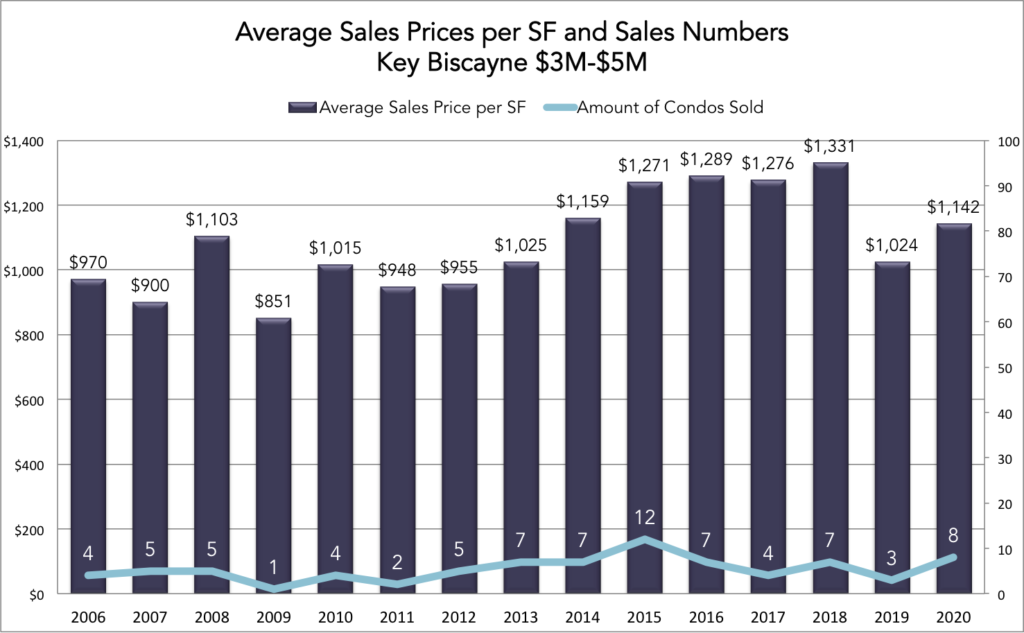
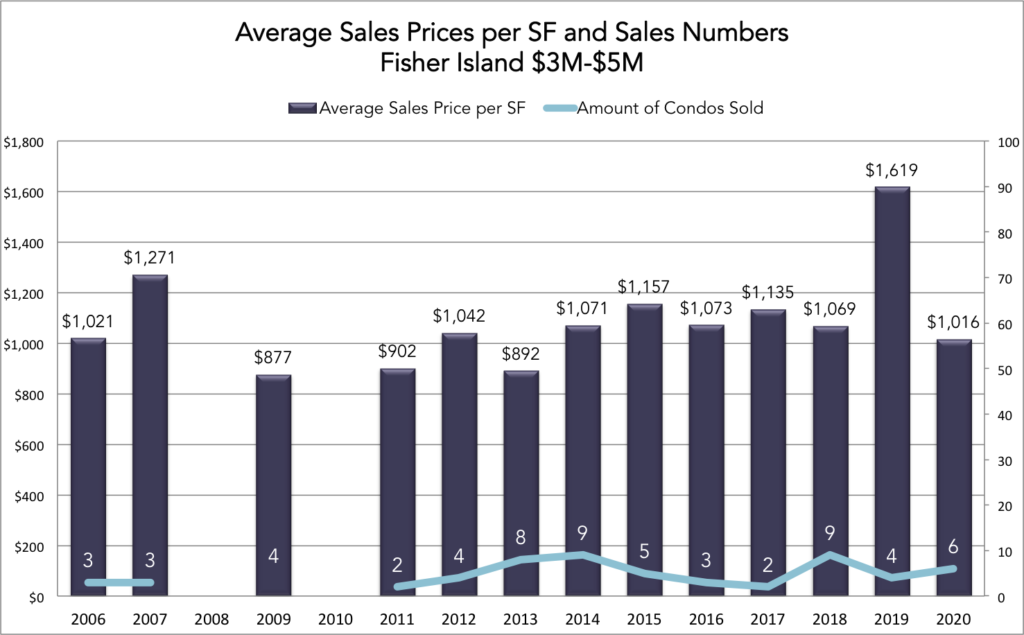
Prices have gone down considerably since the market’s peak although the limited amount of sales within this price point can easily lead to price fluctuations that do not property represent the market. For example Miami Beach saw two top sales happen in 2020 in the area’s most exclusive condos, which inflated the average price per SF for 2020. In the below graphs you see per Miami neighborhood was the prices have done in the last 15 years.
We created the below graphs with our Condo Geek Analytical tool, which is capable of tracing the condo market back to 15 years, and to compare the different condos to one another regarding prices per SF, inventory levels and historic performance. Here you can see what prices per SF these condos traded at during the last market cycle. As a rule of thumb we say it is safe to pay prices near the 2012/2013 levels. For example, the South of Fifth market is a good market to get deals. The market has reached 2012 price levels and is one where good quality units can now be purchased for a more attractive price.
It is important to note that some condos are still selling very well. Even if a market is seeing downward price levels and high inventory that does not mean this market does not offer a set of condos that do very well. As mentioned before we offer the right tools to tell the good from the bad.
Contact the David Siddons Group for more information about specific units or for a more personalized chat about investing in the Miami real estate market!
The $5M+ Condo Market
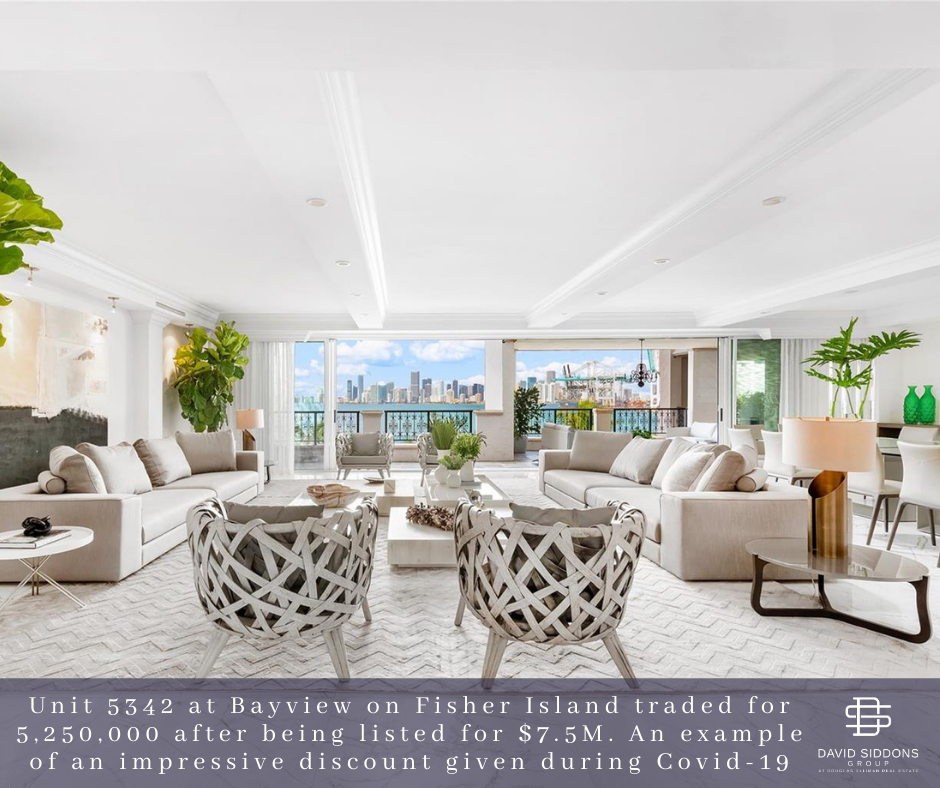
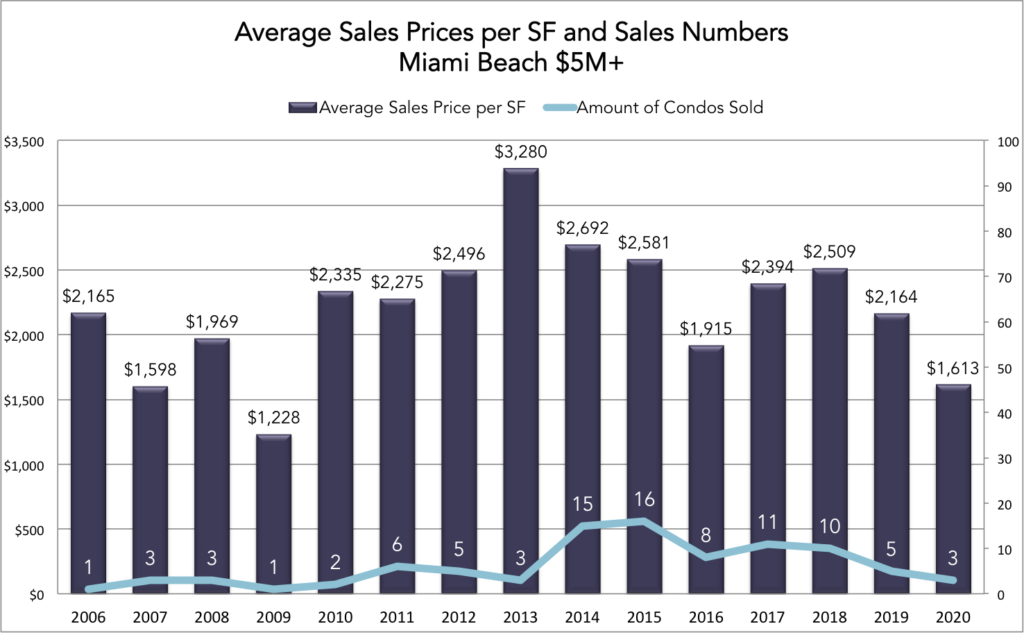
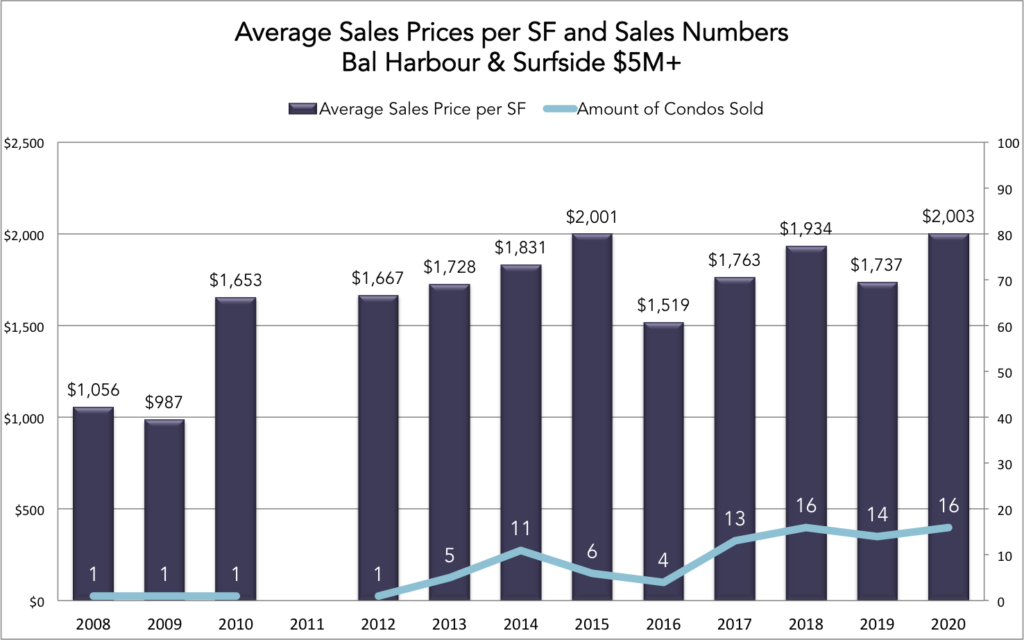
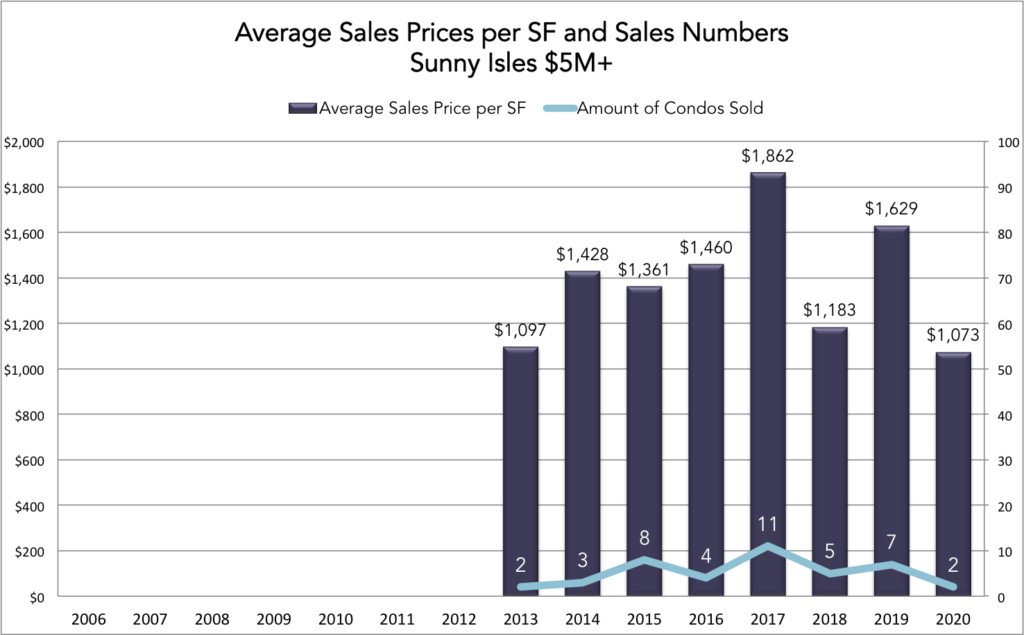
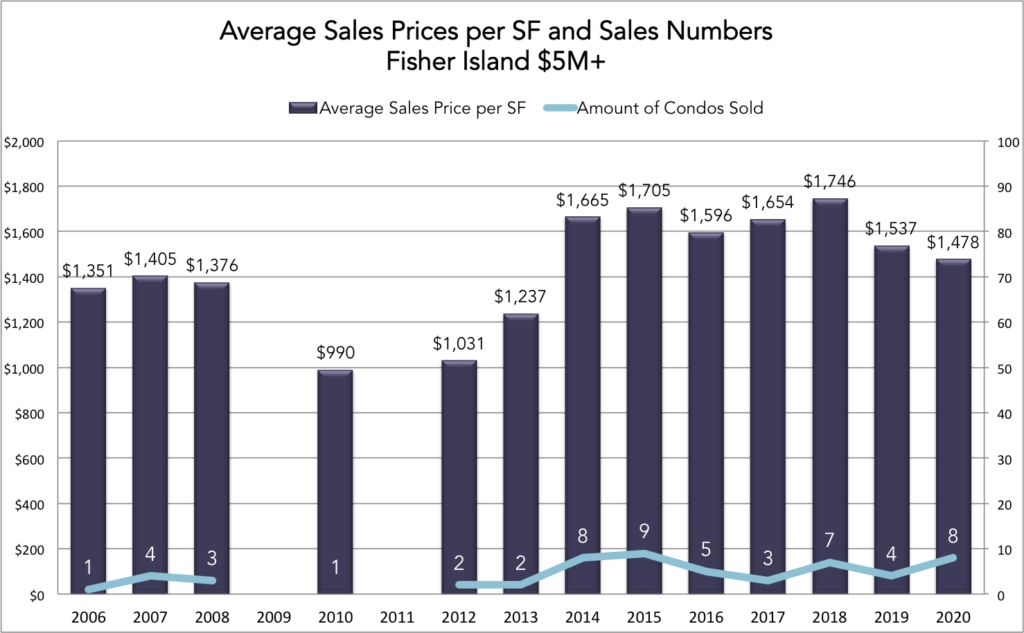
In the last 6 months (March 15 – Sept 15) we recorded 28 sales in the $5M+ market compared to 37 the year before. This 24% decrease is a striking difference with the single-family home market that flourished (+55%) in this price bracket and went from 36 sales in 2019 to 56 sales in 2020. From the 28 closed sales we saw a concentration of sales in Surfside and Bal Harbour, which represented 35% of all sales (10 out of 28). Other preferred areas are Fisher Island (7 sales) and South of Fifth (3 sales). A lower number of sales occurred in Downtown (3 sales at One Thousand Museum), Key Biscayne (1), Sunny Isles (2) and Miami Beach (2). In total there are 7 pending sales here; 2 on Fisher island, 2 in Sunny Isles, 2 on Miami Beach and 1 on Key Biscayne.
While Sunny Isles and Miami Beach were once the center of attention there has been a shift of luxury buyers. Luxury sales is now in hands of mostly New Yorkers (and buyers from the high-tax states in the northeast) and therefore Sunny Isles and the southern parts of the beach are less desired while the mainland doesn’t even offer that type of product. These buyers lean more towards areas such as Bal Harbour, Surfside or the ultra private Fisher Island. They are looking for privacy, service and tranquility, large units and supreme finishes. Condos that fare well and see lots of sales are Oceana Bal Harbour, St Regis, the Surf Club Four Seasons, 87 Park, Palazzo del Sol, Palazzo della Luna.
No less than 347 condos are available in this price range. With 28 sales in the last 6 months we are looking at 75 months of inventory. Meaning it will take up to 6 years to years to absorb all current inventory if market conditions will remain equal. Most of the inventory sits in Sunny Isles and Miami Beach, while desired areas such as Surfside or Bal Harbour are also seeing an elevated level of inventory albeit a decreasing level. This is a very overheated market still! The other problem is that the market is lacking good quality product. Most product gets always sold in the same buildings as mentioned earlier, which are St Regis Bal Harbour, Oceana Bal Harbour, 87 Park, Palazzo del Sol, The Four Seasons in Surfside etc.
We see that the Beach has seen a large decrease in prices per SF over the years meaning there are some good opportunities to be had. As mentioned before most of the good quality buildings still trade very well and will not be sold with large discounts (generally speaking!). Sunny Isles is a luxury market that is currently experiencing lots of trouble. These condos were constructed during the peak of the last cycle and sold for top dollar. Upon delivery many owners were disappointed with the quality (value/ price relations were off) and resale values were very low. Besides this, many of the buyers for this type of product experienced currency exchange difficulties and demand plummeted. This market was extremely fragile before and the pandemic just rubbed salt into the wounds. Important for buyers to know is that the condos that do sell often sell for a considerable discount where 10-20% off is no exception. This market is perfect for savvy investors to get some great deals. Use the table below to see what kind of price levels you should expect to pay for a good deal.

FAQ
These are the most commonly Miami Real Estate Related questions
What should relocation buyers know before buying real estate in Miami?
HOME BUYERS
Relocation buyers looking at homes in Miami should understand that choosing the right house is less about the property itself and more about location, schools, and long-term value. Many buyers make the mistake of focusing on price or finishes, while the real driver of value is the neighborhood and micro-location. Older homes often represent better value, but may also be part of a future redevelopment cycle. Newer homes command premiums, but don’t always sell faster if pricing is ahead of the market. Commute time, school access, and community dynamics are critical and often underestimated. The key is to evaluate homes not just as lifestyle purchases, but as long-term assets within a very localized market.
Sources:
https://luxlifemiamiblog.com/relocating-to-miami/
https://luxlifemiamiblog.com/relocating-to-miami-with-a-family/
CONDO BUYERS:
Relocation buyers should understand that Miami is a highly segmented, building-driven market, not a uniform one. Pricing can vary significantly between similar properties depending on building quality, layout, and financial health. Many buyers assume newer construction equals better investment, but that is often not the case. Factors like HOA fees, reserves, and rental policies can materially impact long-term value and liquidity. Negotiation opportunities often exist, especially in slower segments, but require precise market knowledge. The key is to evaluate micro-markets and individual buildings, not just neighborhoods or price per square foot.
Sources:
https://luxlifemiamiblog.com/miami-real-estate-market-report/
https://luxlifemiamiblog.com/new-construction-miami-guide/
What are the best areas for relocating families with children
For families relocating to Miami with young children, the most recommended neighborhoods are Coral Gables, Coconut Grove, and Pinecrest. Coral Gables offers the best balance of top schools, safety, and long-term value. Coconut Grove is ideal for younger families seeking walkability, greenery, and a lifestyle-driven environment. Pinecrest provides larger homes, excellent schools, and better value for space, making it ideal for growing families. The key driver across all three is access to strong schools and primary residential stability. Relocation decisions are less about new construction and more about long-term livability and resale strength.
Sources:
https://luxlifemiamiblog.com/best-neighborhoods-miami/
https://luxlifemiamiblog.com/what-are-the-best-family-neighborhoods-in-miami-in-2023/
Are new construction condos in Miami a good investment?
New construction condos in Miami can be a good investment—but only if you understand that not all buildings perform the same. According to the David Siddons Group, many buyers assume “new = better,” but in reality, performance depends on pricing, layout, building quality, and long-term demand. Some new developments set future price benchmarks and can drive long-term appreciation, especially in top-tier projects. However, many are priced aggressively at launch, and buyers relying on marketing instead of data often overpay.
The market is highly segmented, meaning two new buildings next to each other can perform very differently.
The best opportunities typically come from selecting the right building early or negotiating correctly in later phases.
In short: new construction is not automatically a good investment—it becomes one only with building-level analysis and disciplined entry pricing.
Sources:
https://luxlifemiamiblog.com/how-to-buy-a-luxury-condo-in-miami/
https://luxlifemiamiblog.com/category/independent-new-construction-condo-reviews/
https://luxlifemiamiblog.com/beyond-clickbait-real-insights-into-miamis-luxury-condo-market/
Why is buying a Miami condo riskier than buyers think?
Buying a Miami condo is often riskier than buyers expect because the true risks are at the building level—not visible in the listing price. Many buyers focus on finishes and views, while overlooking HOA reserves, insurance exposure, and potential special assessments. In reality, two identical units in different buildings can perform completely differently over time. Rising HOA fees and stricter regulations are also increasing the true cost of ownership, especially in older buildings. Liquidity can be affected by factors like financial health, rental policies, and ongoing repairs. The key risk is not the condo itself—but buying into the wrong building without proper due diligence.
Sources:
https://luxlifemiamiblog.com/how-to-buy-a-luxury-condo-in-miami/
https://luxlifemiamiblog.com/miami-condo-market-risks/
What are Miami's Safest Areas?
Which Miami Areas Still offer Great Value (Budget Friendly alternatives to Coral Gables and Pinecrest)
If you’re looking for better value than Coral Gables or Pinecrest, the answer (in true Siddons style) is not “go cheaper”—it’s go one layer outside the obvious markets.
The strongest value plays are:
- Schenley Park → closest substitute to Coral Gables at ~20% discount while maintaining similar character and location
- Biltmore Heights → almost identical feel to the Gables but ~25–30% cheaper on a $/SF basis
- Glenvar Heights → central location with larger lots and ~25% pricing advantage vs South Miami/Gables
- Baptist / Galloway (Kendall) → Pinecrest-style living (space, schools, land) at up to ~30% lower pricing
The pattern is consistent:
👉 Buyers are shifting west and slightly off-market to gain land, scale, and pricing efficiency. You don’t find value by going to a “cheaper neighborhood”—you find it by identifying adjacent micro-markets that offer the same lifestyle fundamentals without the brand premium.
Sources:
https://luxlifemiamiblog.com/best-value-neighborhoods-miami/
https://luxlifemiamiblog.com/category/miami-neighborhoods/
Is NOW a good time to buy in Miami?
Are Miami real estate prices going down in 2026?
No—but that’s the wrong way to look at it. Miami is not one market anymore, so prices are not moving in one direction. In 2026, the market is split into two: ultra-luxury, scarcity-driven areas (like waterfront and top-tier neighborhoods) are still holding or even rising, while mid-tier condos and oversupplied segments are flat or correcting. What we’re seeing is price divergence, not a crash—some properties are gaining value while others are quietly adjusting downward. Rising inventory and more selective buyers are putting pressure on pricing in certain segments, especially older condos or buildings with weaker fundamentals.
At the same time, global wealth and cash buyers continue to support pricing at the top end of the market. So the real answer: prices aren’t broadly dropping—they’re being repriced based on quality, location, and supply.
Should I buy a house or a condo when relocating to Miami?
The decision comes down to lifestyle first, investment second—and most relocation buyers get that backwards. If you want space, privacy, schools, and long-term family living, a single-family home in areas like Coral Gables or Coconut Grove is typically the stronger choice. If you prioritize walkability, low maintenance, and proximity to business districts, a condo in Brickell or waterfront markets makes more sense.
From an investment perspective, homes tend to be more stable, while condos are more building-dependent and cyclical. Most relocation clients underestimate how much building quality, HOA structure, and future costs impact condo performance. The right answer isn’t “house vs condo”—it’s which asset fits your lifestyle AND holds value within its micro-market.
How do I choose the right Miami neighborhood for my lifestyle?
Why are Miami condo prices so different between buildings?
Miami condo pricing varies widely because value is determined at the building level, not just by location. Two buildings next to each other can have major differences in financial health, reserves, HOA fees, and management quality. Buyers also pay premiums for better layouts, views, amenities, and newer construction—but not all “new” buildings perform equally. Factors like rental policies, upcoming assessments, and building reputation can significantly impact resale value. This is why price per square foot alone is misleading in Miami’s condo market. The real driver of value is how that specific building competes within its micro-market over time.
Sources:
https://luxlifemiamiblog.com/how-to-buy-a-luxury-condo-in-miami/
https://luxlifemiamiblog.com/category/independent-new-construction-condo-reviews/
WHY WORK WITH DAVID? THINGS YOU SHOULD KNOW...
For all our analytics we are agents driving some very unique and advanced tech. We Provide a granular and custom experience that empower our clients with the insight and tools to understand the most complex behaviors of any local markets.
-
Analytical
Over 100 reports produced to date
-
Knowledgeable
Over 1800 published articles and counting


Related Articles
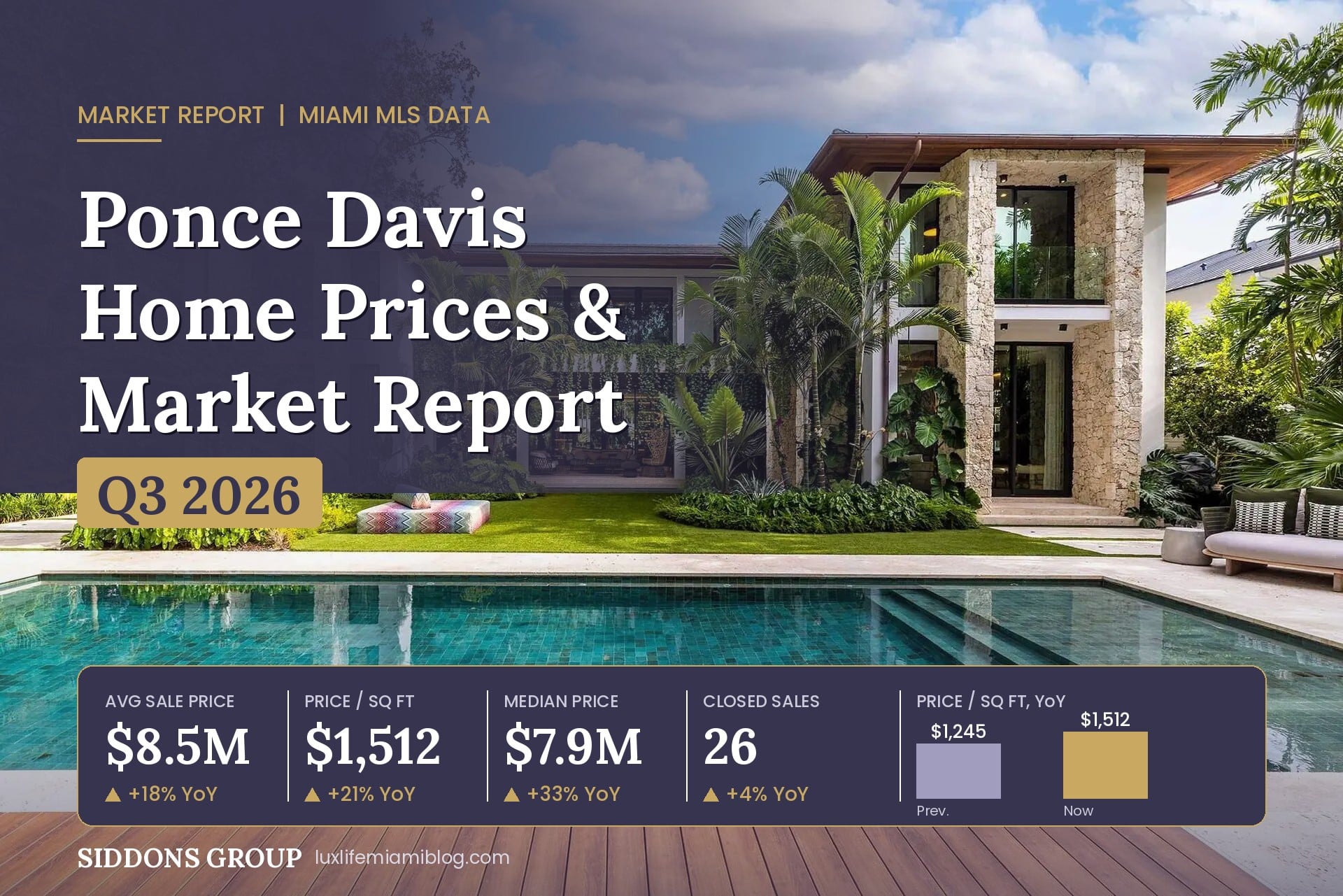
Ponce Davis Home Prices & Market Report: Q3 2026
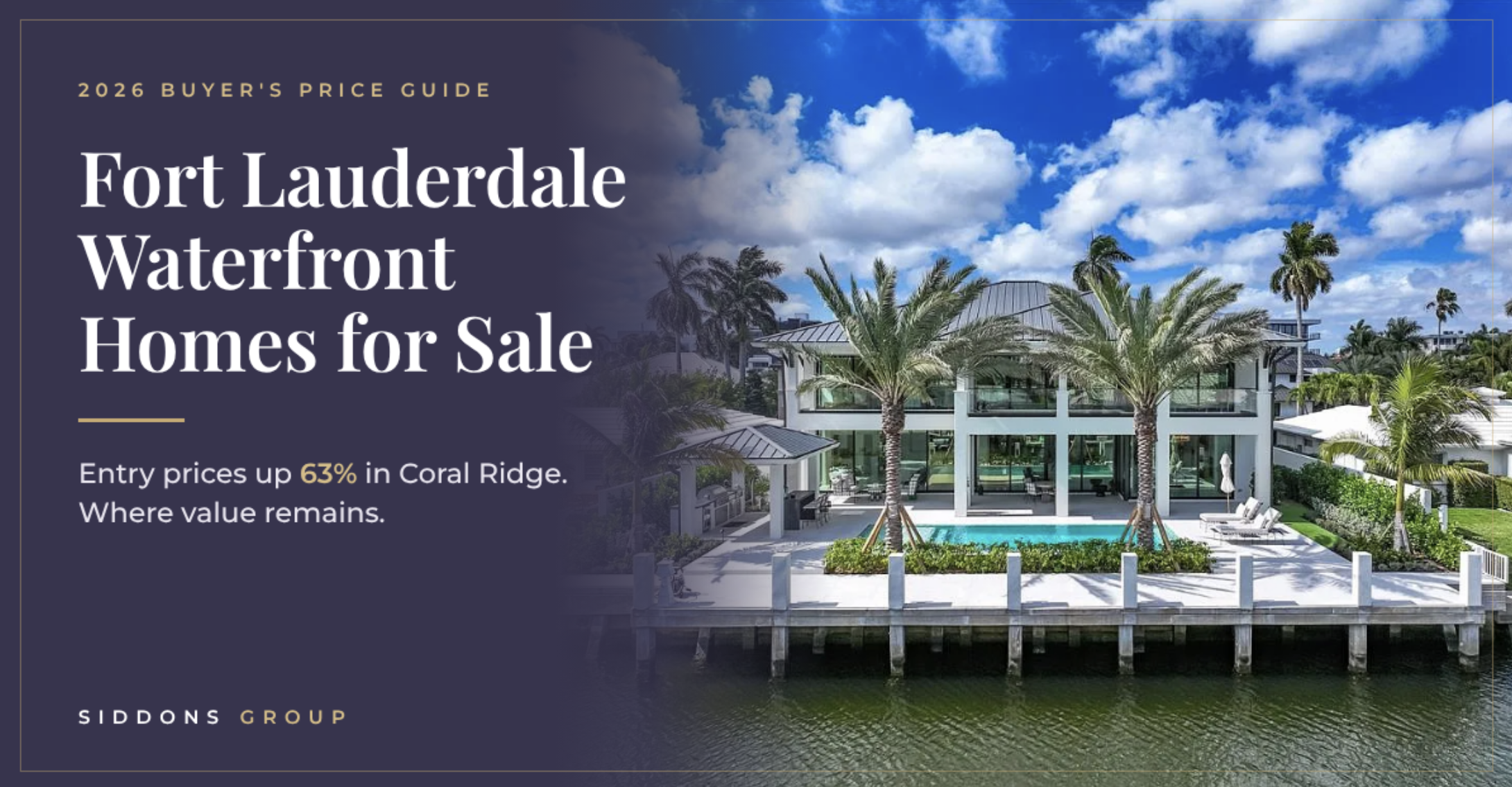
Fort Lauderdale Waterfront Homes in 2026

Greenview at Presidential Aventura

The Best Real Estate Agent in Ponce Davis

Pinecrest New Construction Is Appreciating 2x Faster Than Older Homes

Inside 1428 Brickell: Why Ytech Skipped the Hotel Brand to Build Brickell’s Best Finishes
Brickell’s Office Boom: What It Means for Luxury Housing in Coral Gables and Coconut Grove
Palmetto Bay Land Values Are Rising. Is Your Home Worth More as Land?

Killian Drive: Kendall’s Luxury New Construction Corridor Hits $1,000/SF

Pinecrest’s 4 Best Streets in 2026
The 5 Best Luxury Streets in Miami’s Gated Communities

The Real Estate Team Behind the Agent: Why Systems Matter More Than Star Power
Selling a Home in Pinecrest: Why Some Homes Sell for $1,500/SF and Others Sit

We Built the Largest YouTube Audience of Any Miami Real Estate Team.
Please fill in your details and David Siddons will contact you

Search related videos

The Best Luxury Condos in Miami in 2024 | The Best Resale Condo per Neighborhood BestCondos
Investing in Miami’s New Condo Construction Market Education
The Residences at Six Fisher Island | Independent Review BestCondos
Insights on Miami Real Estate Trends: A Discussion with Eli Beracha Professor of Real Estate Education
Fort Lauderdale Real Estate Forecast | Market Predictions for 2024 Education
2024 Miami Real Estate: Top 10 Predictions & Trends to Watch! Education
Leveling Up in Real Estate with Alvaro Nuñez Education
5 Reasons to Invest in Miami Pre Construction Condos NewCondosFTL
Miami Real Estate 2024 Forecast! #BetterDecisions CondoMarket
Correct Miami Real Estate Predictions For 3 Years Straight! With Ana Bozovic Education
Miami’s Luxury Condo Market: Fact From Fiction! With Craig Studnicky #BetterDecisions CondoMarket
Precise and Actionable Independent Condo Reviews! CondoMarket


- Get our Newsletter
- Subscribe
- No Thanks
Get the latest news from Miami Real Estate News
Close
Edit Search
Close
2 of 14
Share this property
Recomend this to a friend, just enter their email below.
Close
Your email was sent successfully
Close
 COMPARE WITH CONDOGEEKS