


















- Best of All
- Best Miami Luxury Condos
- Most popular
- Relocating to Miami
- Private Schools
- Investments
- Gated communities
- Waterfront information
- Luxury homes
- Luxury Condos
- New Construction Condos in South Florida
- Independent Pre-Construction condo reviews for Miami
- Independent Pre-Construction condo reviews for Fort Lauderdale
Advantages of Real Estate Investment Funds
In this “Better Decisions” podcast episode, I engaged in a conversation with Dylan Fonseca from Centro, a commercial real estate fund headquartered in Miami. As dedicated owners and operators, they specialize in the acquisition and management of real estate assets that generate cash flow, all within the framework of a carefully structured fund. With a commitment to long-term ownership, Centro concentrates its efforts on commercial shopping centers and multifamily properties. As a caveat thus fund and therefor this podcast is only good for accredited investors.
We delve into Centro’s approach, exploring their strategies for identifying lucrative investment opportunities and maximizing returns. Whether you’re a seasoned investor or new to the world of real estate, join us as we uncover valuable insights and investment advice that could shape your financial future. What surprised myself was the high yield some of these funds are returning. Even in todays market we are seeing annual returns between 7-9% with a further appreciation of the asset of 50% or more. When averaging this out it is bring about returns of as much as 20% year on year for the duration of a 7 year fund.
Differing from traditional real estate investment discussions, our podcast aims to keep you informed about fresh and valuable investment insights.
Real Estate Investment Funds | Unveiling the Enigma
Why is there a lack of awareness surrounding these real estate funds? The reason lies in their relative unfamiliarity. Unlike individual real estate purchases or investments, which are more common, real estate funds operate within a more complex domain. Accessing these funds typically requires a good amount of capital and know-how to understand how they work. Consequently, they remain largely inaccessible to the general public. Essentially, these funds function as collective ventures wherein individuals pool their resources to acquire assets such as shopping centers or multi-family buildings. Given the high price points associated with these assets, participation in such funds tends to be exclusive.
How Does a Commercial Real Estate Fund Work?
Centro specializes in mid-sized assets valued between $15-50 million. In this way, he occupies a special position where he doesn’t compete with big institutions investing billions of dollars, nor does he compete with individual investors. He’s squarely in a niche and seeks higher returns within that range. Usually, a fund lasts for about 7 years and can be split into three stages: a period for gathering investors and assets, a phase for managing investments, and a period for selling assets as the fund grows older.
If you invest $1 million in Centro’s real estate fund, you commit to this fund for a value of $1M. You sign the agreements and pay an initial deposit into the fund’s escrow account. Funds are drawn gradually as needed, with investors contributing according to their commitment. For example, if the fund buys an asset that is worth 10% of the total fund amount, then the asset manager will ask you for 10% of what you committed to. During deployment periods, the fund strategically acquires deals after assessing the market to pinpoint the best investment strategies, ensuring a balance between risk and return. Once acquisitions are complete, the operational phase begins, generating monthly returns for investors. The lifecycle of a fund is around 7 to 8 years, and during this period the investment matures. The commercial lease might be increased leading to higher returns on investment. At the end of the investment cycle, the harvesting period commences, which means the fund will be selling the assets as they have reached the end of the fund life.
With usual fund sizes hovering around $150 million and consisting of roughly 47 to 50 investors, Centro also manages funds with smaller groups of 15 to 25 investors. Generally, funds prefer investors who can commit at least $1 million.
Anticipated Returns of Centro’s Commercial Real Estate Investment Funds
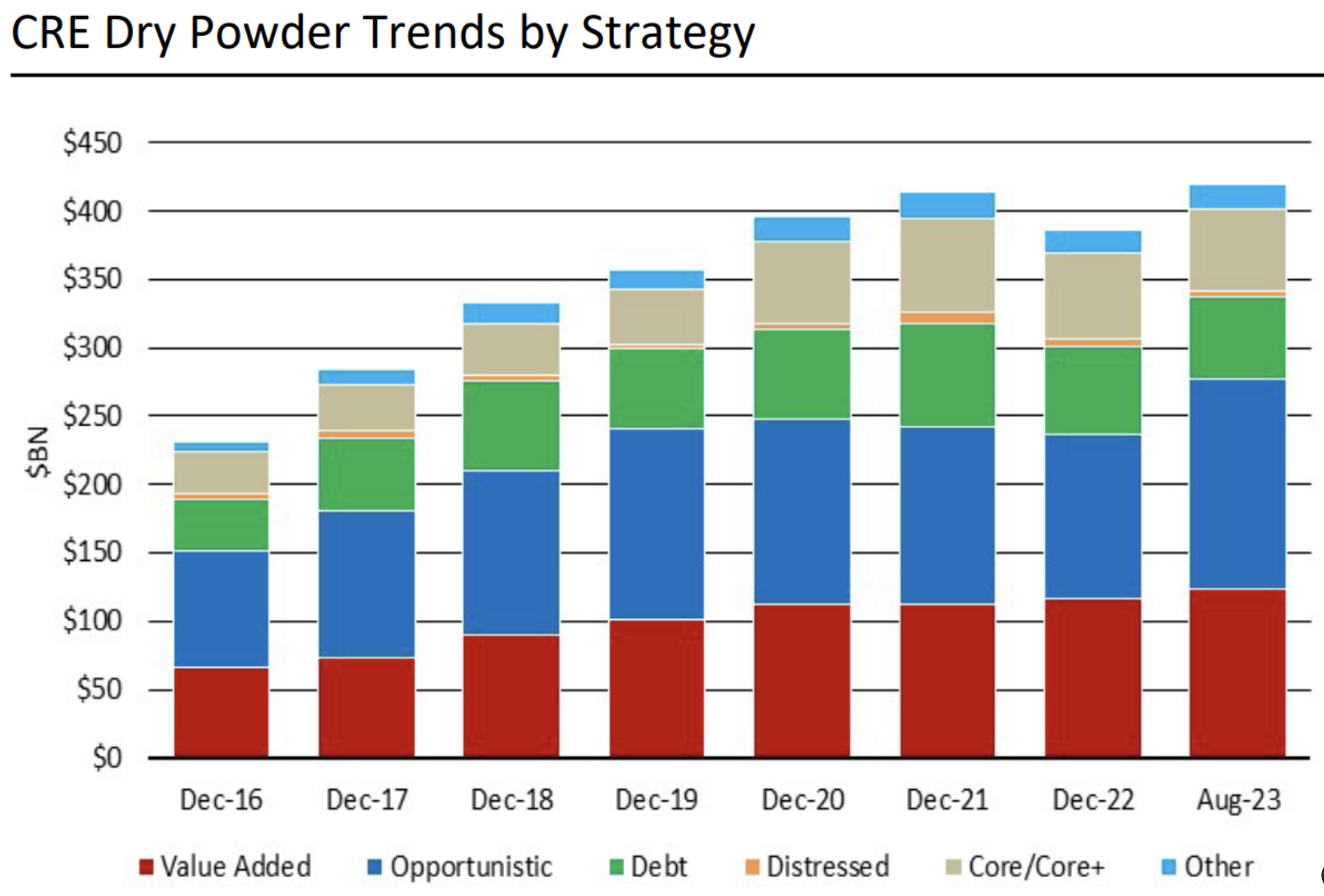
Dry Powder or Pent-up demand from investors waiting to get into Commercial Real Estate
How do you Define the Ownership in the Real Estate Fund?
When you invest in the fund, you’re essentially owning a portion of the company. There are two important documents you’ll sign: the Operating Agreement and the Subscription Agreement.
- The Operating Agreement outlines the rules of the company, including how decisions are made and how the company is managed.
- The Subscription Agreement details how your money is handled and specifies what you’re buying and what percentage of the company you own.
Determining Real Estate Investment Choices
So, who decides which assets the fund invests in? That responsibility falls on asset managers such as Dylan. But how do you, as a real estate investor, stay informed about these investments? Do you pitch ideas or simply receive explanations? Centro has specific investment criteria; for example, they might target shopping centers in the southeast anchored by national companies like Whole Foods. They look at high-traffic areas, with the right demographic and the right type of commercial tenants. There are many shopping centers or malls in South Florida, but not all are high performers. Centro specializes in finding cash cows. However, acquiring such assets requires expertise and entails risks. Sellers may not take you seriously unless you’re well-prepared and credible.
Centro occupies a unique position in the market—not too small, not too large—which allows them to access a lot of promising deals. With over 20 years of experience and a background in managing assets worth billions, Dylan and his team have established relationships with key players in the industry. They’re well-known among brokers and have earned respect within the industry, giving them an edge when it comes to making deals.
Leveraging Data for Informed Investment Decisions
Retail is currently experiencing a surge, with major players entering the market, making it an attractive prospect for landlords. We’re witnessing a shift where retail presents high returns with relatively low risk, making it an opportune time to invest in this sector. But how does Centro decipher this trend? Their approach is data-centric; they leverage vast datasets that others may not have access to, providing them with valuable insights. This advantage allows them to make informed decisions and uncover opportunities that others might overlook. For instance, Centro analyzes various data points such as cell phone data to understand (foot) traffic trends, comparing the performance of different retail outlets like Whole Foods. By examining what factors contribute to the success of certain locations, they can identify patterns and determine the ideal locations for new projects.
Ultimately, Centro’s goal is to secure tenants who have the potential to thrive and demonstrate to them how they can succeed. Their success is crucial to the funds, and their research-driven approach ensures that they make strategic decisions to benefit both parties.
What are the Risks Involved?
Speaking of risk, it’s relatively lower compared to other sectors. In the fund’s model, the fund owns the land and constructs the building. After it is leased, the tenants are responsible for maintaining the properties they occupy, known as net leases, Unlike in other asset classes where the owner bears these costs (gross leases). In addition, costs like insurance are also borne by the tenant. It is of course in the interest of Centro to keep these costs down to be more attractive to these potential tenants.
Commercial Real Estate Investment Funds in 2024 and Beyond
Retail has always relied heavily on location for survival. Shopping centers, being among the most strategically positioned assets, benefit from high accessibility and convenience. Centro focuses on acquiring retail spaces in prime locations along major highways and intersections, ensuring a constant flow of traffic and the right demographic profile. Whether it’s a grocery store, medical facility, or pet shop, businesses thrive due to their placement, making these investments highly resilient.
Furthermore, Centro considers prospects. For instance, if a mall occupies a prime spot, can we explore additional developments such as residential apartments? Or if it’s adjacent to a hospital, will that hospital need to expand somewhere in the future? Centro’s investments provide dual revenue streams—through land ownership and lease income—ensuring financial stability and potential growth over time.
Exploring Retail’s Current Dominance: What’s Driving its Success?
In South Florida, retail is outperforming other commercial sectors despite a history of overbuilding. While there’s currently an oversupply of properties, buyers are gravitating towards high-quality retail spaces, especially in prime locations where new construction is rare. This limited new supply prevents a significant softening in the market. In contrast to industrial and multifamily sectors, there’s less new supply in retail, giving landlords of quality malls a competitive edge.
The Effect of Rising Interest Rates
However, recent market dynamics have been influenced by rising interest rates, impacting transaction volumes. Buyers are cautious about financing projects with higher interest rates, affecting the perceived value of properties. At the same time, sellers did not want to lower the prices, This is the same paradigm we have seen in the residential market where we see a standoff between sellers and buyers. Yet, there’s a positive shift as sellers become more realistic in their expectations, leading to a healthier, more balanced market. Funds that are expiring this year will therefore see less appreciation than those experienced in the previous year. Although appreciation was lower, the income was compensated with the high yield achieved in recent years. Sellers becoming more realistic, together with several REITS selling off assets will lead to increased deal flow and a healthier market.

Why Sell a High-Yield Asset?
Why consider selling assets that generate 7-8% returns if you’re already earning good interest, and why isn’t everyone purchasing them? The typical approach is to acquire a property and hold onto it for several years. Market timing isn’t always perfect; you buy when it’s not yet matured but appreciating, and then sell when the time is right. Asset managers of large insinuation do not look at every individual asset. They focus more on achieving high returns in a certain period. Therefore when the lifecycle ends they sell the assets no matter how it performs. For many investors, a more tailor-made approach in which every asset is evaluated at the end of the proposed lifestyle would be beneficial. Centro’s business size allows them to engage with investors and tailor their decisions accordingly. Unlike massive asset managers tied to pension funds, Dylan’s funds have the flexibility to adapt to market conditions. Middle-ground investors like Dylan can make more personalized decisions, thanks to the manageable size of their investor base.
If some people want out and others don’t
If an investor decides to exit before the end date, we assist in finding someone willing to acquire their shares. There isn’t a set valuation, so departing investors leave with their original share of the investment whether it’s appreciated or depreciated. Typically, nine out of ten investors within the group will purchase the departing investor’s shares.
Making Informed Investment Decisions in the Real Estate Market
Often, individuals ask the wrong questions when navigating the real estate landscape. While there may be an abundance of condos on the market, finding large condos with 4 bedrooms and 3,000 SF+ can be challenging. It’s crucial to ask the right questions and scrutinize the unique aspects of each property. Not all retail spaces are created equal, and discerning investors like Dylan focus on selective properties with high-performance potential. While high yields may seem attractive, it’s essential to evaluate whether the extra percentage points justify the investment. Assessing the individuals behind the deal is equally critical. Do they possess the necessary skills and experience to execute the strategy effectively? Understanding the background, qualifications, and business plan of the team involved is paramount for success. In the dynamic Florida market, it’s easy to be swayed by trends or recommendations from friends. However, investing in easily replaceable assets may not yield long-term benefits. Consider the durability of the investment over time, especially when the initial allure fades. While perfection is elusive, thorough research and effective communication can mitigate risks. Unforeseen events like the COVID-19 pandemic underscore the importance of adaptability and clear communication from investment partners. Ultimately, strive for well-informed investment decisions guided by a comprehensive understanding of the market dynamics.
Conclusions
In the world of real estate investment, Centro stands out for its focused and strategic approach, offering investors unparalleled opportunities for growth and stability.
- Focused Investment Approach: Centro directs its efforts towards commercial shopping centers, recognizing them as lucrative assets with consistent returns.
- Long-Term Ownership Strategy: At Centro, commitment to long-term ownership is not just a strategy; it’s a promise of stability and sustained growth over time, ensuring investors reap the rewards of patient investment.
- Exclusive Investment Opportunities: Centro opens doors to exclusive investment opportunities typically inaccessible to individual investors, providing a gateway to a world of high-value assets.
- High-Performing Assets: Specializing in mid-sized assets valued between $15-50 million, Centro strategically targets high-profit areas, maximizing returns for its investors.
- Data-Driven Decision Making: Leveraging cutting-edge technology and extensive datasets, Centro employs a data-driven approach to identify and capitalize on lucrative investment opportunities, ensuring informed decisions at every step.
- Flexible Investment Structure: Centro offers investors the flexibility to tailor their investment decisions according to their preferences and market conditions, providing a personalized approach to wealth creation.
- Diverse Revenue Streams: Investments in prime retail locations under Centro’s guidance offer investors dual revenue streams through land ownership and lease income, guaranteeing financial stability and long-term growth potential.
- High Returns with Low Risk: Centro’s funds deliver impressive potential dividends of 7-8% annually, coupled with the possibility of further appreciation over time, making them a compelling choice for investors seeking attractive returns with minimized risk.
FAQ
These are the most commonly Miami Real Estate Related questions
What should relocation buyers know before buying real estate in Miami?
HOME BUYERS
Relocation buyers looking at homes in Miami should understand that choosing the right house is less about the property itself and more about location, schools, and long-term value. Many buyers make the mistake of focusing on price or finishes, while the real driver of value is the neighborhood and micro-location. Older homes often represent better value, but may also be part of a future redevelopment cycle. Newer homes command premiums, but don’t always sell faster if pricing is ahead of the market. Commute time, school access, and community dynamics are critical and often underestimated. The key is to evaluate homes not just as lifestyle purchases, but as long-term assets within a very localized market.
Sources:
https://luxlifemiamiblog.com/relocating-to-miami/
https://luxlifemiamiblog.com/relocating-to-miami-with-a-family/
CONDO BUYERS:
Relocation buyers should understand that Miami is a highly segmented, building-driven market, not a uniform one. Pricing can vary significantly between similar properties depending on building quality, layout, and financial health. Many buyers assume newer construction equals better investment, but that is often not the case. Factors like HOA fees, reserves, and rental policies can materially impact long-term value and liquidity. Negotiation opportunities often exist, especially in slower segments, but require precise market knowledge. The key is to evaluate micro-markets and individual buildings, not just neighborhoods or price per square foot.
Sources:
https://luxlifemiamiblog.com/miami-real-estate-market-report/
https://luxlifemiamiblog.com/new-construction-miami-guide/
What are the best areas for relocating families with children
For families relocating to Miami with young children, the most recommended neighborhoods are Coral Gables, Coconut Grove, and Pinecrest. Coral Gables offers the best balance of top schools, safety, and long-term value. Coconut Grove is ideal for younger families seeking walkability, greenery, and a lifestyle-driven environment. Pinecrest provides larger homes, excellent schools, and better value for space, making it ideal for growing families. The key driver across all three is access to strong schools and primary residential stability. Relocation decisions are less about new construction and more about long-term livability and resale strength.
Sources:
https://luxlifemiamiblog.com/best-neighborhoods-miami/
https://luxlifemiamiblog.com/what-are-the-best-family-neighborhoods-in-miami-in-2023/
Are new construction condos in Miami a good investment?
New construction condos in Miami can be a good investment—but only if you understand that not all buildings perform the same. According to the David Siddons Group, many buyers assume “new = better,” but in reality, performance depends on pricing, layout, building quality, and long-term demand. Some new developments set future price benchmarks and can drive long-term appreciation, especially in top-tier projects. However, many are priced aggressively at launch, and buyers relying on marketing instead of data often overpay.
The market is highly segmented, meaning two new buildings next to each other can perform very differently.
The best opportunities typically come from selecting the right building early or negotiating correctly in later phases.
In short: new construction is not automatically a good investment—it becomes one only with building-level analysis and disciplined entry pricing.
Sources:
https://luxlifemiamiblog.com/how-to-buy-a-luxury-condo-in-miami/
https://luxlifemiamiblog.com/category/independent-new-construction-condo-reviews/
https://luxlifemiamiblog.com/beyond-clickbait-real-insights-into-miamis-luxury-condo-market/
Why is buying a Miami condo riskier than buyers think?
Buying a Miami condo is often riskier than buyers expect because the true risks are at the building level—not visible in the listing price. Many buyers focus on finishes and views, while overlooking HOA reserves, insurance exposure, and potential special assessments. In reality, two identical units in different buildings can perform completely differently over time. Rising HOA fees and stricter regulations are also increasing the true cost of ownership, especially in older buildings. Liquidity can be affected by factors like financial health, rental policies, and ongoing repairs. The key risk is not the condo itself—but buying into the wrong building without proper due diligence.
Sources:
https://luxlifemiamiblog.com/how-to-buy-a-luxury-condo-in-miami/
https://luxlifemiamiblog.com/miami-condo-market-risks/
What are Miami's Safest Areas?
Which Miami Areas Still offer Great Value (Budget Friendly alternatives to Coral Gables and Pinecrest)
If you’re looking for better value than Coral Gables or Pinecrest, the answer (in true Siddons style) is not “go cheaper”—it’s go one layer outside the obvious markets.
The strongest value plays are:
- Schenley Park → closest substitute to Coral Gables at ~20% discount while maintaining similar character and location
- Biltmore Heights → almost identical feel to the Gables but ~25–30% cheaper on a $/SF basis
- Glenvar Heights → central location with larger lots and ~25% pricing advantage vs South Miami/Gables
- Baptist / Galloway (Kendall) → Pinecrest-style living (space, schools, land) at up to ~30% lower pricing
The pattern is consistent:
👉 Buyers are shifting west and slightly off-market to gain land, scale, and pricing efficiency. You don’t find value by going to a “cheaper neighborhood”—you find it by identifying adjacent micro-markets that offer the same lifestyle fundamentals without the brand premium.
Sources:
https://luxlifemiamiblog.com/best-value-neighborhoods-miami/
https://luxlifemiamiblog.com/category/miami-neighborhoods/
Is NOW a good time to buy in Miami?
Are Miami real estate prices going down in 2026?
No—but that’s the wrong way to look at it. Miami is not one market anymore, so prices are not moving in one direction. In 2026, the market is split into two: ultra-luxury, scarcity-driven areas (like waterfront and top-tier neighborhoods) are still holding or even rising, while mid-tier condos and oversupplied segments are flat or correcting. What we’re seeing is price divergence, not a crash—some properties are gaining value while others are quietly adjusting downward. Rising inventory and more selective buyers are putting pressure on pricing in certain segments, especially older condos or buildings with weaker fundamentals.
At the same time, global wealth and cash buyers continue to support pricing at the top end of the market. So the real answer: prices aren’t broadly dropping—they’re being repriced based on quality, location, and supply.
Should I buy a house or a condo when relocating to Miami?
The decision comes down to lifestyle first, investment second—and most relocation buyers get that backwards. If you want space, privacy, schools, and long-term family living, a single-family home in areas like Coral Gables or Coconut Grove is typically the stronger choice. If you prioritize walkability, low maintenance, and proximity to business districts, a condo in Brickell or waterfront markets makes more sense.
From an investment perspective, homes tend to be more stable, while condos are more building-dependent and cyclical. Most relocation clients underestimate how much building quality, HOA structure, and future costs impact condo performance. The right answer isn’t “house vs condo”—it’s which asset fits your lifestyle AND holds value within its micro-market.
How do I choose the right Miami neighborhood for my lifestyle?
Why are Miami condo prices so different between buildings?
Miami condo pricing varies widely because value is determined at the building level, not just by location. Two buildings next to each other can have major differences in financial health, reserves, HOA fees, and management quality. Buyers also pay premiums for better layouts, views, amenities, and newer construction—but not all “new” buildings perform equally. Factors like rental policies, upcoming assessments, and building reputation can significantly impact resale value. This is why price per square foot alone is misleading in Miami’s condo market. The real driver of value is how that specific building competes within its micro-market over time.
Sources:
https://luxlifemiamiblog.com/how-to-buy-a-luxury-condo-in-miami/
https://luxlifemiamiblog.com/category/independent-new-construction-condo-reviews/
WHY WORK WITH DAVID? THINGS YOU SHOULD KNOW...
For all our analytics we are agents driving some very unique and advanced tech. We Provide a granular and custom experience that empower our clients with the insight and tools to understand the most complex behaviors of any local markets.
-
Analytical
Over 100 reports produced to date
-
Knowledgeable
Over 1800 published articles and counting


Related Articles

Killian Drive: Kendall’s Luxury New Construction Corridor Hits $1,000/SF

Pinecrest’s 4 Best Streets in 2026

The 5 Best Luxury Streets in Miami’s Gated Communities

The Real Estate Team Behind the Agent: Why Systems Matter More Than Star Power

Selling a Home in Pinecrest: Why Some Homes Sell for $1,500/SF and Others Sit

We Built the Largest YouTube Audience of Any Miami Real Estate Team.

Empty Nesters in Miami: What Comes After the Big Family Home?

Palmetto Bay Has Almost No Inventory. So Why Are Homes Still Sitting?
The Decisions That Set Your Miami Condo’s Price, Years Before You Ever See It

Coconut Grove’s Best New Penthouse for Sale in 2026: The Well Penthouses Explained

Which Schools Serve Palmetto Bay? A Guide to Public School Boundaries

Beyond the Developer Finish

Ritz-Carlton Residences Pompano Beach Resale: The Opportunity After Closing

Kendall Real Estate vs. Coral Gables Real Estate: More Land, More House, Same Budget
Please fill in your details and David Siddons will contact you

Search related videos

Are St. Regis Sunny Isles Residences Worth the Brand Premium?
Coral Gables Market Report 2025: What the Headlines Aren’t Telling You!
How David Siddons’ Power Team Drives Miami’s Luxury Market
Mid‑Year 2025 Coconut Grove Report: The Truth About What’s Selling Now
Brickell Mid‑Year Market Report 2025 | Is Brickell’s Luxury Market in Trouble?
Pinecrest Mid-Year Market Report 2025 | What’s Selling, What’s Sitting & Why
Miami Beach Condo Market Mid-Year Report 2025 | What Buyers & Sellers Need to Know
How to Lose $1M in The Miami Condo market | Top Mistakes That Cost Miami Condo Buyers Millions
The Well Project EXPOSED Coconut Grove’s Hottest Units
Miami Real Estate in 2025 Is NOT What You Think 😱 | Midyear Must Knows for Buyers & Sellers!
7 Things You Should Never Say to a Real Estate Agent in Miami!
Landmark Victoria Park Residence in Fort Lauderdale: Inside 420 NE 11th Ave 🌴✨
Luxury Living on 2355 S. Miami Ave | Fully Furnished 4-Bed Home w/ Resort-Style Pool 🏊
Is Mandarin Oriental Residences Miami a Smart Condo Investment? Prices, Floorplans, Views & Finishes


- Get our Newsletter
- Subscribe
- No Thanks
Get the latest news from Miami Real Estate News
Close
Edit Search
Close
2 of 14
Share this property
Recomend this to a friend, just enter their email below.
Close
Your email was sent successfully
Close
 COMPARE WITH CONDOGEEKS