













- Best of All
- Best Miami Luxury Condos
- Most popular
- Relocating to Miami
- Private Schools
- Investments
- Gated communities
- Waterfront information
- Luxury homes
- Luxury Condos
- New Construction Condos in South Florida
- Independent Pre-Construction condo reviews for Miami
- Independent Pre-Construction condo reviews for Fort Lauderdale
Best New Construction Condos Miami 2026 | Ranked & Reviewed | David Siddons
Updated May 26, 2026.
If you are searching for the best new construction condos in Miami, you are already ahead of most buyers — but only if you know what to look for. Most Miami real estate agents will tell you what to buy. Very few will tell you what to avoid and why. That distinction is exactly what this guide is built on.
Summary to the Best and Worst Miami New Condo Constructions of 2026
Most Miami real estate agents will tell you what to buy. Very few will tell you what to avoid and why. That distinction is exactly what this guide is built on. I have sold nearly $1 billion in Miami new construction across Brickell, Miami Beach, Coconut Grove, Bal Harbour, Sunny Isles, Coral Gables, and Fort Lauderdale. Walked more than 60 projects, reviewed contracts line by line, and tracked what each building actually delivered versus what was promised at the sales gallery.
That experience produced a seven-category scoring framework. Every project in Miami’s current pipeline has been run through it. The results are blunt: only 20% of Miami new construction condos score as a Strong buy. 30% are Selective. 50% should be avoided entirely. This is not what you will hear from a developer’s sales gallery. It is the independent analysis serious buyers need before committing to a pre-construction contract. Read this guide first. Then call me before you sign anything. 305.508.0899 | [email protected]
Here is my independent assessment of each of the top 10, including what I think it is best suited for, current pricing, and the best resale alternative if the project is sold out:
Four Seasons Residences Coconut Grove – 9.54
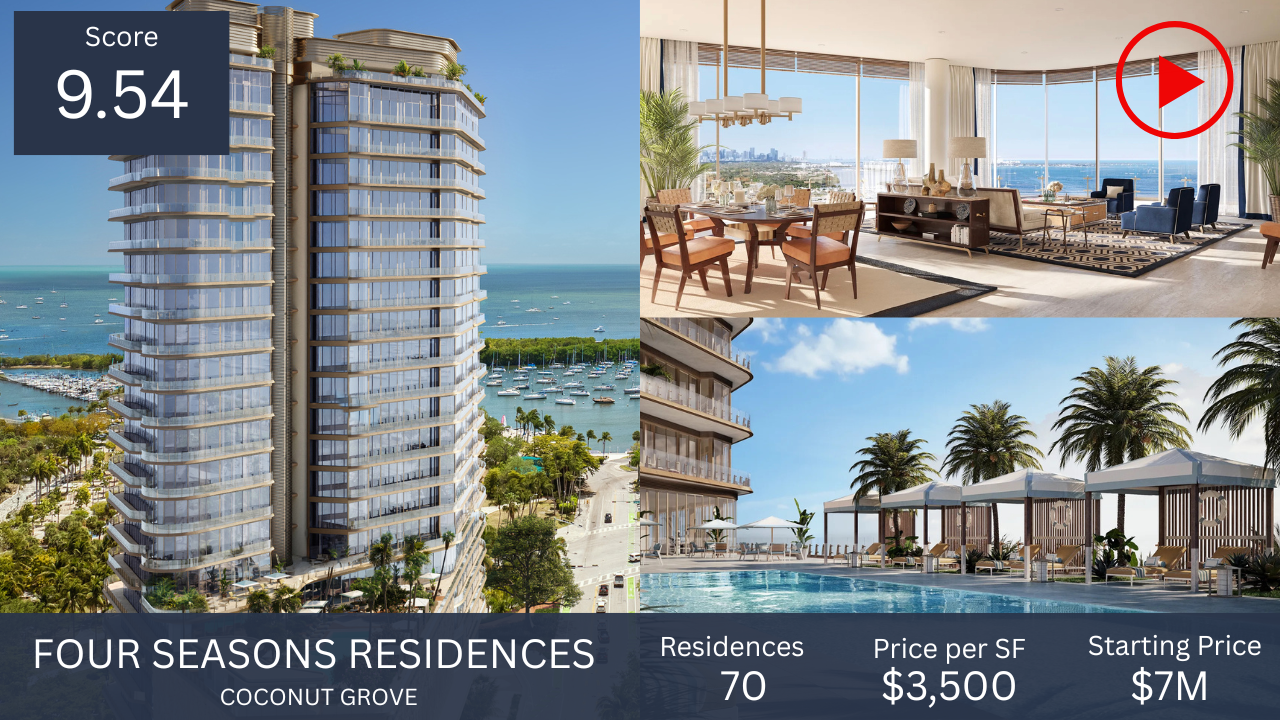
The Four Seasons Coconut Grove has the strongest track record in Miami. The existing Four Seasons properties in Brickell (2006) and Surfside (2017) both command the highest price per square foot in their respective neighborhoods and hold the highest appreciation. It is the unwavering service of the brand that makes it great. What makes this one the best is that it sits in the strongest condo-appreciating neighborhood in Miami and simply cannot be replicated. Built for end use, large units, water views, exclusivity, and walkability make this hard to beat. I believe this building best serves empty nesters looking for a village in the city who want water access and love boating. 75% sold. Expect to pay $3,400 per square foot or more. Best resale alternative: Park Grove.
Connect with me to learn more about the Floor plans, latest inventory and Prices
The Residences at Mandarin Oriental Brickell Key – 9.47
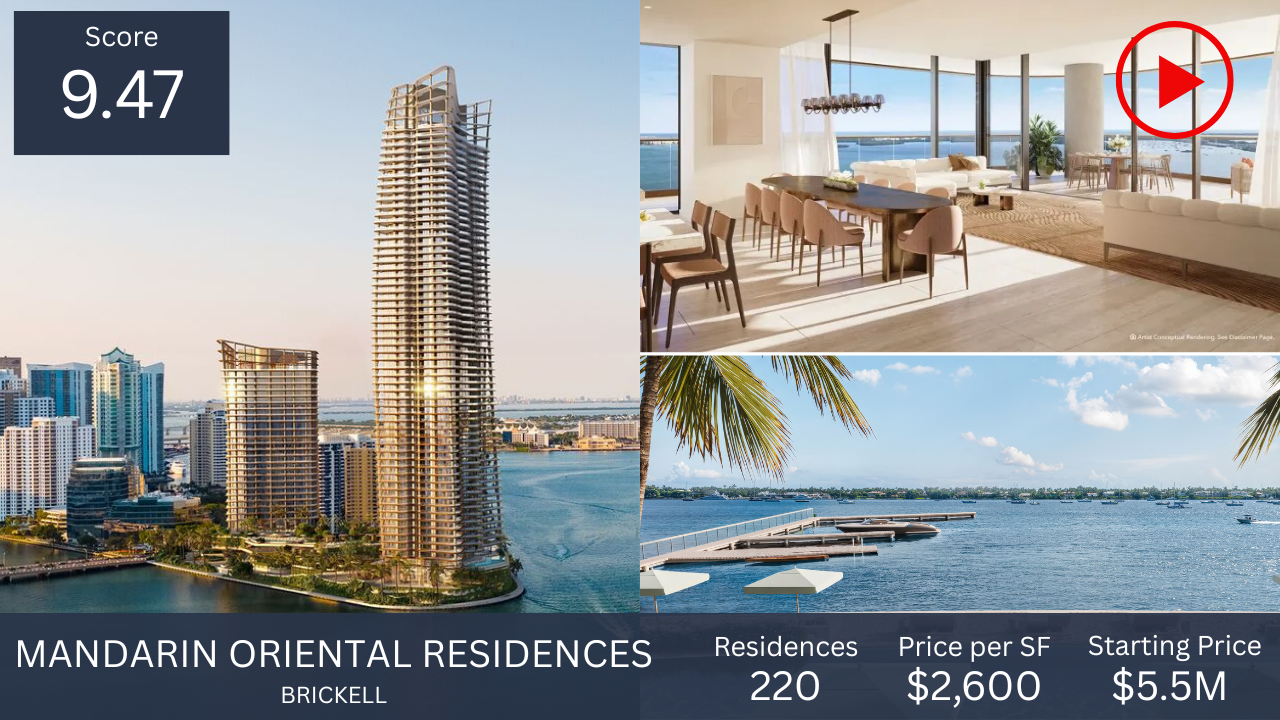
The Residences at Mandarin Oriental Brickell Key is another legitimate hospitality brand. Large units, an irreplaceable location, and a massive five-acre lot size. As of June 2026, the developer has just released the second tower high-floor residences, which start at $4.5M. I was impressed by the finishes, the floor plans, and the unobstructed view corridors. I also believe this is the condo that will best serve the new demographic of professional empty nesters making a move to Miami looking for a luxury urban resort experience. 75% sold. Expect to pay $2,600 per square foot or more. Best resale alternative: Four Seasons Brickell.
Connect with me to learn more about the Floor plans, latest inventory and Prices
Not sure which Miami new construction condo is right for you?
David Siddons has sold $1B+ in Miami new construction. Get his unfiltered take before you sign anything.
Schedule a Free CallThe Well Coconut Grove – 9.38
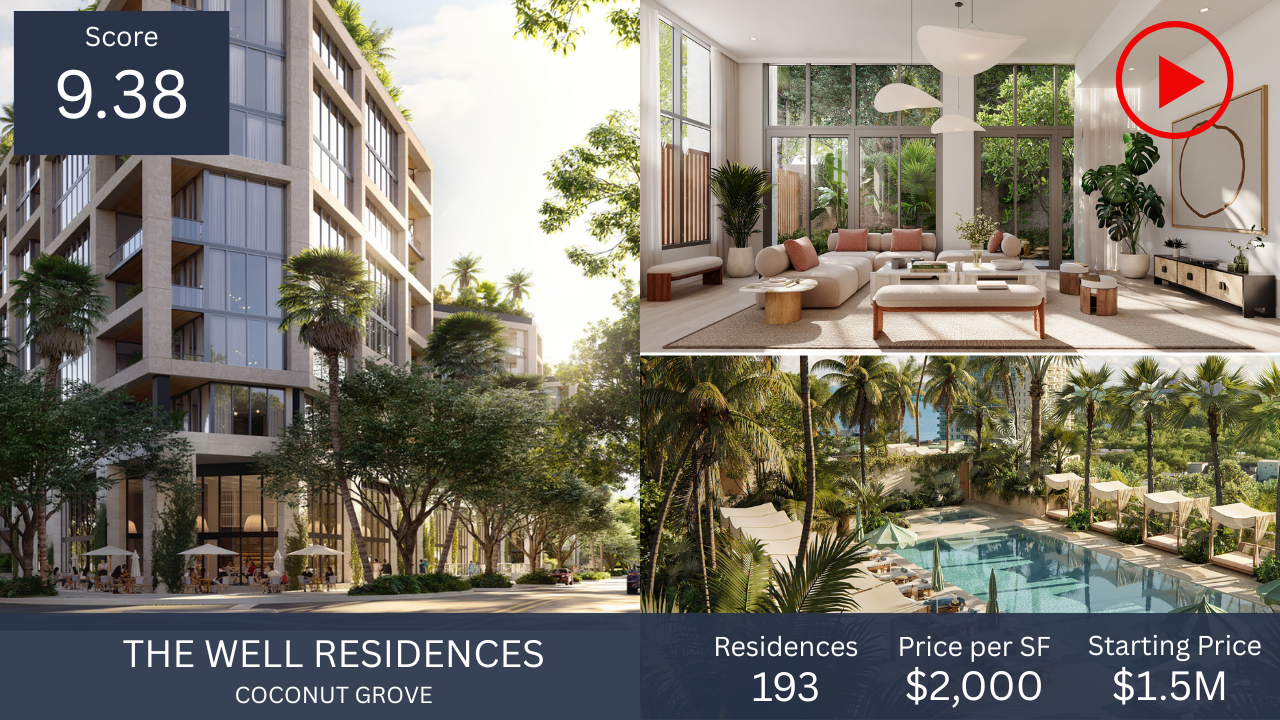
The Well Coconut Grove is a Terra project located in the heart of Coconut Grove. Perfect for those who put health and wellness first, and for those who want the tranquility of a village setting with access to everything Miami has to offer. It also suits buyers with a more restricted budget compared to Four Seasons, with options available sub-$6M. Newly released penthouses offer 20-foot ceilings, making them a genuine rarity in this market. 60% sold. Expect to pay from $2,000 per square foot. Best resale alternative: Mr. C Residences.
Connect with me to learn more about the Floor plans, latest inventory and Prices
The Perigon Miami Beach – 9.31
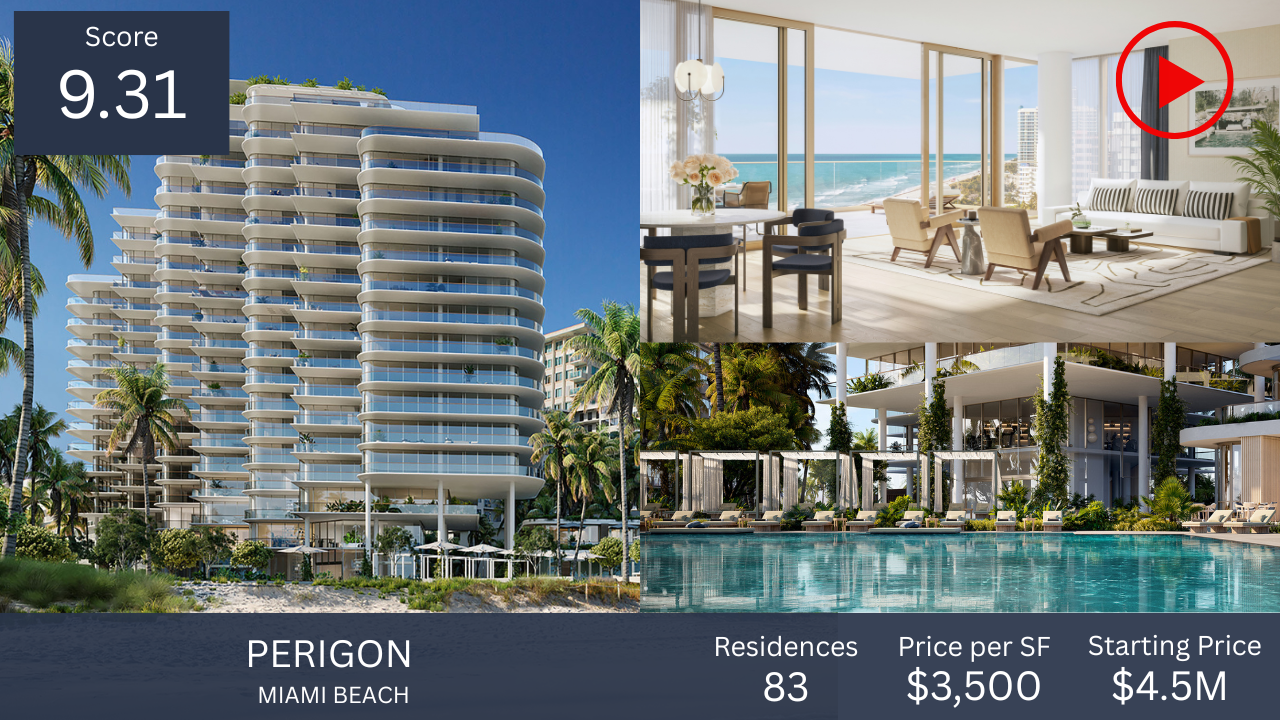
The Perigon Miami Beach is another Terra project. Boutique, ultra-luxury, and away from the South Beach crowd. Some really large units of nearly 5,000 square feet on the 01 line with exceptional views. Admittedly 90% sold, with a high entry-level price of $4,600 per square foot. With most of the building sold you may have to wait for resales on this project, or alternatively look at Ocean Terrace. Best resale alternative: 87 Park.
Connect with me to learn more about the Floor plans, latest inventory and Prices
St Regis Brickell – 9.22
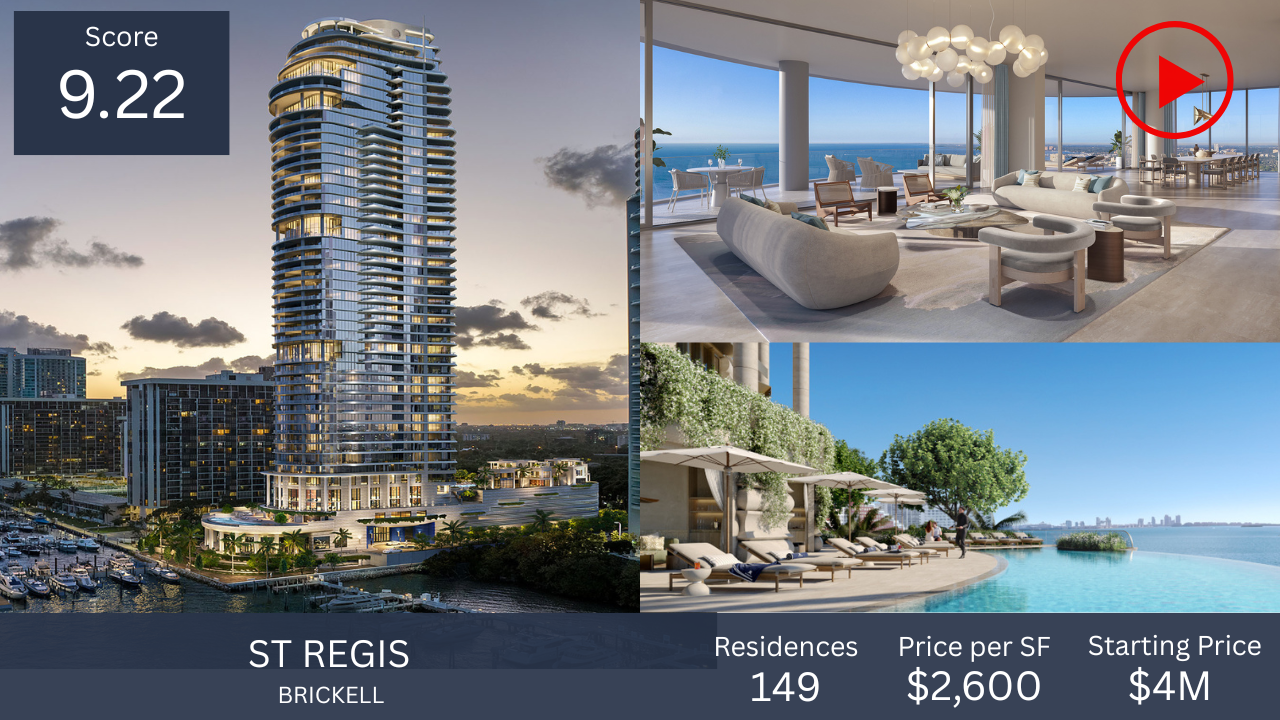
For some buyers St Regis Brickell ranks ahead of Mandarin Oriental. Located on the quieter south side of Brickell, expect less traffic. Price per square foot is much the same as Mandarin but in my opinion the view corridors are not as unobstructed and the finishes do not quite compare. Strong brand name. Like Mandarin, this condo best serves the new demographic of professional empty nesters making a move to Miami looking for a luxury urban resort experience. 60% sold. Expect to pay $2,600 per square foot. New competition is now coming from Nobu, located on the north side of Brickell. Best resale alternative: Four Seasons Brickell.
Connect with me to learn more about the Floor plans, latest inventory and Prices
Six Fisher Island – 9.07
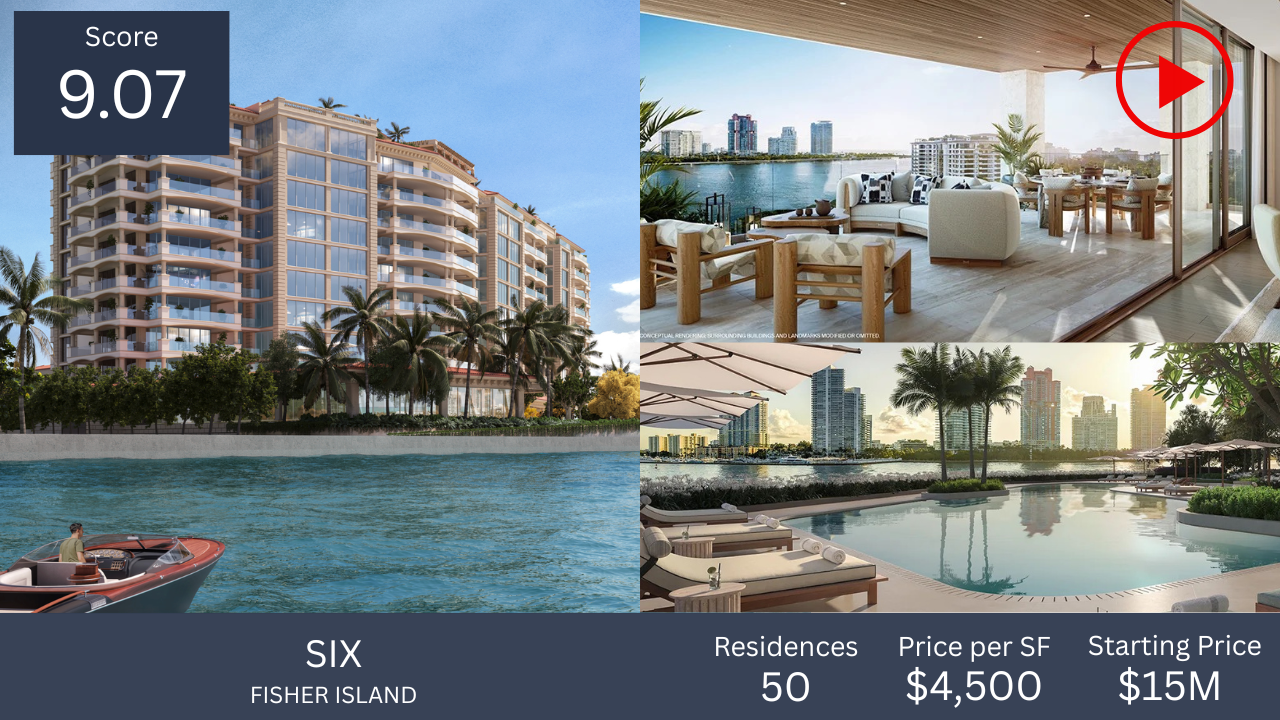
For those who want privacy above everything else. Six Fisher Island is is an ultra-luxury project with stunning views and a fully self-contained resort experience: tennis, golf, beach club, gym, marina, and shops, all within a gated island environment. The only friction point for some buyers is the seven-minute ferry to Miami Beach. If you value privacy and security above all else in an ultra-luxury condo setting, nothing in Miami compares. This project is 70% sold. Expect to pay $4500 per sqft or more. Best resale alternative: Palazzo Del Sol or Palazzo Della Luna
Connect with me to learn more about the Floor plans, latest inventory and Prices
Rivage Bal Harbour – 9.15

Rivage Bal Harbour is the only new luxury condo in Bal Harbour. Boutique, large floor plans, and ultra-luxury finishes. An enclave of luxury for beach buyers with the added benefit of access to the Bal Harbour Shops. This condo best serves those looking for a private beach experience with proximity to South Beach without being in it. 90% sold. Expect to pay $4,200 per square foot. No new competition has been announced in this market. Best resale alternatives: Arte, Fendi Chateau, Four Seasons Surfside.
Connect with me to learn more about the Floor plans, latest inventory and Prices
Ocean Terrace Miami Beach – 8.99
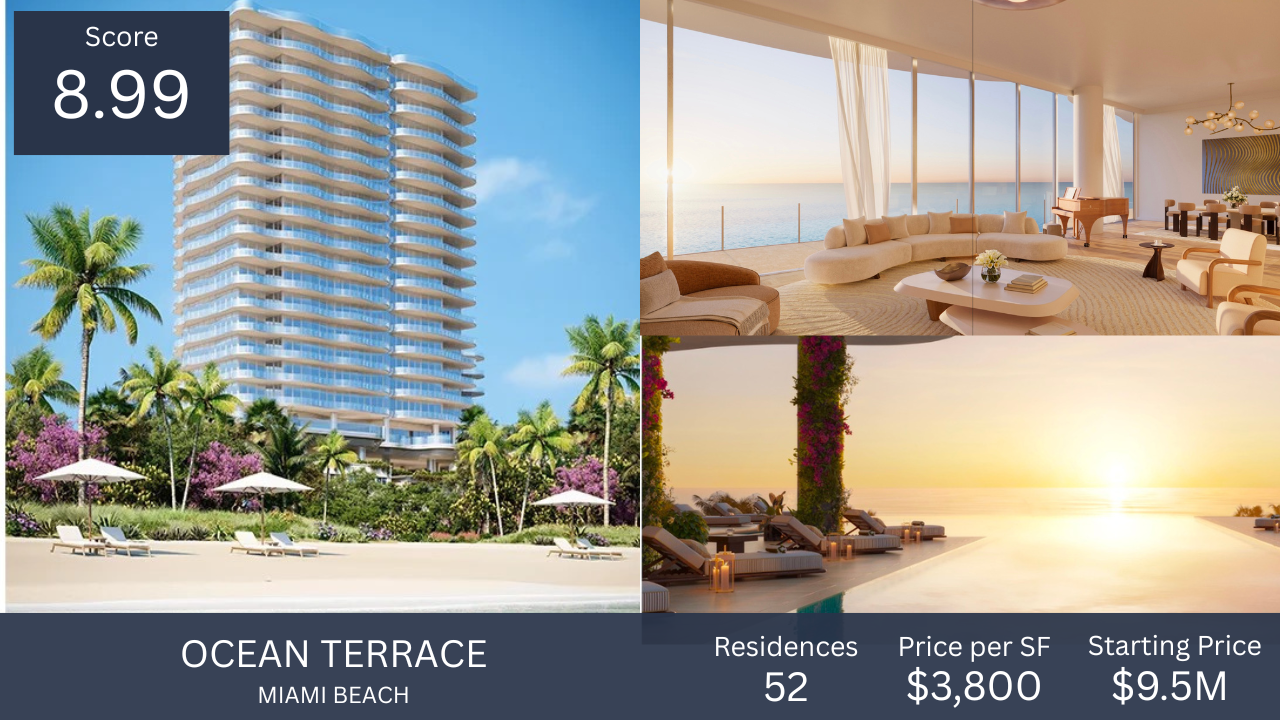
Built on a prime location on North Beach, with an entire city block of shops and a hotel element being redeveloped by the Witcoff Group. Boutique, oceanfront, and genuinely scarce product with real infrastructure surrounding it. Ocean Terrace Miami Beach best serves those who want a contained resort but village beach experience away from South Beach. It is also something of a strategic future play from an investment perspective, as the North Beach transformation is still in early stages. Expect to pay $3,800 per square foot. Best resale alternatives: Arte, Fendi Chateau.
Connect with me to learn more about the Floor plans, latest inventory and Prices
Ponce Park Residences Coral Gables – 8.93
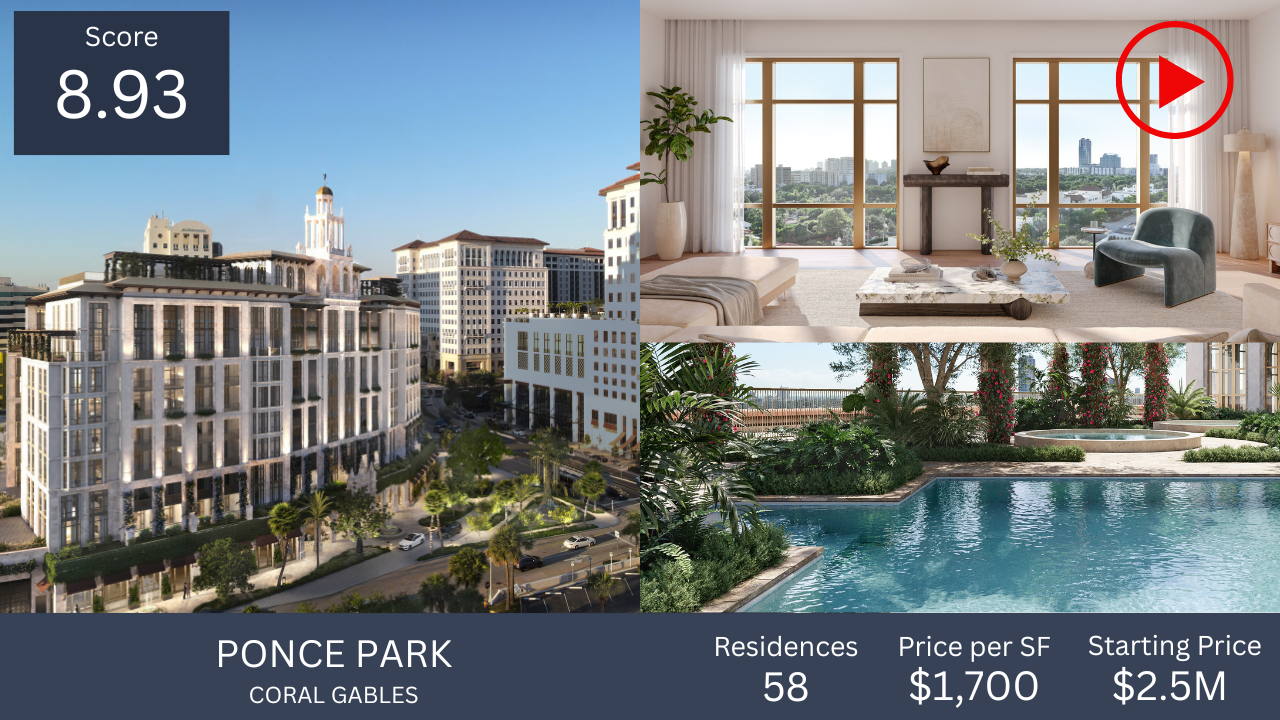
Ponce Park Residences in Coral Gables offers the most accessible price point in our top 10 list. Located in Coral Gables, this is not for those who want waterfront. It is for those who want access to shops, restaurants, golf courses, and the established Coral Gables lifestyle. A solid number of local empty nester buyers will find this highly appealing. The Gables is traditionally known for single-family living, and that is what surrounds this building. Large units, solid finish level, and genuine convenience are the main draws here. Around 50% sold. Expect to pay around $1,700 per square foot. Best resale alternatives: Biltmore Park, The Village, Althea Row.
Connect with me to learn more about the Floor plans, latest inventory and Prices
St Regis Sunny Isles – 8.87
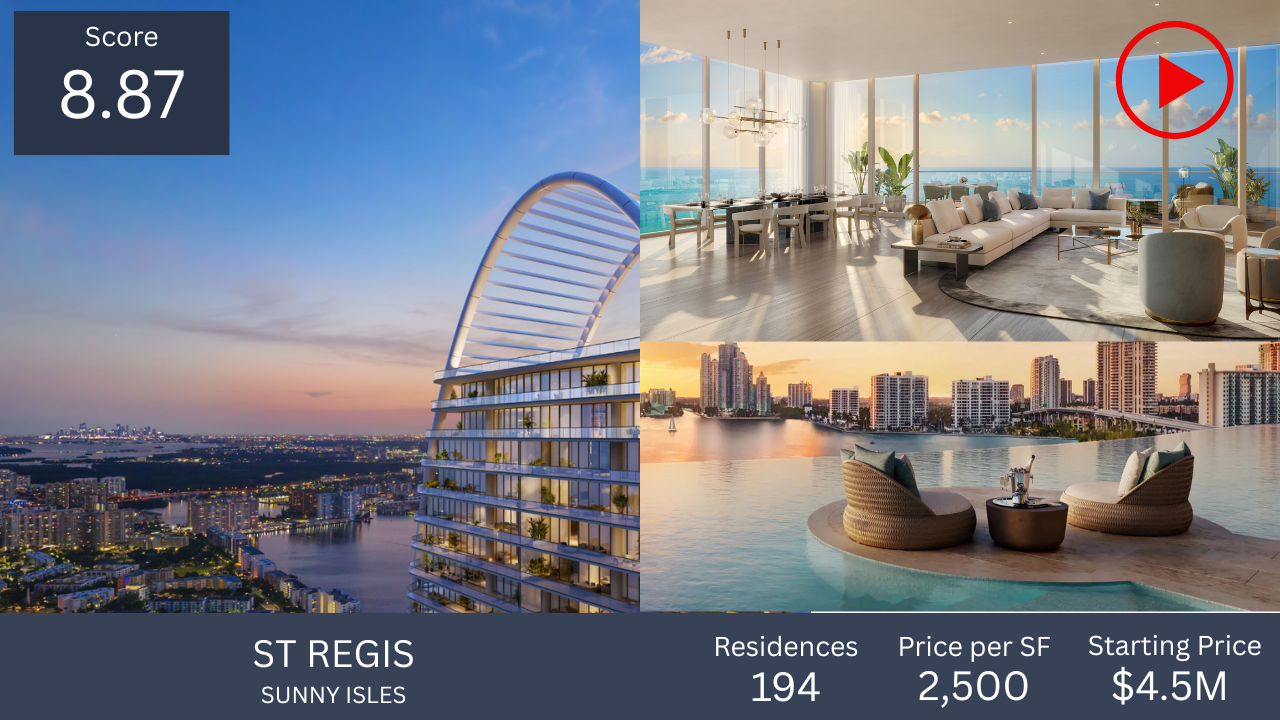
Historically a weak beach market with questionable competition, but St Regis Sunny Isles delivers. A strong hotel brand with two top-level restaurants and resort amenities built in. Very strong sales trajectory. Four-bedroom units of 4,000 square feet at $10M represent excellent value compared to other resort-level new developments on the sand. This is arguably the most affordable beach play in Miami’s current new construction pipeline. Who buys this is typically going to be foreign national families looking for a beach getaway in Miami and will often be seasonal visitors looking for sand, sun and the full service experience without paying SOFI or SOBE prices. Expect to pay $2,500 per square foot or more. Best resale alternative: Acqualina Estates.
Connect with me to learn more about the Floor plans, latest inventory and Prices
DSG Scoring Framework · 2026
Lowest Scoring Condos in Miami
Not every new construction condo in Miami deserves the price it is asking. Out of over 60 projects reviewed against our seven-category framework, these eight score lowest. The reasons vary — car and fashion brand licensing with no operational substance, short-term rental models that historically suppress end-user appreciation, extreme investor concentration, and projects delivering into severely oversupplied submarkets. Understanding why a building scores low is as valuable as knowing what to buy. In every case below we name a stronger alternative at a comparable price point.
#
Building
Score
01
Frida Kahlo Residences Wynwood
4.1
02
Mercedes-Benz Places
4.2
03
Dolce & Gabbana Residences
4.6
04
E11even Residences
4.8
05
Bentley Residences Sunny Isles
4.9
06
The Standard Residences
5.2
07
Lofty Brickell
5.4
08
Aria Reserve
5.6
Not every new construction condo in Miami deserves the price it is asking. Out of over 60 projects reviewed against our seven-category framework, these eight score lowest. The reasons vary — car and fashion brand licensing with no operational substance, short-term rental models that historically suppress end-user appreciation, extreme investor concentration, and projects delivering into severely oversupplied submarkets. Understanding why a building scores low is as valuable as knowing what to buy. In every case below we name a stronger alternative at a comparable price point.
Run your shortlist through the DSG framework.
Schedule a free consultation with David and get an independent score on any building you are considering.
Schedule a Free CallHow We Score Every New Construction Condo in Miami
We measure every project across seven categories. Together they determine whether a building lands in our Strong, Selective, or Caution tier. Here is what we look at and why each one matters.
1. Developer Track Record Has the developer built comparable projects before and delivered on time? A first-time luxury developer carries fundamentally different risk than one with three completed towers. Equally important is the brand relationship. At Four Seasons and Mandarin Oriental, the brand is deeply embedded in the product. At several car-branded condos, it was a licensing agreement and nothing more. The results speak for themselves. Watch our podcast on the truth about luxury branding.
2. Supply Pipeline at Delivery You are not buying into today’s market. You are buying into 2028 or 2029 when the building delivers. South Florida currently has 9,026 units in the pipeline. Brickell alone accounts for 4,254 of those, nearly 47% concentrated in one submarket. When multiple investor-heavy towers deliver simultaneously, sellers and landlords all try to exit at once. That compresses prices exactly when you need them to hold.
3. Building Fundamentals Unit density, end-user to investor ratios, parking, HOA fees, and amenity load. A 600-unit Brickell tower is not a 60-unit Coconut Grove building, even if both are marketed as luxury. Investor-dominated pre-sales above 60% produce concentrated resale pressure at completion. Parking below 1:1 is a structural resale disadvantage no brand overcomes.
4. Unit-Level Analysis Two units in the same building can have materially different outcomes. We look at price versus resale ceiling, floor plan efficiency, view durability, and unit mix. If a comparable tower can legally be built between you and your view before you close, the premium you paid may not survive resale.
5. Neighborhood Trajectory Where is the neighborhood going by the time you take title, not where it is today. Coconut Grove in 2019 and Coconut Grove in 2026 are different investment propositions at the same address. Flood zone exposure now drives insurance cost trajectories that directly affect carrying costs, rental yields, and resale liquidity. Read our latest neighborhood market reports.
6. Contract and Legal Structure What the sales team says and what the contract says are frequently different. We review deposit structure, assignment rights, material change provisions, completion date protections, and rental restrictions across every building we evaluate. Buyers have purchased on Airbnb assumptions in buildings where the documents prohibit rentals under six months. That cannot be corrected after closing. Watch our contract analysis breakdown.
7. Resale Exit Analysis Every variable above exists because of what it means here. Round-trip transaction costs run 8 to 10%. On a $2M purchase that is $160K to $200K before you generate a dollar of net return. We model the realistic exit for every building we evaluate: who buys it, at what price, whether rental income covers carrying costs at delivery, and whether the appreciation assumption is supported by actual comparable transactions.
Matching Your Budget to the Right Building
The word “best” is meaningless in luxury real estate until two inputs are fixed: your budget and your intended lifestyle. A four-bedroom at Four Seasons Coconut Grove may be the strongest buy in Miami, but not if your budget is $5M. The Perigon is exceptional ultra-luxury beachfront, but not if you need walkability and schools at the door.
Use our matching tool below to filter the entire Miami new construction pipeline against both inputs simultaneously. The shortlist you see will only show buildings that fit your budget and your lifestyle. Not a generic ranking of the market.
Browse ALL Miami New Construction Condos
Conclusion: What This Market Rewards and What It Punishes
The South Florida new construction market in 2026 is not uniformly good or uniformly bad. It is a market of sharp contrasts, and the difference between a strong outcome and a costly mistake comes down to one question most buyers never ask: not “is this a good building?” but “who will be buying this from me, at what price, and will that buyer still exist?” The highest risk in today’s market clusters around three conditions: density without genuine demand depth, brand recognition without underlying real estate substance, and submarket oversupply that will compress pricing and elongate absorption cycles at the exact moment you need to exit. These risks are not always visible in a sales presentation. They are visible in the data, in the pipeline, and in the contract, if you know where to look.
For relocation buyers, two assumptions are worth challenging immediately. Newer does not automatically mean safer. Luxury does not automatically mean a strong investment. The most desirable projects in this market are frequently the least promoted, and pricing between buildings that appear comparable on the surface can diverge dramatically once floor plan efficiency, supply pipeline, and exit analysis are properly applied. The buyers who underperform in this market rarely chose the wrong building. They simply never understood how that building would perform at completion because nobody walked them through the analysis before they signed.
Your Call To Action
The DSG Scoring Framework is built from personally reviewing more than 60 new construction condos across South Florida, tracking what those buildings actually deliver at completion, and reading contracts closely enough to know where the risk is buried and where the buyer is exposed. If you are evaluating a new development, already under contract and second-guessing your decision, or trying to understand where to focus given your budget and timeline, the conversation starts with one call. David will tell you directly which buildings pass the framework, which units within a building outperform the rest, what your contract actually says versus what you were told, and what your realistic exit looks like before you are locked into one.
Call 305.508.0899 or schedule a conversation below. No obligation. Just the analysis.
Related Miami New Construction Guides
- All Miami New Construction Condos
- Independent Condo Review (60+ in total)
- Miami Branded Condo Mirage
- Our new site dedicated to new construction in Miami
- The Best and Worst Resale Condos in Miami
- How to Buy a Luxury Condo in Miami (2026 Playbook for Smart Buyers)
- Who Is the Best Real Estate Agent in Miami for New Construction Condos? (2026 Data-Driven Guide)
- Miami New Construction Condos: Contracts, Risks & What Buyers Must Know Before Signing
- The Ugly Truth of the Miami New Construction Market
- Our Miami Market Reports
FAQ
These are the most commonly Miami Real Estate Related questions
Are pre-construction condos a good investment?
Pre-construction condos in Miami can be a strong investment—but only in the right projects.
👉 Buildings with limited supply, strong end-user demand, and prime locations tend to hold value and appreciate over time.
👉 High-density, investor-heavy towers often face resale competition at completion, which can limit short-term gains.
Bottom line: Pre-construction works best when you’re selective—not when you buy into the broader trend.
Pick up the phone and call pre-construction condo market expert David Siddons. He is unfiltered and will not shy away from telling you the bad and the ugly
Should I buy now or wait?
It depends on your timeline and risk tolerance.
👉 Buying now secures today’s pricing and inventory, especially in projects with limited remaining units
👉 Waiting may offer more choice—but also exposes you to price increases and less favorable unit selection
Reality: The best opportunities are usually project-specific, not market-timed.
Which areas are oversupplied?
Oversupply in Miami is not citywide—it’s highly localized.
👉 Parts of Brickell and Edgewater have a large pipeline of high-rise units delivering around the same time
👉 This can create short-term resale pressure, especially in buildings with similar positioning
👉 In contrast, areas like Miami Beach, Surfside, and Bay Harbor Islands tend to have more supply constraints and zoning limitations
Key insight: Oversupply is about how many similar units compete at delivery, not just total construction volume.
What determines long-term value?
Long-term value in Miami condos is driven by a few consistent factors:
👉 Scarcity — limited supply, waterfront positioning, or unique product
👉 End-user demand — buildings people want to live in, not just invest in
👉 Building quality and reputation — developer, design, and long-term maintenance
👉 Location durability — proximity to lifestyle drivers (beach, walkability, views)
Bottom line: The best-performing condos are those that remain desirable beyond the initial sales cycle—not just at launch.
What are the best new construction condos in Miami in 2026?
The best condos are those with low density, strong end-user demand, and limited competing supply, particularly in areas like Coconut Grove, Surfside, and Fisher Island.
WHY WORK WITH DAVID? THINGS YOU SHOULD KNOW...
For all our analytics we are agents driving some very unique and advanced tech. We Provide a granular and custom experience that empower our clients with the insight and tools to understand the most complex behaviors of any local markets.
-
Analytical
Over 100 reports produced to date
-
Knowledgeable
Over 1800 published articles and counting


Related Articles
The Best Real Estate Agent in Ponce Davis
Pinecrest New Construction Is Appreciating 2x Faster Than Older Homes
Inside 1428 Brickell: Why Ytech Skipped the Hotel Brand to Build Brickell’s Best Finishes
Inside Ocean House Surfside
Brickell’s Office Boom: What It Means for Luxury Housing in Coral Gables and Coconut Grove
Palmetto Bay Land Values Are Rising. Is Your Home Worth More as Land?
Killian Drive: Kendall’s Luxury New Construction Corridor Hits $1,000/SF
Pinecrest’s 4 Best Streets in 2026
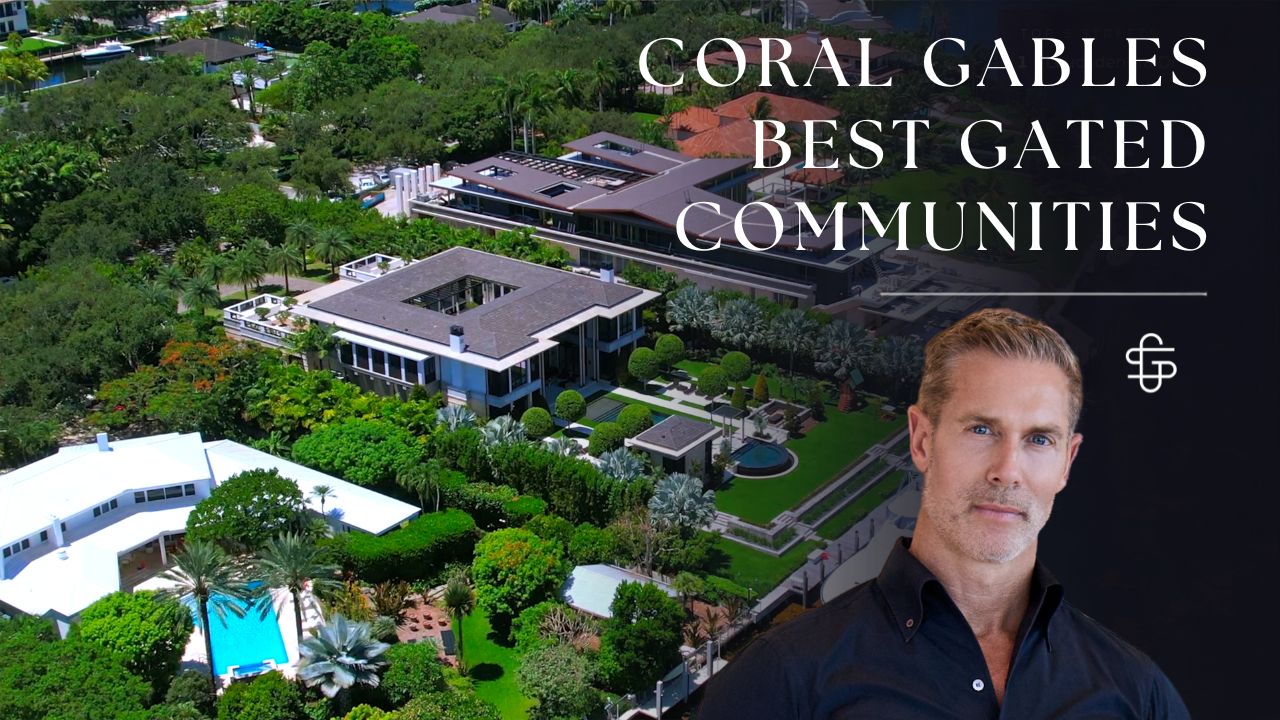
The 5 Best Luxury Streets in Miami’s Gated Communities
The Real Estate Team Behind the Agent: Why Systems Matter More Than Star Power
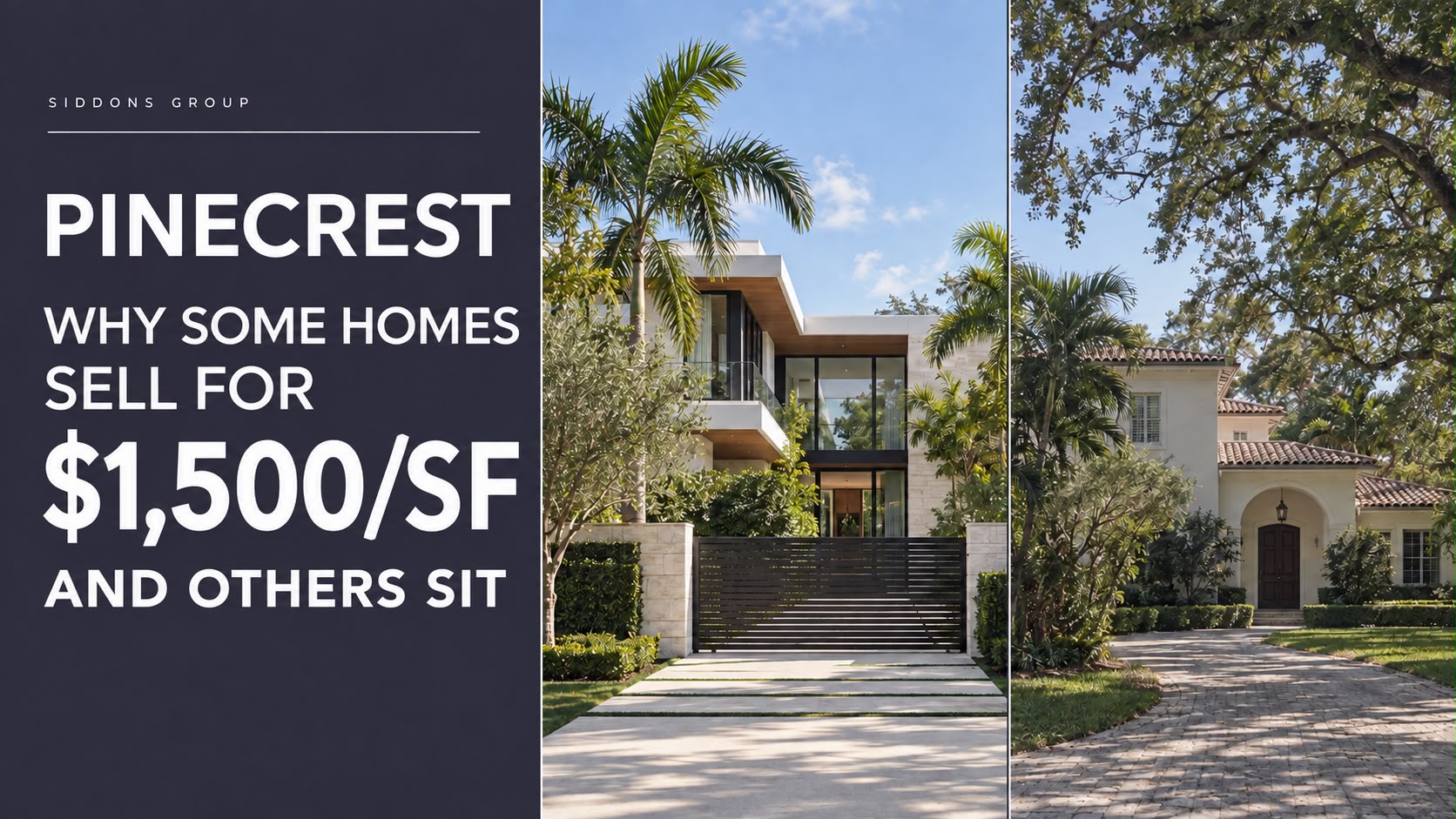
Selling a Home in Pinecrest: Why Some Homes Sell for $1,500/SF and Others Sit

We Built the Largest YouTube Audience of Any Miami Real Estate Team.
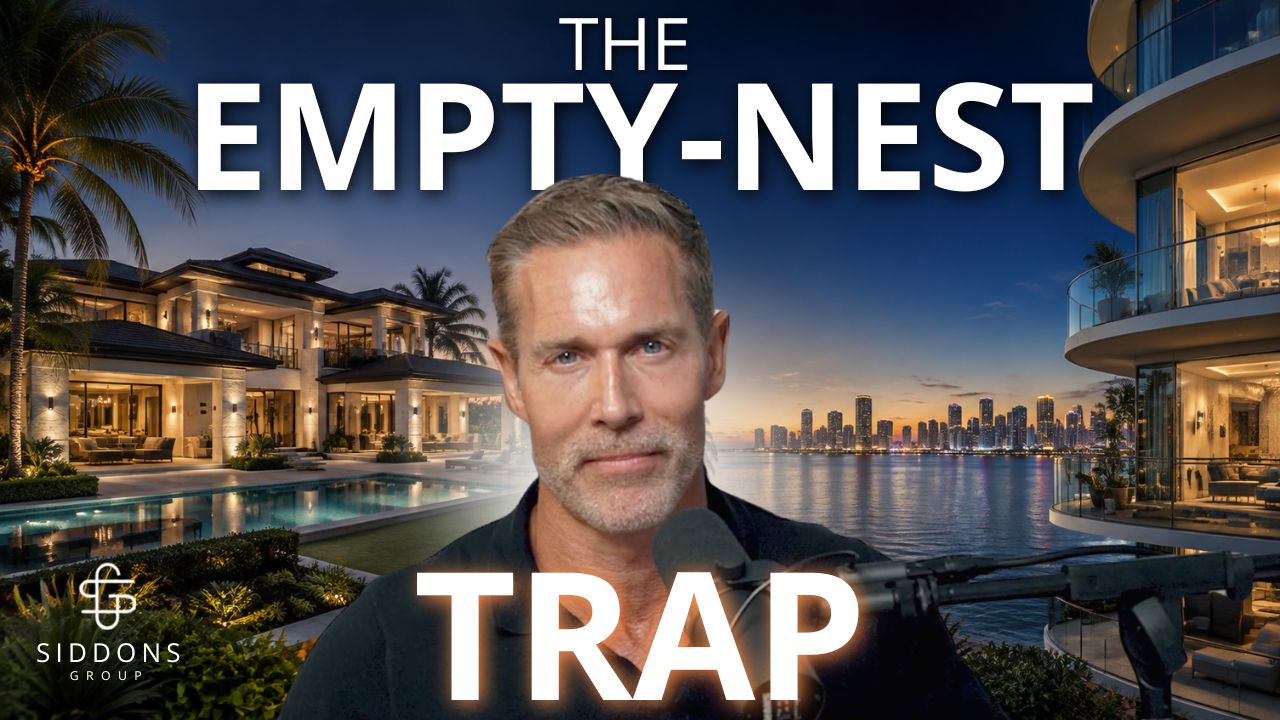
Empty Nesters in Miami: What Comes After the Big Family Home?
Palmetto Bay Has Almost No Inventory. So Why Are Homes Still Sitting?
Please fill in your details and David Siddons will contact you

Search related videos

Are St. Regis Sunny Isles Residences Worth the Brand Premium?
Coral Gables Market Report 2025: What the Headlines Aren’t Telling You!
How David Siddons’ Power Team Drives Miami’s Luxury Market
Mid‑Year 2025 Coconut Grove Report: The Truth About What’s Selling Now
Brickell Mid‑Year Market Report 2025 | Is Brickell’s Luxury Market in Trouble?
Pinecrest Mid-Year Market Report 2025 | What’s Selling, What’s Sitting & Why
Miami Beach Condo Market Mid-Year Report 2025 | What Buyers & Sellers Need to Know
How to Lose $1M in The Miami Condo market | Top Mistakes That Cost Miami Condo Buyers Millions
The Well Project EXPOSED Coconut Grove’s Hottest Units
Miami Real Estate in 2025 Is NOT What You Think 😱 | Midyear Must Knows for Buyers & Sellers!
7 Things You Should Never Say to a Real Estate Agent in Miami!
Landmark Victoria Park Residence in Fort Lauderdale: Inside 420 NE 11th Ave 🌴✨
Luxury Living on 2355 S. Miami Ave | Fully Furnished 4-Bed Home w/ Resort-Style Pool 🏊
Is Mandarin Oriental Residences Miami a Smart Condo Investment? Prices, Floorplans, Views & Finishes


- Get our Newsletter
- Subscribe
- No Thanks
Get the latest news from Miami Real Estate News
Close
Edit Search
Close
2 of 14
Share this property
Recomend this to a friend, just enter their email below.
Close
Your email was sent successfully
Close
 COMPARE WITH CONDOGEEKS