



















- Best of All
- Best Miami Luxury Condos
- Most popular
- Relocating to Miami
- Private Schools
- Investments
- Gated communities
- Waterfront information
- Luxury homes
- Luxury Condos
- New Construction Condos in South Florida
- Independent Pre-Construction condo reviews for Miami
- Independent Pre-Construction condo reviews for Fort Lauderdale
Florida Amendment 3 Passed: Why Your Residency Date Matters More Than Your Closing Date
By Sarah Alayon, Palmetto Bay Expert, and David Siddons, The David Siddons Group | Douglas Elliman · November 4, 2026
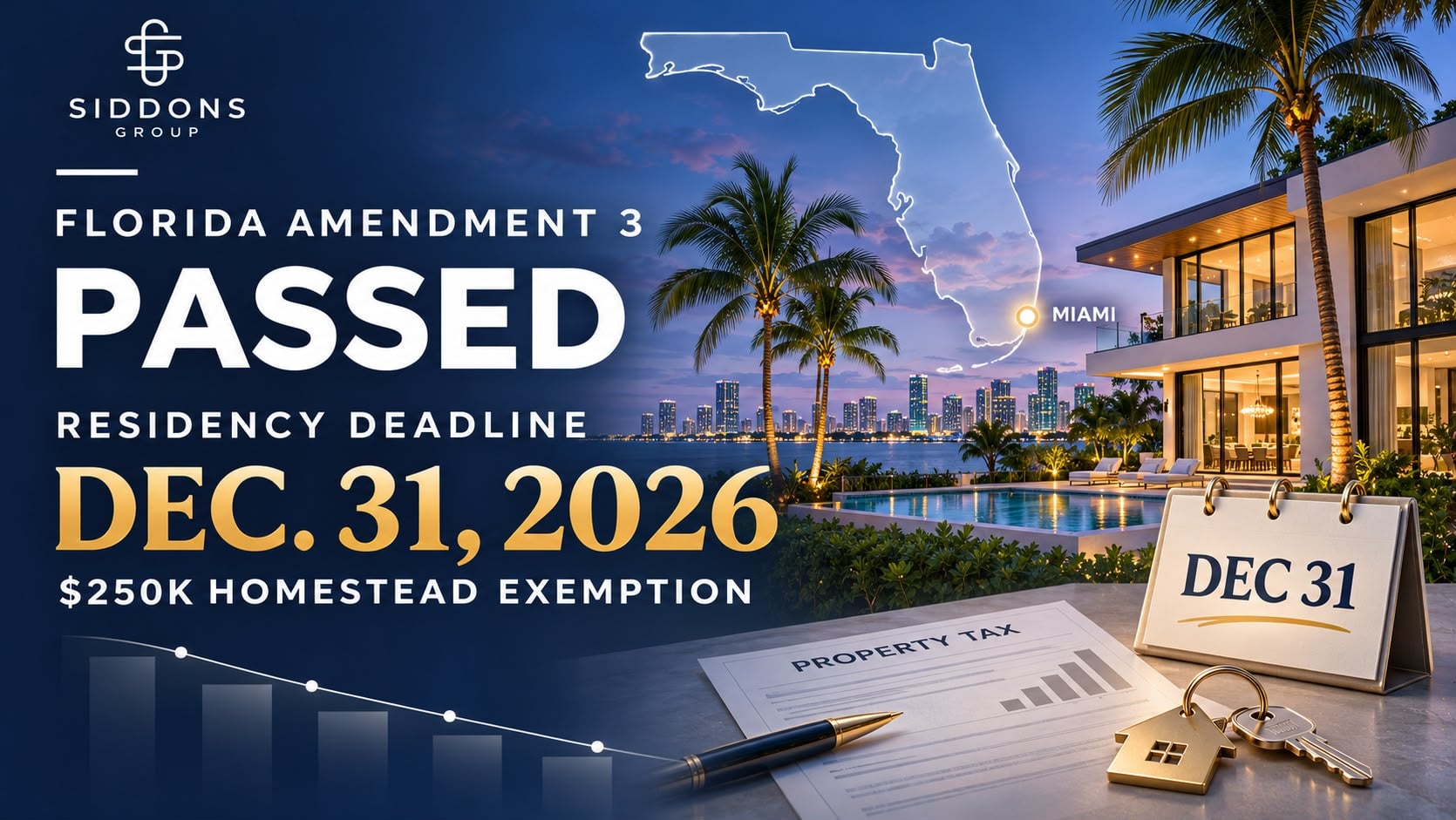
Florida voters approved Amendment 3 on November 3, 2026, with roughly 62% of the vote, above the 60% required. Starting January 1, 2027, the homestead exemption on non-school property taxes rises from about $50,000 to $150,000, then to $250,000 in 2028. But the full amount right away only goes to people who are permanent Florida residents on December 31, 2026. Everyone who becomes a resident later starts at about $50,000 and waits until their fifth year of homestead.
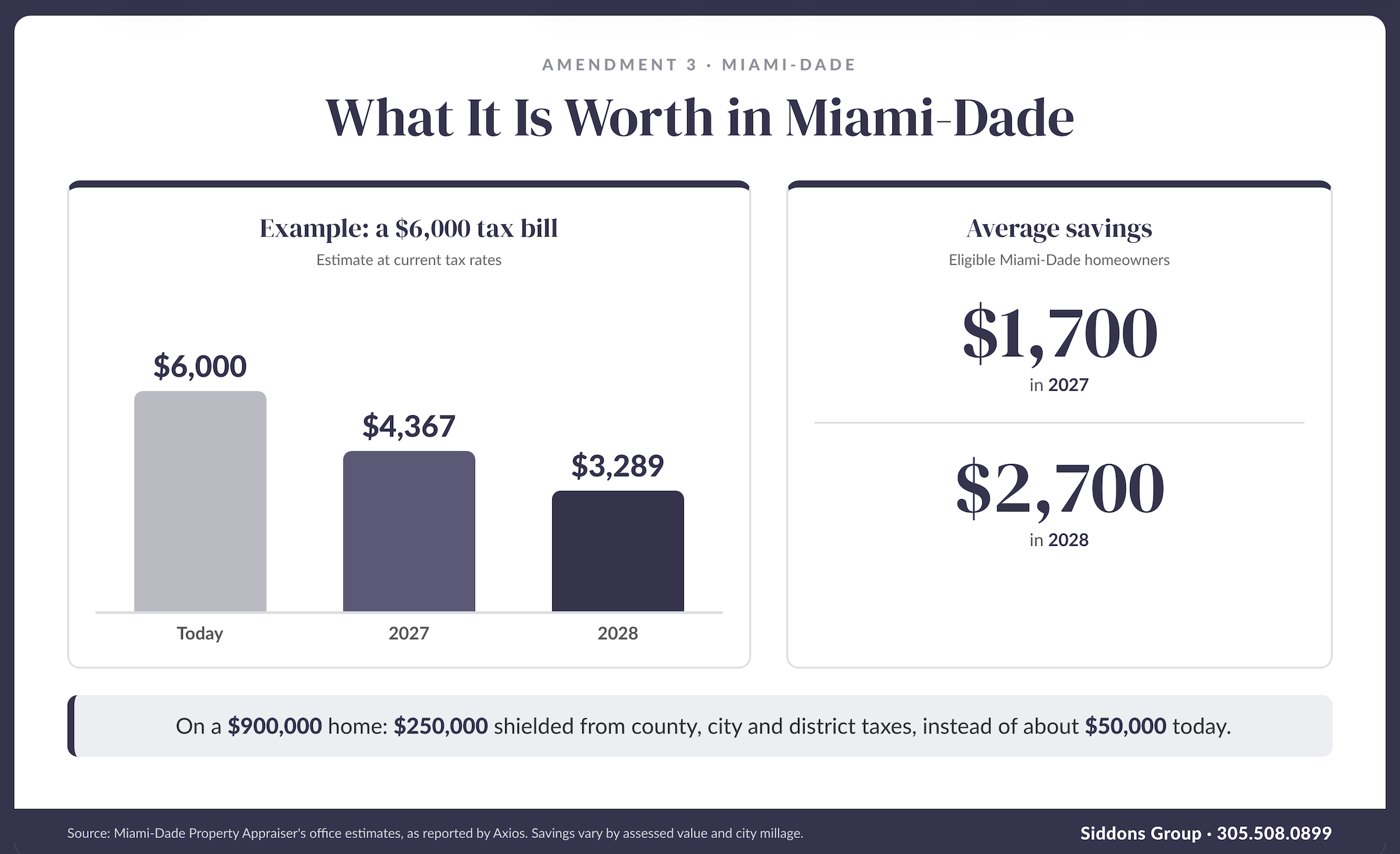
The test is residency, not ownership. You do not need to buy by January 1. You need to live here.
What Amendment 3 Changes
| 2026 (today) | 2027 | 2028 and after | |
|---|---|---|---|
| Homestead exemption, non-school taxes | About $50,000 | $150,000 | $250,000 then indexed to inflation |
| Homestead exemption, school taxes | $25,000 | $25,000 | $25,000 |
| Annual assessment cap, non-homestead property (non-school taxes) | 10% | 5% | 5% |
Source: Pinellas County Property Appraiser, Amendment 3 FAQ. Approved by Florida voters November 3, 2026.
Non-school taxes are everything on your bill except the school board line: county, city and special district levies. Those are now calculated on a much smaller taxable value.
What does not change:
- Save Our Homes stays. Annual increases in your homestead’s assessed value are still capped at 3% or CPI, whichever is lower.
- Portability stays, so you can still carry your Save Our Homes savings to your next Florida homestead.
- Senior, veteran, disability and widow/widower exemptions stay.
- School taxes keep the same $25,000 exemption and are not capped.
The amendment also limits how counties and cities can spend property tax revenue, steering it to core services such as public safety and infrastructure. You will first see the change on your August 2027 TRIM notice and your November 2027 tax bill.
What It Is Worth in Miami-Dade
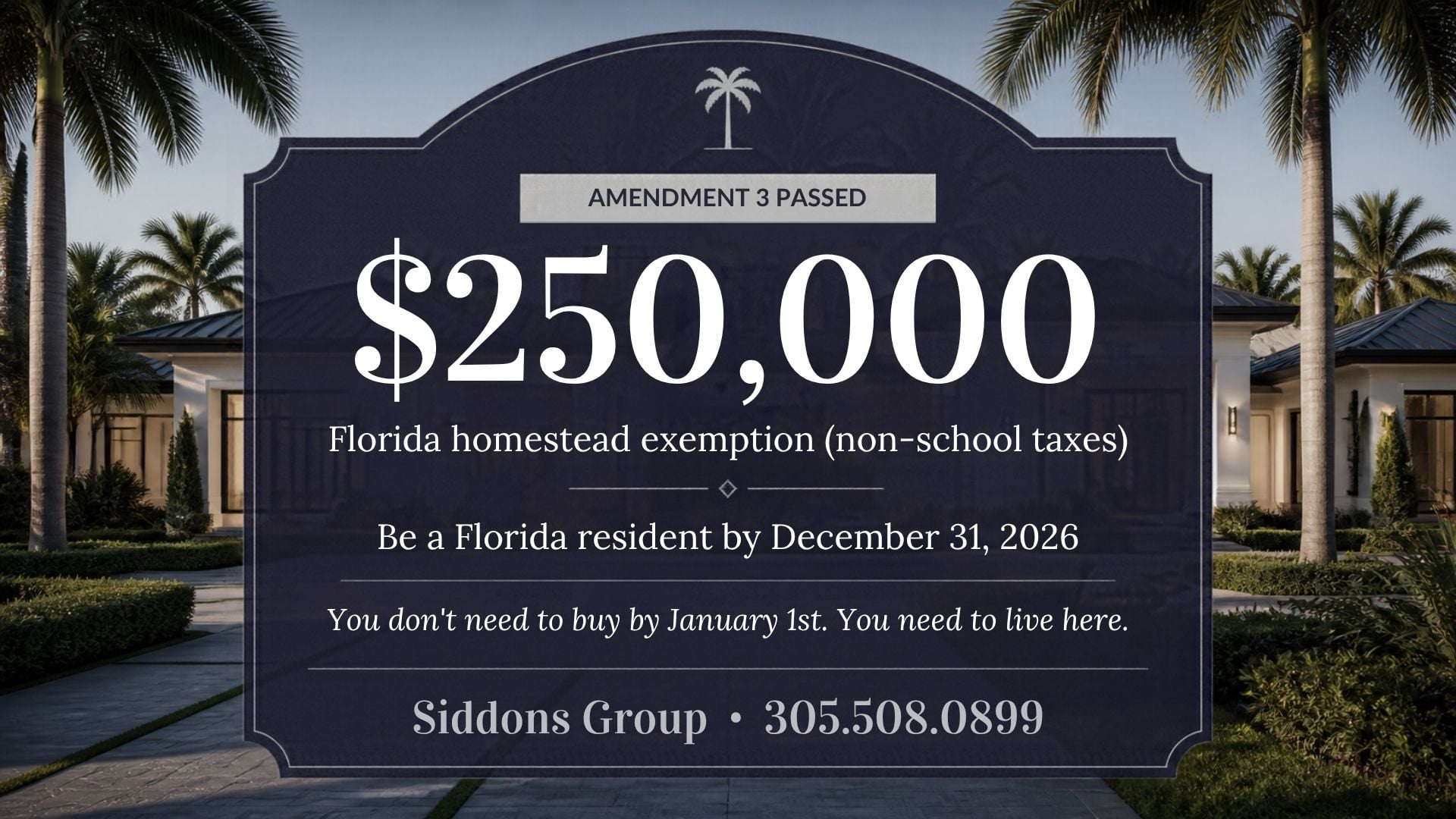
For a primary residence with a $900,000 assessed value, $250,000 is now shielded from county, city and district levies instead of roughly $50,000. Miami-Dade Property Appraiser Tomás Regalado’s office has estimated average savings for eligible county homeowners of about $1,700 in 2027 and $2,700 in 2028. In one example reported by Axios, a tax bill of about $6,000 drops to roughly $4,367 in 2027 and $3,289 in 2028 at current rates. Your number depends on your home’s assessed value and your city’s millage, so run your own estimate with the Miami-Dade Property Appraiser’s tax estimator.
Keep in mind that local governments set millage rates. Miami-Dade County projects a revenue loss in the hundreds of millions in the first year, so rates could change as budgets adjust.
DECEMBER 31, 2026 IS THE LINE
Not Sure Which Side of the Line You're On?
Relocating, renting, moving up or closing before year-end? Book a 30-minute call and we'll map out your residency and purchase timing so you get the full $250,000 homestead exemption.
Or call 305.508.0899
The December 31 Line: Two Families, Same Move
Permanent Florida resident on December 31, 2026: you get the larger exemption as soon as you qualify for homestead, even if you buy in 2027, 2028 or later. Not a resident on that date: you get about $50,000 for non-school taxes (indexed to inflation from 2028) until the fifth year of your homestead exemption.
Picture two families relocating from New York to Miami.
- Family A establishes permanent residency in December 2026, rents for a year, and buys in 2028. They receive the full exemption from their first homestead year.
- Family B arrives in February 2027 and buys the same year. For four years they carry roughly $200,000 less in exempt value than Family A.
Same city, same budget, two months apart. On a Miami home, that gap can add up to thousands of dollars. The standard homestead rules still apply on top of this: you must own and live in the home on January 1 of the tax year and file by March 1.
Two details to know, per Kaufman Rossin:
- The new-resident rule applies only “to the extent permitted by the U.S. Constitution,” so it may face legal challenges.
- Starting January 1, 2030, a county or city can shorten the five-year wait with a two-thirds vote of its governing body. Do not count on it.
Which Buyer Are You?
Relocating from out of state. The next few weeks matter more than your closing date. Establish residency before year-end and you keep the full benefit, even if the right home takes another year to find.
Renting in Miami today. If Florida is already your permanent home, you are inside the line. Buy on your own schedule. Do not let headlines rush you into the wrong property.
Already own here and moving up. You are a resident, so your next homestead qualifies for the larger exemption. Lower carrying costs may make a bigger purchase more affordable than it looked a month ago. And portability still lets you bring your Save Our Homes savings with you.
Not a resident today but closing before year-end. Move in and update every address before December 31. Owning and living in the home on January 1, 2027 lets you file for 2027 homestead by March 1 and see the $150,000 exemption on your first bill.
Buying a second home or investment property. Homestead does not apply, and part-time residents get no homestead exemption. But the annual assessment cap on non-school taxes drops from 10% to 5% on January 1, 2027, which makes carrying costs more predictable. The property is still reassessed at full market value when it sells.
Your Residency Checklist: Do This Before December 31
The Legislature and the Property Appraiser have not yet defined exactly how December 31 residency will be documented. These are the markers the Property Appraiser already asks for on a homestead application, so start here and keep dated copies of everything.
- Get a Florida driver’s license. Surrender your out-of-state license. FLHSMV requires new residents to get one within 30 days, in person. December appointments fill up, so book now.
- Register your car in Florida. New residents have 10 days. You need Florida insurance and a VIN verification first.
- Register to vote in Florida and cancel your registration in your old state.
- File a Declaration of Domicile with the Miami-Dade Clerk of the Court. It must be notarized and costs $10 to record plus $3 for a certified copy. Getting the filed copy back takes about four weeks, so do not wait until late December.
- Close out ties to your prior state, including any homestead exemption there. You cannot hold homestead in two states.
- Build your paper trail. Update your address with the IRS, banks, insurers and your employer. Keep your Miami lease or deed on file.
- File for homestead once you own. The deadline is March 1 every year, through the Miami-Dade Property Appraiser online, by mail or in person.
- Review your situation with a CPA or real estate attorney, especially if you split time between states.
Reading This After December 31, 2026?
You can still benefit. You start with about $50,000 for non-school taxes, which is roughly what everyone gets today, and you reach the full $250,000 (indexed) in your fifth year of homestead. Save Our Homes, portability and Florida’s lack of a state income tax all still apply. The earlier you establish residency and file homestead, the earlier your five-year clock starts. And watch your city and county from 2030, when they can vote to shorten the wait.
Key Dates
- November 3, 2026: Amendment 3 approved with roughly 62% of the vote.
- December 31, 2026: Be a permanent Florida resident by this date.
- January 1, 2027: $150,000 exemption and 5% non-homestead cap take effect. Own and live in your home on this date to claim 2027 homestead.
- March 1, 2027 (and every year): Homestead filing deadline.
- August 2027: TRIM notices show the new exemption.
- January 1, 2028: Exemption rises to $250,000.
- January 1, 2030: Cities and counties may vote to shorten the five-year wait.
Don’t Let December 31 Pass You By
Amendment 3 can save Miami homeowners thousands of dollars a year, but only if your timing is right. Whether you are relocating from out of state, renting in Miami today, moving up to a bigger home or closing before year-end, the steps you take in the next few weeks decide whether you get the full $250,000 homestead exemption right away or wait years for it. We’ll help you map out your residency, time your purchase and show you exactly what the new tax picture looks like on the homes you’re considering. Book a free 30-minute call on Calendly, email David directly at [email protected], or call 305.508.0899 today.
This article is general information, not tax or legal advice. Implementation details for Amendment 3 are still being finalized by the Florida Legislature. Consult a qualified CPA or attorney about your situation. Last updated November 4, 2026.
FAQ
These are the most commonly Miami Real Estate Related questions
Did Florida Amendment 3 pass?
Yes. Voters approved it on November 3, 2026, with roughly 62% of the vote.
Do I need to buy a home before January 1, 2027 to get the larger exemption?
No. You need to be a permanent Florida resident on December 31, 2026. You can buy later and still get the larger exemption when you qualify for homestead.
How much is the new Florida homestead exemption?
$150,000 for non-school property taxes in 2027 and $250,000 in 2028, indexed to inflation after that. The $25,000 school-tax exemption stays the same.
What if I move to Florida in 2027 or later?
You start with about $50,000 for non-school taxes and receive the full exemption in your fifth year of homestead. From 2030, a county or city can shorten that wait with a two-thirds vote.
How much will Miami-Dade homeowners save?
The Miami-Dade Property Appraiser’s office estimates average savings of about $1,700 in 2027 and $2,700 in 2028 for eligible homeowners. Your savings depend on your assessed value and local millage.
Does Amendment 3 help second-home owners and investors?
Not through homestead. But the annual assessment cap on non-homestead property drops from 10% to 5% for non-school taxes starting January 1, 2027.
How do I prove Florida residency?
A Florida driver’s license, Florida vehicle registration, Florida voter registration, a Declaration of Domicile, and updated addresses with the IRS, banks and insurers.
When is the Miami-Dade homestead deadline?
March 1 of each year.
WHY WORK WITH DAVID? THINGS YOU SHOULD KNOW...
For all our analytics we are agents driving some very unique and advanced tech. We Provide a granular and custom experience that empower our clients with the insight and tools to understand the most complex behaviors of any local markets.
-
Analytical
Over 100 reports produced to date
-
Knowledgeable
Over 1800 published articles and counting


Related Articles

Bristol Tower Brickell Condos: 2026 Market Report, Prices & Outlook

Raffles Coconut Grove: Prices, Floor Plans and Our Take on Miami’s Newest Bayfront Condo

Coral Gables New Construction Homes 2027
EDITION Residences Miami Edgewater

Galloway Glen Real Estate 2026: What Homes Sell for in This Kendall Neighborhood

St. Regis Bahia Mar Penthouse Review: A $22M Fort Lauderdale Sky Home at Half the Price of Miami

Edgewater Miami Condo Market 2026: $1M+ Resale at $968 a Foot vs. $2,000 for Pre-Construction

Buying or Selling a Condo in Litigation in South Florida: Red Flag or Opportunity?

The 2028 Brickell Condo Cliff: Which Buildings Are at Risk and Where Smart Money Is Moving

Should You Stage Your Home Before Selling? What 1,266 Agents and Two Studies Found

Fort Lauderdale Waterfront Homes in 2026

Greenview at Presidential Aventura

The Best Real Estate Agent in Ponce Davis

Pinecrest New Construction Is Appreciating 2x Faster Than Older Homes
Please fill in your details and David Siddons will contact you

Search related videos

Are St. Regis Sunny Isles Residences Worth the Brand Premium?
Coral Gables Market Report 2025: What the Headlines Aren’t Telling You!
How David Siddons’ Power Team Drives Miami’s Luxury Market
Mid‑Year 2025 Coconut Grove Report: The Truth About What’s Selling Now
Brickell Mid‑Year Market Report 2025 | Is Brickell’s Luxury Market in Trouble?
Pinecrest Mid-Year Market Report 2025 | What’s Selling, What’s Sitting & Why
Miami Beach Condo Market Mid-Year Report 2025 | What Buyers & Sellers Need to Know
How to Lose $1M in The Miami Condo market | Top Mistakes That Cost Miami Condo Buyers Millions
The Well Project EXPOSED Coconut Grove’s Hottest Units
Miami Real Estate in 2025 Is NOT What You Think 😱 | Midyear Must Knows for Buyers & Sellers!
7 Things You Should Never Say to a Real Estate Agent in Miami!
Landmark Victoria Park Residence in Fort Lauderdale: Inside 420 NE 11th Ave 🌴✨
Luxury Living on 2355 S. Miami Ave | Fully Furnished 4-Bed Home w/ Resort-Style Pool 🏊
Is Mandarin Oriental Residences Miami a Smart Condo Investment? Prices, Floorplans, Views & Finishes


- Get our Newsletter
- Subscribe
- No Thanks
Get the latest news from Miami Real Estate News
Close
Edit Search
Close
2 of 14
Share this property
Recomend this to a friend, just enter their email below.
Close
Your email was sent successfully
Close
 COMPARE WITH CONDOGEEKS