








- Best of All
- Best Miami Luxury Condos
- Most popular
- Relocating to Miami
- Private Schools
- Investments
- Gated communities
- Waterfront information
- Luxury homes
- Luxury Condos
- New Construction Condos in South Florida
- Independent Pre-Construction condo reviews for Miami
- Independent Pre-Construction condo reviews for Fort Lauderdale
619 Brickell by Nobu Hospitality
Price, Units, Amenities & Our Independent Review
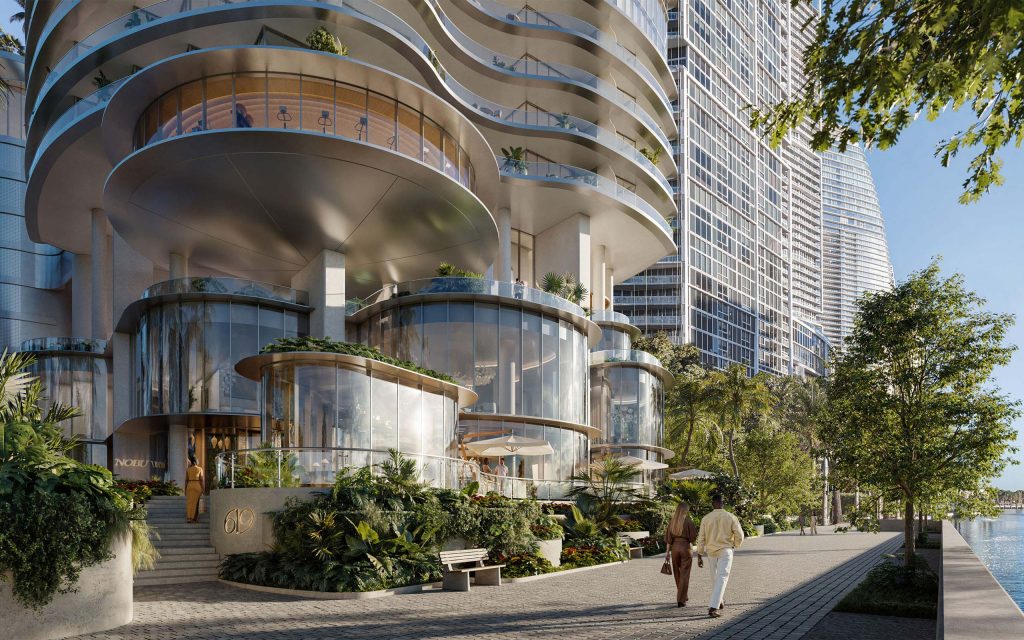
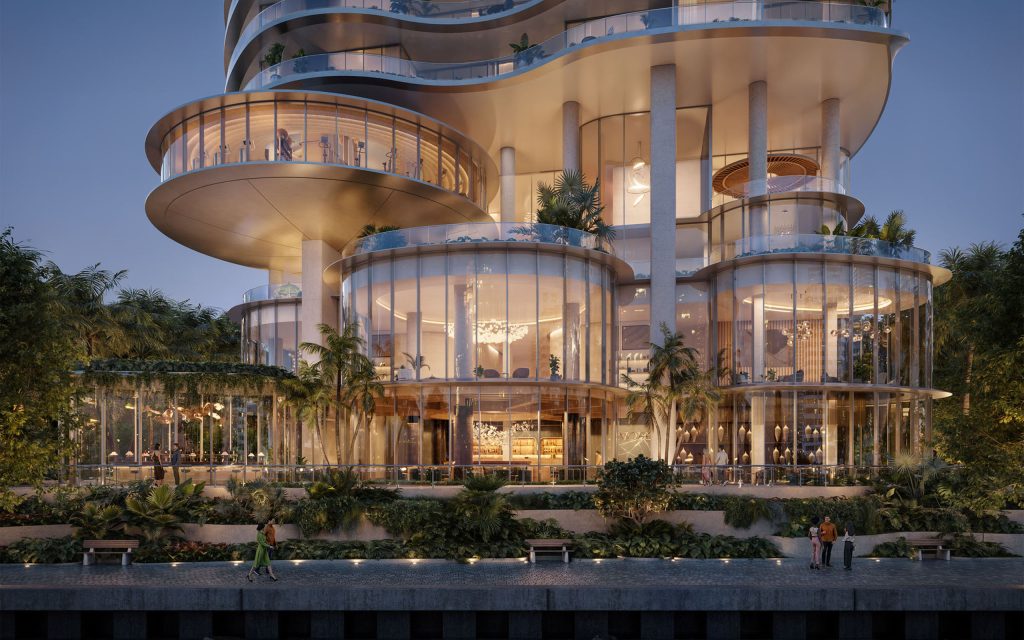
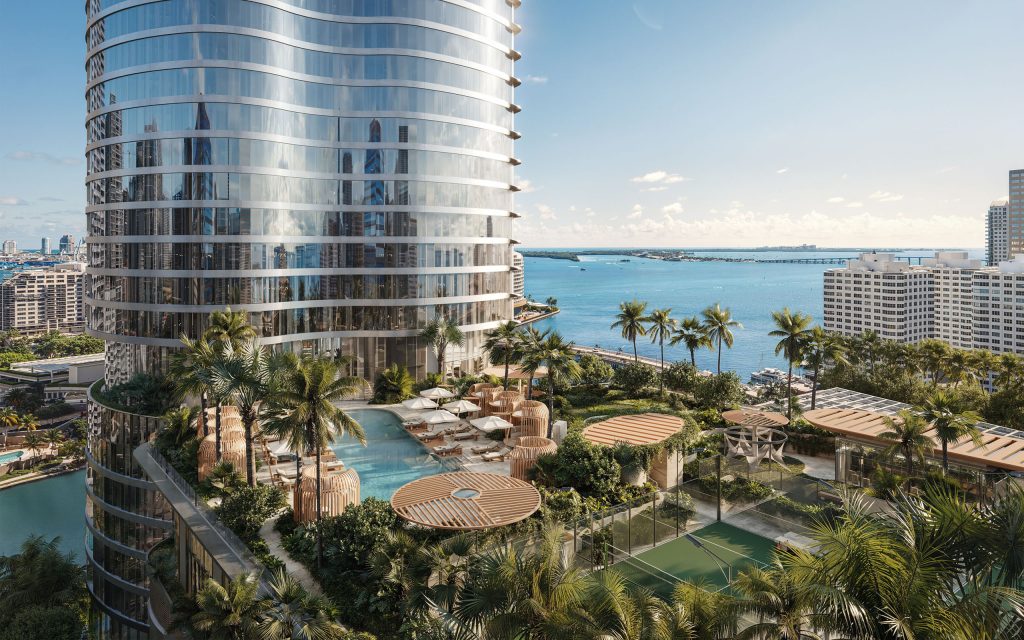
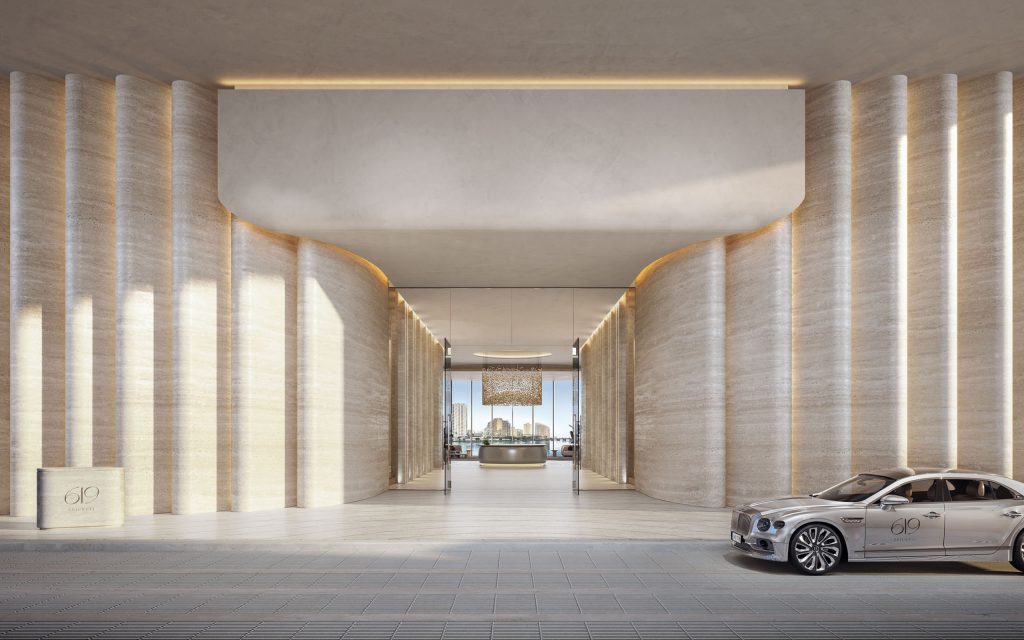
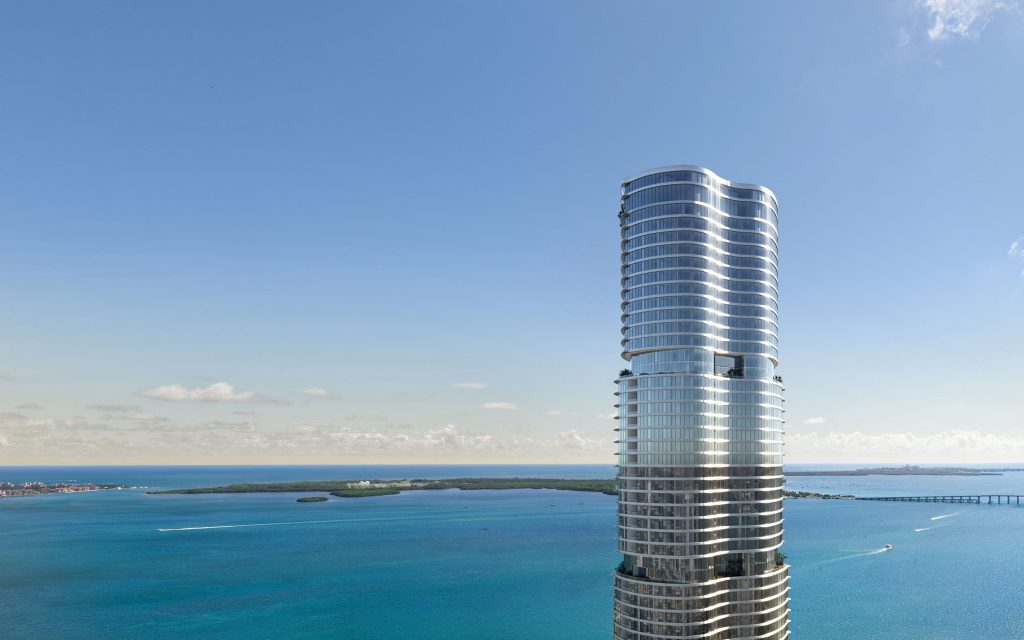
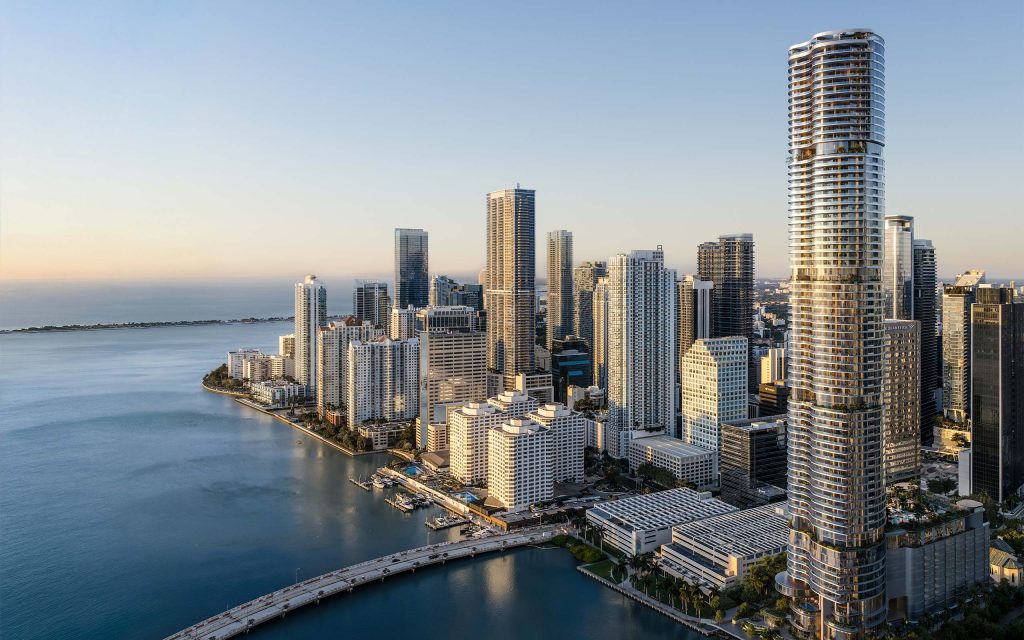
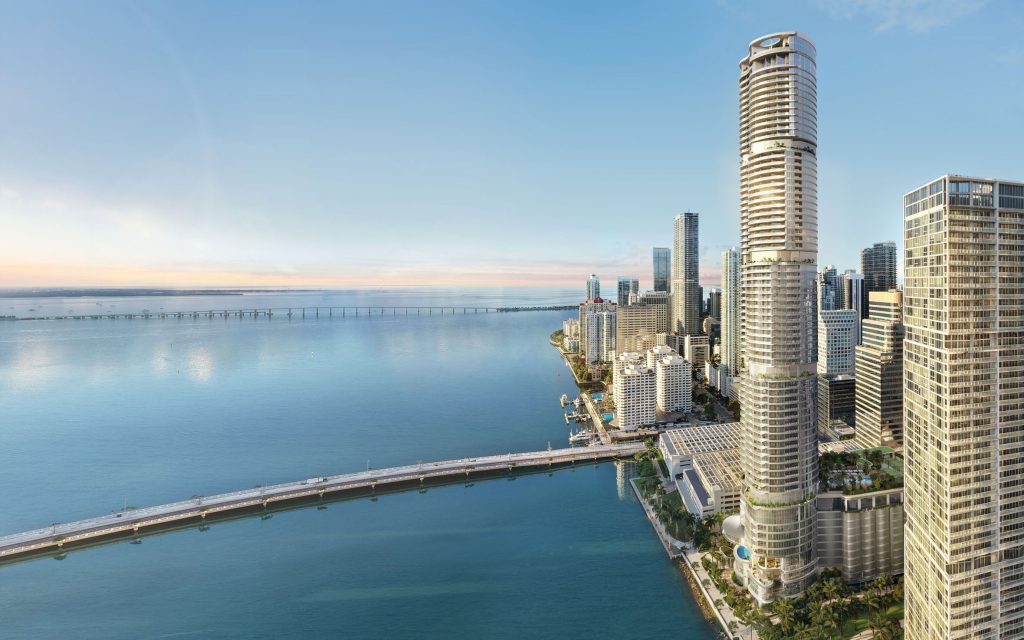
Miami’s evolution into a global luxury capital continues with 619 Brickell, also known in the market as Nobu Brickell, a landmark bayfront tower designed by Foster + Partners in partnership with Nobu Hospitality. Rising 74 stories above Biscayne Bay, this is a new construction condo with 306 residences ranging from one bedroom plus den to four bedrooms, including sky villas and penthouses.
Most of what’s published on this project is developer marketing: renderings, amenity lists, and a “call us” button. What’s missing is the part that actually helps you decide: current pricing, how the unit mix compares to the rest of Brickell, which lines are worth buying, and whether this project holds up against the Mandarin Oriental and Saint Regis. That’s the analysis below, based on our territory manager’s on the ground read and our standard seven point stress test.
Price Per Square Foot at 619 Brickell
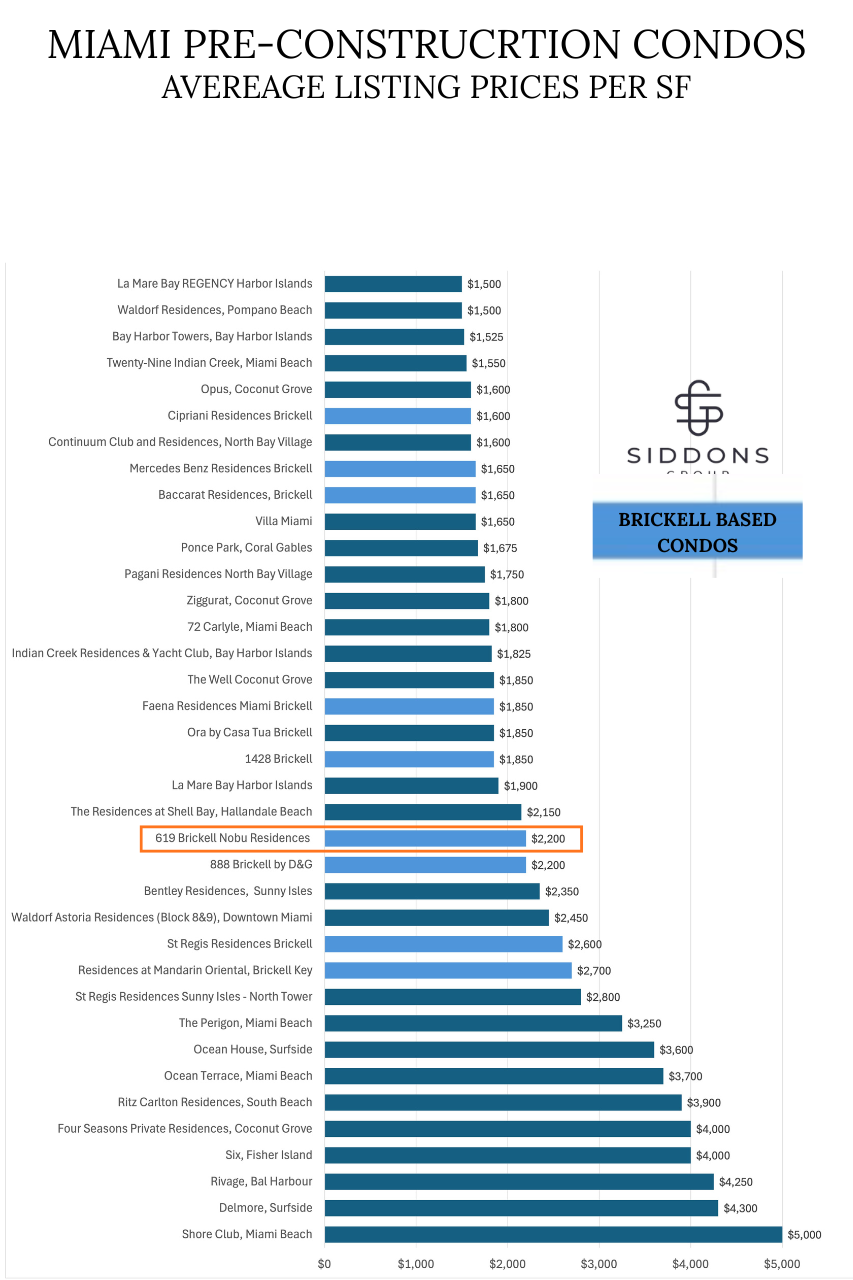
619 Brickell is currently in its reservation phase, with pricing running approximately $2,100 to $2,300 per square foot. Once the reservation phase closes, pricing is expected to move up to $2,600 or more per square foot, putting it in line with the Mandarin Oriental Residences and the Saint Regis Residences Brickell, both of which are trending toward $2,700 per square foot for new construction on the water.
For comparison, resale at the Four Seasons Residences, one of Brickell’s top performing buildings, currently runs around $1,600 per square foot for a three bedroom, roughly half of what 619 Brickell is asking. That gap is the premium the market is placing on new construction, a bayfront address, and the Nobu name. Whether that premium is worth it depends on your priorities and timeline, but it’s the benchmark to weigh before you reserve.
Unit Mix and Floor Plans
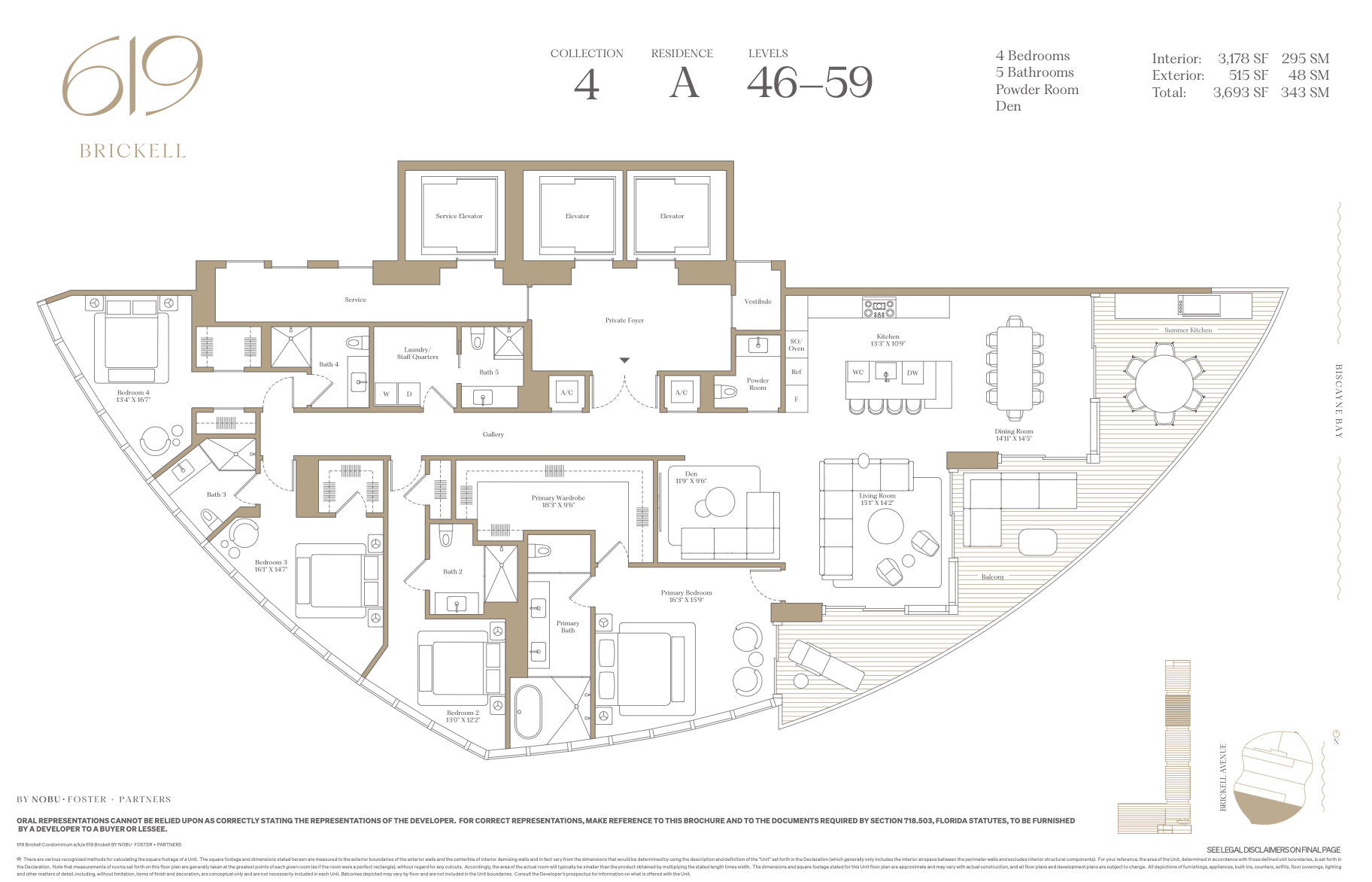
619 Brickell’s 306 residences span one bedroom plus den through four bedroom layouts, plus sky villas and penthouses. Based on current release information, the building primarily has two and three bedrooms rather than studios or compact one bedrooms, a mix that historically attracts more owner occupants than short term investors. Four bedroom duplex residences run around 4,000 square feet with elevated ceilings, effectively private homes stacked into a tower.
Get the Full 619 Brickell Report and Current Pricing
Speak directly with the David Siddons Group for independent guidance on 619 Brickell, current availability, and pricing before the reservation phase closes.
Call or text 305.508.0899 | Email [email protected]
Which Line to Buy
Southeast facing corners (the A-Line) are the strongest units in the building, with the clearest, most unobstructed views of Brickell Key and the skyline. Lower floor residences facing the river and boardwalk offer a distinct, single family home feel that’s rare in a high rise. Units facing north or west toward the city are the ones to think twice about. Those views are available in nearly every other Brickell tower, so you’re not paying a premium for anything unique there.
One Trade-Off Worth Knowing: Location and Access
619 Brickell’s address is also its most active. The tower sits close to the Miami River bridge, where bridge openings can create periodic delays for anyone arriving or leaving by car. That’s a real difference from the more insulated positions of Brickell Key, where the Mandarin Oriental sits across the water, or South Brickell, where the Saint Regis occupies a quieter residential pocket.
For buyers who walk to work and want to be steps from Brickell’s restaurants, offices, and retail, this is a non-issue and arguably part of the appeal. For buyers who prioritize a calm, seamless arrival every time, it’s worth weighing before you reserve. Neither is wrong. It’s a question of which buyer you are, and that’s exactly what we walk through on a call.
Waterfront Living Without Compromise
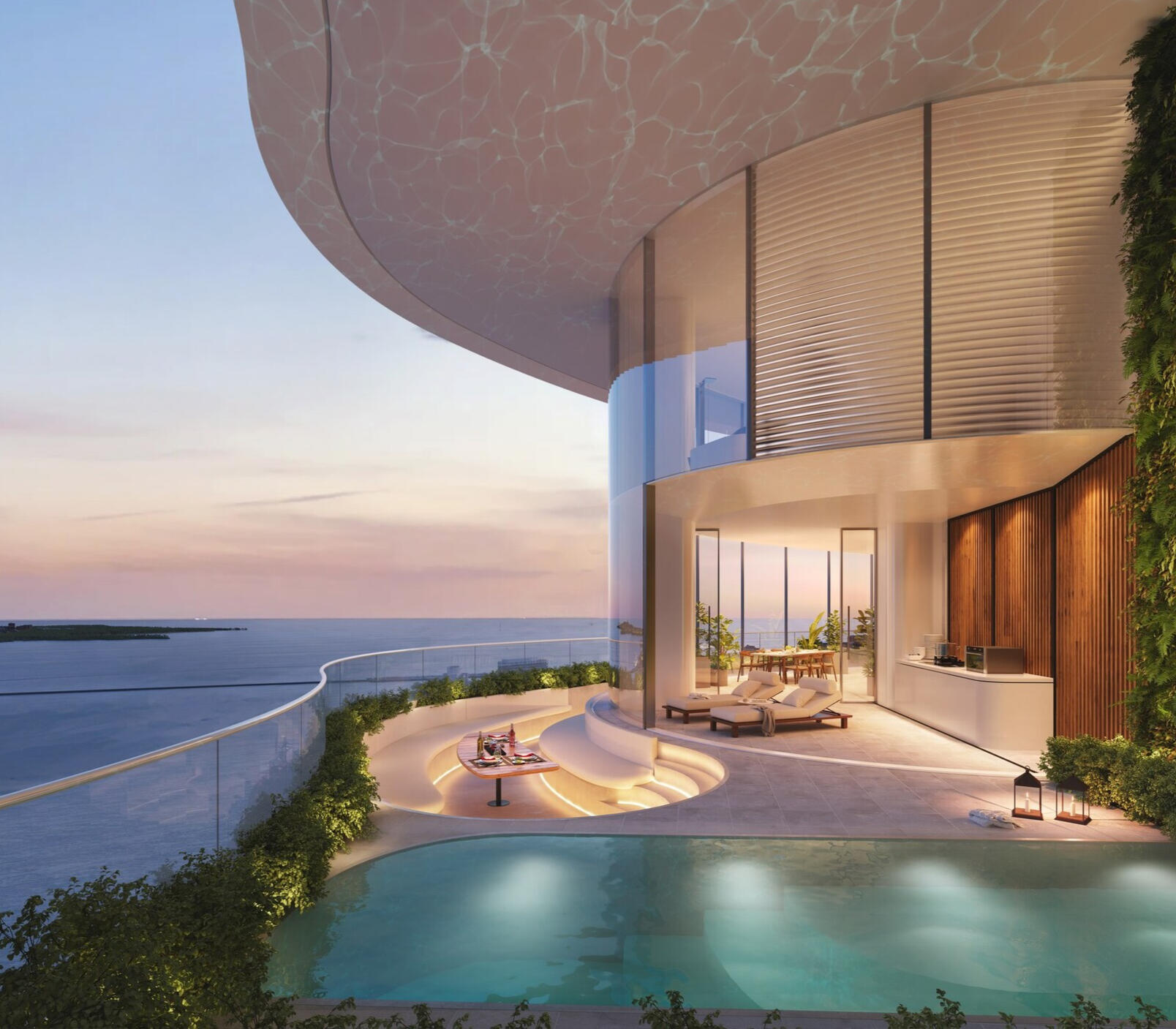
Every home at 619 Brickell is oriented toward Biscayne Bay, so water, light, and horizon stay constant. Residences include panoramic bay views from living rooms and primary suites, expansive indoor-outdoor terraces, 10 foot ceilings, Gaggenau kitchens, medical-grade HEPA air purification, ozone-enhanced water systems, circadian lighting, low-EMF interiors, smart climate and humidity control, and outdoor summer kitchens in select residences. These homes are built to optimize comfort, health, and longevity, not just to look good in a rendering.
The Design Direction: Built to Age Well
Foster + Partners and Nobu are leaning into a Japanese-inspired design language across 619 Brickell: natural materials, calm palettes, and understated finishes rather than heavy ornamentation or a look chasing a current trend. For a purchase in the seven figure range, that’s a meaningful decision. A design built on restraint and natural materials tends to hold up visually over a 10 to 20 year hold, where a more decorative, of-the-moment look can start to feel dated well before the building is paid off. It’s a quieter selling point than the amenities list, but it’s one of the reasons we think this project will age better than most of what’s currently under construction in Brickell.
Wellness and Longevity: Over 90,000 Square Feet of Amenities
At the heart of the project is one of the most complete wellness ecosystems built into a luxury residential tower, anchored by the Nobu Spa and Longevity Suite. Longevity and recovery therapies include cryotherapy, hyperbaric oxygen therapy, infrared and red light therapy, PEMF, ozone, IV and peptide therapy, a salt room and lymphatic suite, a Tesla chair and meditation pods, and a recovery lounge with a facial rejuvenation lab.
The thermal and hydro circuit includes a hammam and aromatherapy sauna, steam rooms, hot and cold plunge pools, a cryo shower, a rejuvenation salt pool, a lap pool, an outdoor spa garden, and private treatment suites. This is wellness built in as infrastructure, not an amenity checklist.
Movement, Lifestyle, and Social Spaces
Beyond wellness, the building supports fitness, recreation, family life, and social connection. The movement and performance center includes a panoramic fitness center, pilates, yoga, spinning and rebound training, and personal coaching. Recreation and leisure spaces include a padel court, F1 and golf simulators, billiards and gaming lounges, and a bike workshop with social salons.
Family and outdoor living is covered by a kids club with indoor and outdoor play, three resort-style pool decks including a sunset pool with cabanas, fire pits and landscaped gardens, an al fresco dining pavilion, and Japanese zen gardens. Refined shared spaces round it out with a private wine cellar, an owners’ lounge, a tea lounge and library salon, and executive suites with a boardroom for private meetings.
Five-Star Services
Residents get white-glove lifestyle management built on Nobu’s hospitality standards: a dedicated lifestyle and wellness concierge, aviation and travel coordination, housekeeping, butler, and home management, pet care and childcare, and access to Nobu’s global dining, cultural, and event network.
Our Seven Point Stress Test
Before any project earns a place on our best new construction list, we run it through the same seven checks every time.
- Developer track record. Key International and 13th Floor Investments have local delivery experience in Brickell with 1010 Brickell, Mint, and Ivy. Foster + Partners’ design pedigree and Baupost’s institutional capital add real weight behind the project.
- Supply pipeline at delivery. By the time 619 Brickell delivers around 2030, the Mandarin Oriental and Saint Regis are expected to be pushing past $2,700 to $3,000 per square foot. That positions 619 Brickell as the value alternative in Brickell’s ultra luxury waterfront tier.
- Building fundamentals. At roughly 300 units, the building avoids the density issues common in 700 to 1,000 unit towers, while staying large enough to properly fund reserves and amenities through square footage based fees. Unlike many hospitality-branded towers, 619 Brickell has no hotel component. The building is fully residential, which supports privacy and long-term stability rather than splitting staff, service, and priorities between hotel guests and owners.
- Operating cost of the wellness build-out. At roughly 90,000 square feet, 619 Brickell’s wellness programming (hyperbaric oxygen therapy, IV and peptide treatment, a salt room, cryotherapy, Tesla chairs) is unmatched in Brickell’s new construction pipeline, and unmatched infrastructure isn’t free to run. HOA fees across Miami’s luxury towers have climbed in recent years on rising insurance, staffing, and reserve requirements, and a building with this level of programming will likely carry higher ongoing costs than a tower with a standard pool and gym. Ask for projected HOA numbers before you reserve, not after you close.
- Unit level analysis. Southeast corners and low floor bayfront units are the standouts. City facing units on the north and west sides are replaceable elsewhere in Brickell.
- Neighborhood trajectory. Brickell’s new construction pricing is already outperforming resale values across the board, anchored by Miami’s financial district. Watch for the 2028 wave of rental product delivery, which could soften the rental market, though this building’s larger unit mix helps insulate it from that risk.
- Contract and legal structure. Developer contracts are, by design, developer friendly. Work with a real estate attorney to negotiate custom terms around timelines, delivery dates, and deposits before signing.
- Resale exit strategy. Between now and 2030, only three new construction, ultra luxury waterfront buildings will exist in Brickell: Mandarin Oriental, Saint Regis, and 619 Brickell. That scarcity gives this project real upside potential, particularly given its central, walkable Brickell location rather than a Brickell Key address across the bridge.
The Nobu Name: What It Is, and What It Isn’t
Nobu’s global recognition comes from restaurants and hotels, not a decades-long track record in residential ownership the way Four Seasons, Saint Regis, Mandarin Oriental, or Rosewood can claim. Nobu’s first hotel opened in 2013, making it a considerably younger hospitality brand than the names it’s now being positioned alongside in Brickell’s ultra-luxury tier.
That doesn’t disqualify it. Nobu’s identity is lifestyle and culinary first, more social and design-forward than the formality of a traditional five-star operator, and that’s part of its draw for the right buyer. But it does mean execution matters more here than it would for a brand with half a century of residential operations behind it. How service, staffing, and day-to-day building management are actually delivered, not just the name on the tower, is what will determine whether that premium holds at resale. We track this closely and can walk you through what we’re seeing.
Is 619 Brickell Worth It?
For buyers who want new construction, a bayfront address, and a wellness-driven, Nobu-backed lifestyle, but aren’t ready for Mandarin or Saint Regis pricing, 619 Brickell currently fills a real gap in the Brickell market. The reservation phase offers the widest unit selection and the best pricing before values climb toward $2,600 and beyond.
It’s not a guaranteed win. Contracts favor the developer until negotiated otherwise, the 2028 rental supply wave is a real variable, and the walkable, busy location will suit some buyers more than others. That’s exactly why independent analysis, not a developer’s brochure, matters before you reserve.
Who This Building Is Really For
Not every Brickell buyer is shopping for the same thing, and 619 Brickell won’t be the right fit for all of them. If your budget is above $7 million and you want maximum privacy in a calmer, more established setting, Mandarin Oriental or Saint Regis are likely still the stronger comparison. If you’re in the $2 million to $7 million range and want waterfront views, strong design, and a more energetic, connected version of luxury, 619 Brickell’s value proposition is at its strongest there, closer in spirit to the city-life appeal of Brickell Flatiron than to the insulated quiet of Four Seasons or Santa Maria.Against other Brickell pre-construction projects like Cipriani Residences or 1428 Brickell, 619 Brickell’s clearest edge is the water. Neither of those buildings sits on Biscayne Bay, and waterfront land in Brickell is running out fast. If a true waterfront address is non-negotiable for you, that narrows the pre-construction field considerably, and 619 Brickell is one of the few options left standing.
Knowing which of these you are before you reserve saves you from comparing 619 Brickell to the wrong building, and it’s the first thing we sort out on a call.
Let's Walk Through 619 Brickell Together
This overview only scratches the surface. On a private call, we'll break down the full project, which unit lines are worth chasing, where the real value sits, what you should expect to pay, and how it all fits your goals.
Developers won't give you this level of analysis. It's not their job to. Ours is to make sure you don't make a six or seven figure decision without it.
BOOK YOUR PRIVATE CALL305.508.0899 | [email protected]
Conclusion: Should You Reserve at 619 Brickell?
619 Brickell brings together three things that rarely show up in the same building: a true bayfront address, architecture and hospitality from names that don’t need an introduction, and pricing that still sits below where Mandarin Oriental and Saint Regis are headed. That combination is exactly why it passed our seven point stress test, and why the reservation phase, right now, is the window where you get the widest unit selection and the most favorable pricing before values move toward $2,600 and beyond.
None of that means every unit or every price is right for every buyer. The line you choose, the contract terms you sign, and your timeline to 2030 all change the math. That’s the conversation worth having before you reserve, not after.
This overview only scratches the surface. Our full analysis includes complete floor plans, our detailed take on every unit line, and a full comparison of 619 Brickell against every other new construction project in South Florida, including the ones we do not recommend. Developers will not give you this level of analysis. It’s not their job to. Ours is to make sure you don’t make a six or seven figure decision without it.
Call us directly at 305.508.0899 or book a time that works for you below, whichever is easier.
FAQ
FAQs about 619 Brickell
What is the price per square foot at 619 Brickell?
During the current reservation phase, pricing runs approximately $2,100 to $2,300 per square foot, expected to rise to $2,600 or more once the reservation phase closes.
Is 619 Brickell the same as Nobu Brickell?
Yes. 619 Brickell is the address and building name; it is developed in partnership with Nobu Hospitality, which is why the project is also referred to as Nobu Brickell in the market.
Who is developing 619 Brickell?
Key International and 13th Floor Investments are developing the project, with architecture by Foster + Partners and funding from Baupost.
How many residences are in 619 Brickell?
The building will have 306 residences ranging from one bedroom plus den to four bedrooms, including sky villas and penthouses.
When will 619 Brickell be delivered?
The project is projected to deliver around 2030.
How does 619 Brickell compare to the Mandarin Oriental and Saint Regis Residences?
619 Brickell is currently priced below both buildings, positioning it as a value alternative within Brickell’s ultra luxury waterfront new construction tier, with pricing expected to converge as the reservation phase closes.
Which unit line should I buy at 619 Brickell?
Southeast facing corners and low floor units facing Brickell Key and the river offer the strongest views and long term value. Units facing north or west toward the city are less differentiated from other Brickell buildings.
WHY WORK WITH DAVID? THINGS YOU SHOULD KNOW...
For all our analytics we are agents driving some very unique and advanced tech. We Provide a granular and custom experience that empower our clients with the insight and tools to understand the most complex behaviors of any local markets.
-
Analytical
Over 100 reports produced to date
-
Knowledgeable
Over 1800 published articles and counting


Related Articles
Which Schools Serve Palmetto Bay? A Guide to Public School Boundaries
Beyond the Developer Finish
Ritz-Carlton Residences Pompano Beach Resale: The Opportunity After Closing
Kendall Real Estate vs. Coral Gables Real Estate: More Land, More House, Same Budget
The 5 Best Streets in Coconut Grove: A Buyer’s Guide from the Agents Who Sell Them
Santa Maria Brickell: 2026 Market Report, Pricing & Outlook
The 5 Best Condos in Brickell 2026 (And 3 Condos to Avoid)

Who is the Best Interior Designer in Miami?
Coconut Grove and Coral Gables $4m Homes – The Hardest Market to Satisfy!
The Past, Present, and Future of Brickell Key
Pier Sixty-Six Phase Two
Pagani Residences Lower Penthouse
The Miami Buyer Migration
Miami Zoning Laws Explained: What Every Buyer Must Know Before You Purchase
Please fill in your details and David Siddons will contact you

Search related videos

Are St. Regis Sunny Isles Residences Worth the Brand Premium?
Coral Gables Market Report 2025: What the Headlines Aren’t Telling You!
How David Siddons’ Power Team Drives Miami’s Luxury Market
Mid‑Year 2025 Coconut Grove Report: The Truth About What’s Selling Now
Brickell Mid‑Year Market Report 2025 | Is Brickell’s Luxury Market in Trouble?
Pinecrest Mid-Year Market Report 2025 | What’s Selling, What’s Sitting & Why
Miami Beach Condo Market Mid-Year Report 2025 | What Buyers & Sellers Need to Know
How to Lose $1M in The Miami Condo market | Top Mistakes That Cost Miami Condo Buyers Millions
The Well Project EXPOSED Coconut Grove’s Hottest Units
Miami Real Estate in 2025 Is NOT What You Think 😱 | Midyear Must Knows for Buyers & Sellers!
7 Things You Should Never Say to a Real Estate Agent in Miami!
Landmark Victoria Park Residence in Fort Lauderdale: Inside 420 NE 11th Ave 🌴✨
Luxury Living on 2355 S. Miami Ave | Fully Furnished 4-Bed Home w/ Resort-Style Pool 🏊
Is Mandarin Oriental Residences Miami a Smart Condo Investment? Prices, Floorplans, Views & Finishes


- Get our Newsletter
- Subscribe
- No Thanks
Get the latest news from Miami Real Estate News
Close
Edit Search
Close
2 of 14
Share this property
Recomend this to a friend, just enter their email below.
Close
Your email was sent successfully
Close
 COMPARE WITH CONDOGEEKS