



















- Best of All
- Best Miami Luxury Condos
- Most popular
- Relocating to Miami
- Private Schools
- Investments
- Gated communities
- Waterfront information
- Luxury homes
- Luxury Condos
- New Construction Condos in South Florida
- Independent Pre-Construction condo reviews for Miami
- Independent Pre-Construction condo reviews for Fort Lauderdale
Mamdani’s NYC Win and the 2026 New York-to-Miami Migration: What It Means for Miami Luxury Real Estate
From the #1 Douglas Elliman Team in Miami – The David Siddons Group
The Big Picture
Zohran Mamdani’s historic win as New York City Mayor marks more than a political milestone, it’s a potential inflection point for the city’s high-net-worth residents, investors, and businesses. His campaign platform, centered on wealth redistribution, expanded rent control, and progressive taxation, has triggered unease in NYC’s financial and real estate sectors.
As Axios and the New York Post report, brokers and developers have already seen an uptick in inquiries from New York since Mamdani’s primary victory. The pattern is familiar: when New York tightens its fiscal or regulatory environment, Miami — with its pro-business climate, no state income tax, and expanding cultural capital , becomes the immediate release valve for wealth and talent migration. Media framing of this “wealth exit” amplifies visibility and urgency, often accelerating actual relocations. The last few years proved it, and this may be the next wave of New York-to-Miami Migration.

When Will the Next Wave Be Strongest?
- Immediate (0–6 months): Expect a sharp increase in inquiry volume and early scouting trips. These buyers are gathering intel, exploring schools, and comparing neighborhoods.
- Near-term (6–12 months): Cash buyers, investors, and second-home seekers make the first real moves, leading to visible absorption in prime markets.
- Mid-term (12–24 months): The largest wave — families completing school years, businesses reorganizing, and long-term movers executing plans. This window will bring the clearest pricing effects in Miami’s top submarkets.
- Longer term (24+ months): Expect stabilization, with sustained demand concentrated in pockets offering top schools, strong elevation, and lifestyle resilience.

Why This Is a Positive Catalyst for Miami
- Renewed Demand from NYC’s Elite Tighter tax and housing policies in New York could push affluent buyers southward. Early signs already point to renewed interest across Miami’s $5M–$20M bracket, with inbound activity strongest from finance, tech, and creative professionals seeking personal and fiscal freedom.
- A Push Toward Certainty and Lifestyle Today’s relocations aren’t just about taxes — they’re about control: over schools, governance, safety, and quality of life. Miami delivers that combination, with world-class amenities, private education, and outdoor living that New York can’t replicate.
- Tight Supply at the Top End Ultra-prime single-family homes east of US-1 and new oceanfront condos are in critically short supply. Expect price acceleration in the most desirable enclaves.
Which Areas Will See the Highest Demand?
Based on buyer behavior and recent reporting:
- Brickell / Downtown Corridor: Easiest transition for Manhattan residents — high-rise living, walkability, and an urban lifestyle.
- Miami Beach (Mid-Beach to South of Fifth): “City meets beach” for those seeking lifestyle and prestige.
- Coconut Grove / Coral Gables / Pinecrest: Family-focused neighborhoods offering privacy, schools, and green space.
- West Palm Beach & Palm Beach County: Estate-scale homes and lower density for ultra-high-net-worth buyers.
- Fort Laudedale / Boca Raton / Jupiter: Ideal for families and executives prioritizing schools, space, and suburban calm.
Miami’s Most Esclusive Neighborhoods
| 2020-2025 Appreciation | Average Sales Price 2025 | 2020–2025 Top-End Market Appreciation | Top Sales Price 2025 | Sales above 5M in last 12 months | Sales above 10M in the last 3 years | Sales above 20M in the last 3 years | |
| Coconut Grove Homes | 94% | $1,050 | 55% | $1,821 | 33 | 13 | 2 |
| Coconut Grove Condos | 98% | $1,183 | 168% | $2,885 | 18 | 14 | 1 |
| Coral Gables Homes | 77% | $1,066 | 25% | $3,290 | 60 | 49 | 13 |
| Pinecrest Homes | 83% | $810 | 84% | $1,525 | 42 | 15 | 0 |
| Ponce Davis Homes | 50% | $920 | 146% | $1,650 | 15 | 7 | 1 |
| Miami Beach Homes | 67% | $1,623 | 68% | $4,950 | 85 | 130 | 57 |
| Miami Beach Condos | 47% | $1,606 | 66% | $5,200 | 57 | 35 | 3 |
| Brickell Condos | 37.5% | $955 | 48% | $1,737 | 7 | 3 | 2 |
| Sunny Isles | 98% | $1,507 | 122% | $2,701 | 48 | 31 | 3 |
| Bal Harbour and Surfside | 55% | $1,827 | 83% | $5,500 | 33 | 37 | 12 |
| Fisher Island | 105% | $2,560 | 34% | $3,250 | 19 | 25 | 4 |
Obstacles NYC Buyers Could Face — and How to Overcome Them
1. Limited Private School Openings
Top Miami schools (Ransom Everglades, Gulliver, Carrollton, Palmer Trinity) operate near capacity.
Our Solution:
Through our network, we connect clients with school advisors and admissions leaders. In our Better Decisions podcast, we’ve interviewed top experts like Simon Hess (Head of Gulliver) and Valeria Averett, a trusted school advisor, mentor, and coach on how to navigate Miami’s private school process.
2. Shortage of Ultra-Prime Homes
The city’s best new builds and architectural estates often sell off-market.
Our Solution:
We offer early access to off-market homes and pre-market listings via developer and private-seller relationships. We also curate luxury rentals for families relocating mid-year or awaiting school placements.
3. Navigating New Construction Timelines
Many ultra-luxury condos — Mandarin Oriental Residences,, Four Seasons Residences Coconut Grove, St. Regis Brickell — are still under development.
Our Solution:
We track every new project, analyzing completion schedules, resale data, and rental potential to align clients with the best timing and value opportunities. For more information preview our independent condo reviews.

‘Second exodus coming soon’: Patrick Bet-David’s grim forecast after Zohran Mamdani’s ‘billionaires shouldn’t exist in NYC’
New York-to-Miami Migration:: How to Prepare
- Define Priorities Early. Align your search with school calendars, commute preferences, and lifestyle goals.
- Secure Local Financing or Proof of Funds. Miami deals move quickly; strong offers win.
- Work with a Team That Understands Both Markets. As the #1 Douglas Elliman team in Miami, we’re deeply connected with top NYC agents and know how to translate expectations into Miami reality. We also have agents in Boca Raton, Fort Lauderdale and Palm Beach, allowing us to provide you with clear comparison without prejudice.
- Leverage Local Expertise. From tax specialists to school advisors and insurance experts, we coordinate every step of the transition.
USEFULL ARICLES:
- What You need to Know about Living in Every Miami Neighborhood in 5 Minutes!
- Finding the Right School in Miami: How to Make a Better Family Decision
- The Myth of the Miami Real Estate Bubble: What the UBS Report Gets Wrong — with Analyst Ana Bozovic
- The Best Gated Communities in Coral Gables | 2025 Performance and What Every Buyer and Seller Should Know.
- The Most Exclusive and Expensive Miami Neighborhoods in 2026 – and Why they Are!
- How to Lose $1M in a Miami Condo: 10 Costly Mistakes Buyers Keep Making
Final Words
If history repeats itself, Mamdani’s policies could ignite the next significant migration wave from New York to Miami — particularly in the upper price brackets. But beyond the headlines, this movement represents something deeper: a shift in where Americans choose to build, invest, and raise families when autonomy and opportunity matter most.
For Miami sellers, that means preparing now.
For New York buyers, it means positioning early.
Connect with the David Siddons Group
If you are Moving from New York to Miami, contact me today. We helped 50 families move during the pandemic, guiding them on schools, the best neighborhoods or communities.
FAQ
These are the most commonly Miami Real Estate Related questions
What should relocation buyers know before buying real estate in Miami?
HOME BUYERS
Relocation buyers looking at homes in Miami should understand that choosing the right house is less about the property itself and more about location, schools, and long-term value. Many buyers make the mistake of focusing on price or finishes, while the real driver of value is the neighborhood and micro-location. Older homes often represent better value, but may also be part of a future redevelopment cycle. Newer homes command premiums, but don’t always sell faster if pricing is ahead of the market. Commute time, school access, and community dynamics are critical and often underestimated. The key is to evaluate homes not just as lifestyle purchases, but as long-term assets within a very localized market.
Sources:
https://luxlifemiamiblog.com/relocating-to-miami/
https://luxlifemiamiblog.com/relocating-to-miami-with-a-family/
CONDO BUYERS:
Relocation buyers should understand that Miami is a highly segmented, building-driven market, not a uniform one. Pricing can vary significantly between similar properties depending on building quality, layout, and financial health. Many buyers assume newer construction equals better investment, but that is often not the case. Factors like HOA fees, reserves, and rental policies can materially impact long-term value and liquidity. Negotiation opportunities often exist, especially in slower segments, but require precise market knowledge. The key is to evaluate micro-markets and individual buildings, not just neighborhoods or price per square foot.
Sources:
https://luxlifemiamiblog.com/miami-real-estate-market-report/
https://luxlifemiamiblog.com/new-construction-miami-guide/
What are the best areas for relocating families with children
For families relocating to Miami with young children, the most recommended neighborhoods are Coral Gables, Coconut Grove, and Pinecrest. Coral Gables offers the best balance of top schools, safety, and long-term value. Coconut Grove is ideal for younger families seeking walkability, greenery, and a lifestyle-driven environment. Pinecrest provides larger homes, excellent schools, and better value for space, making it ideal for growing families. The key driver across all three is access to strong schools and primary residential stability. Relocation decisions are less about new construction and more about long-term livability and resale strength.
Sources:
https://luxlifemiamiblog.com/best-neighborhoods-miami/
https://luxlifemiamiblog.com/what-are-the-best-family-neighborhoods-in-miami-in-2023/
Are new construction condos in Miami a good investment?
New construction condos in Miami can be a good investment—but only if you understand that not all buildings perform the same. According to the David Siddons Group, many buyers assume “new = better,” but in reality, performance depends on pricing, layout, building quality, and long-term demand. Some new developments set future price benchmarks and can drive long-term appreciation, especially in top-tier projects. However, many are priced aggressively at launch, and buyers relying on marketing instead of data often overpay.
The market is highly segmented, meaning two new buildings next to each other can perform very differently.
The best opportunities typically come from selecting the right building early or negotiating correctly in later phases.
In short: new construction is not automatically a good investment—it becomes one only with building-level analysis and disciplined entry pricing.
Sources:
https://luxlifemiamiblog.com/how-to-buy-a-luxury-condo-in-miami/
https://luxlifemiamiblog.com/category/independent-new-construction-condo-reviews/
https://luxlifemiamiblog.com/beyond-clickbait-real-insights-into-miamis-luxury-condo-market/
Why is buying a Miami condo riskier than buyers think?
Buying a Miami condo is often riskier than buyers expect because the true risks are at the building level—not visible in the listing price. Many buyers focus on finishes and views, while overlooking HOA reserves, insurance exposure, and potential special assessments. In reality, two identical units in different buildings can perform completely differently over time. Rising HOA fees and stricter regulations are also increasing the true cost of ownership, especially in older buildings. Liquidity can be affected by factors like financial health, rental policies, and ongoing repairs. The key risk is not the condo itself—but buying into the wrong building without proper due diligence.
Sources:
https://luxlifemiamiblog.com/how-to-buy-a-luxury-condo-in-miami/
https://luxlifemiamiblog.com/miami-condo-market-risks/
What are Miami's Safest Areas?
Which Miami Areas Still offer Great Value (Budget Friendly alternatives to Coral Gables and Pinecrest)
If you’re looking for better value than Coral Gables or Pinecrest, the answer (in true Siddons style) is not “go cheaper”—it’s go one layer outside the obvious markets.
The strongest value plays are:
- Schenley Park → closest substitute to Coral Gables at ~20% discount while maintaining similar character and location
- Biltmore Heights → almost identical feel to the Gables but ~25–30% cheaper on a $/SF basis
- Glenvar Heights → central location with larger lots and ~25% pricing advantage vs South Miami/Gables
- Baptist / Galloway (Kendall) → Pinecrest-style living (space, schools, land) at up to ~30% lower pricing
The pattern is consistent:
👉 Buyers are shifting west and slightly off-market to gain land, scale, and pricing efficiency. You don’t find value by going to a “cheaper neighborhood”—you find it by identifying adjacent micro-markets that offer the same lifestyle fundamentals without the brand premium.
Sources:
https://luxlifemiamiblog.com/best-value-neighborhoods-miami/
https://luxlifemiamiblog.com/category/miami-neighborhoods/
Is NOW a good time to buy in Miami?
Are Miami real estate prices going down in 2026?
No—but that’s the wrong way to look at it. Miami is not one market anymore, so prices are not moving in one direction. In 2026, the market is split into two: ultra-luxury, scarcity-driven areas (like waterfront and top-tier neighborhoods) are still holding or even rising, while mid-tier condos and oversupplied segments are flat or correcting. What we’re seeing is price divergence, not a crash—some properties are gaining value while others are quietly adjusting downward. Rising inventory and more selective buyers are putting pressure on pricing in certain segments, especially older condos or buildings with weaker fundamentals.
At the same time, global wealth and cash buyers continue to support pricing at the top end of the market. So the real answer: prices aren’t broadly dropping—they’re being repriced based on quality, location, and supply.
Should I buy a house or a condo when relocating to Miami?
The decision comes down to lifestyle first, investment second—and most relocation buyers get that backwards. If you want space, privacy, schools, and long-term family living, a single-family home in areas like Coral Gables or Coconut Grove is typically the stronger choice. If you prioritize walkability, low maintenance, and proximity to business districts, a condo in Brickell or waterfront markets makes more sense.
From an investment perspective, homes tend to be more stable, while condos are more building-dependent and cyclical. Most relocation clients underestimate how much building quality, HOA structure, and future costs impact condo performance. The right answer isn’t “house vs condo”—it’s which asset fits your lifestyle AND holds value within its micro-market.
How do I choose the right Miami neighborhood for my lifestyle?
Why are Miami condo prices so different between buildings?
Miami condo pricing varies widely because value is determined at the building level, not just by location. Two buildings next to each other can have major differences in financial health, reserves, HOA fees, and management quality. Buyers also pay premiums for better layouts, views, amenities, and newer construction—but not all “new” buildings perform equally. Factors like rental policies, upcoming assessments, and building reputation can significantly impact resale value. This is why price per square foot alone is misleading in Miami’s condo market. The real driver of value is how that specific building competes within its micro-market over time.
Sources:
https://luxlifemiamiblog.com/how-to-buy-a-luxury-condo-in-miami/
https://luxlifemiamiblog.com/category/independent-new-construction-condo-reviews/
WHY WORK WITH DAVID? THINGS YOU SHOULD KNOW...
For all our analytics we are agents driving some very unique and advanced tech. We Provide a granular and custom experience that empower our clients with the insight and tools to understand the most complex behaviors of any local markets.
-
Analytical
Over 100 reports produced to date
-
Knowledgeable
Over 1800 published articles and counting


Related Articles
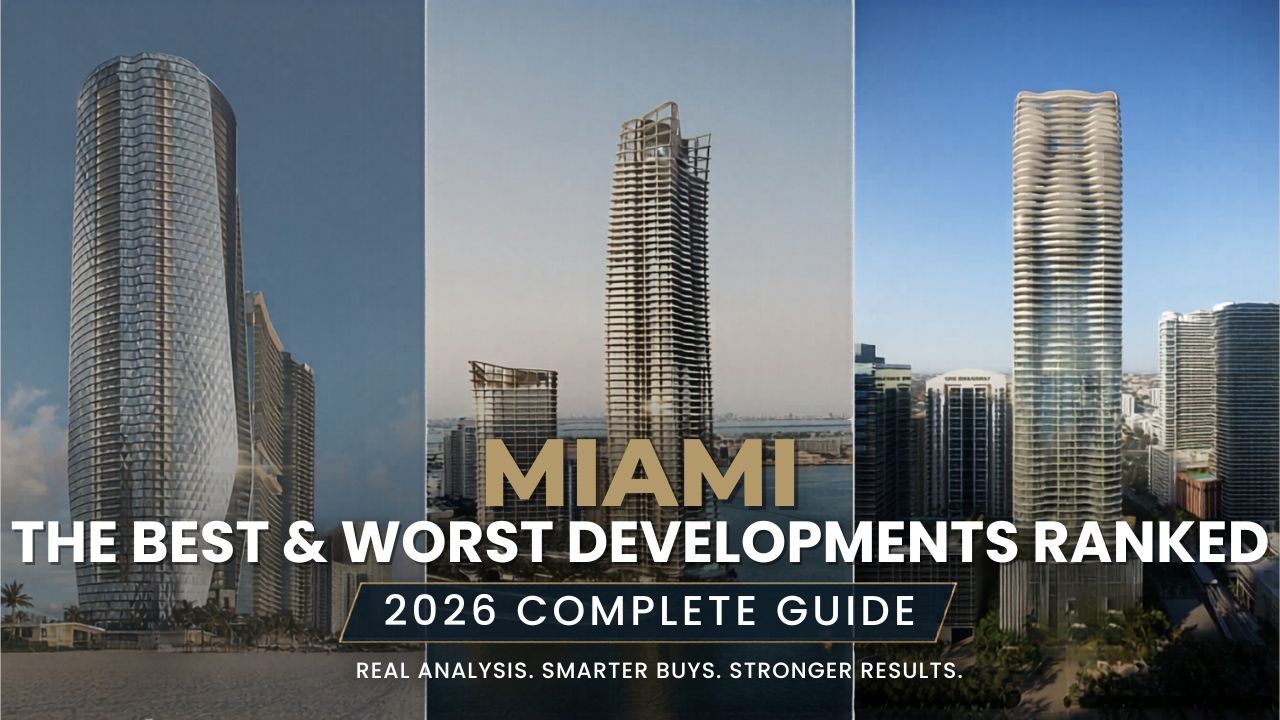
Ranking The Best and Worst Miami New Construction Condos for 2026

Coral Gables Real Estate Market Q1 2026
Kendall Luxury Real Estate Market Update Q1 2026
Miami Real Estate Market Report Q1 2026: The Two-Market Reality Driving Prices

Sunny Isles Real Estate Market Q1 2026
Who Is the Best Real Estate Agent in Miami for New Construction Condos? (2026 Data-Driven Guide)

How to Buy a Luxury Condo in Miami (2026 Playbook for Smart Buyers)

Pinecrest Real Estate Market Update Q1 2026
Aventura Real Estate Market Report Q1 2026
Brickell Real Estate Market Report Q1 2026
Coconut Grove Real Estate Market Q1 2026

South of Fifth Real Estate Market Report Q1 2026
Fort Lauderdale Luxury Real Estate Update Q1 2026 | A Quiet Market Shift is Underway
Best Value Neighborhoods in Miami
Please fill in your details and David Siddons will contact you

Search related videos

Are St. Regis Sunny Isles Residences Worth the Brand Premium?
Coral Gables Market Report 2025: What the Headlines Aren’t Telling You!
How David Siddons’ Power Team Drives Miami’s Luxury Market
Mid‑Year 2025 Coconut Grove Report: The Truth About What’s Selling Now
Brickell Mid‑Year Market Report 2025 | Is Brickell’s Luxury Market in Trouble?
Pinecrest Mid-Year Market Report 2025 | What’s Selling, What’s Sitting & Why
Miami Beach Condo Market Mid-Year Report 2025 | What Buyers & Sellers Need to Know
How to Lose $1M in The Miami Condo market | Top Mistakes That Cost Miami Condo Buyers Millions
The Well Project EXPOSED Coconut Grove’s Hottest Units
Miami Real Estate in 2025 Is NOT What You Think 😱 | Midyear Must Knows for Buyers & Sellers!
7 Things You Should Never Say to a Real Estate Agent in Miami!
Landmark Victoria Park Residence in Fort Lauderdale: Inside 420 NE 11th Ave 🌴✨
Luxury Living on 2355 S. Miami Ave | Fully Furnished 4-Bed Home w/ Resort-Style Pool 🏊
Is Mandarin Oriental Residences Miami a Smart Condo Investment? Prices, Floorplans, Views & Finishes


- Get our Newsletter
- Subscribe
- No Thanks
Get the latest news from Miami Real Estate News
Close
Edit Search
Close
Share this property
Recomend this to a friend, just enter their email below.
Close
Your email was sent successfully
Close
 COMPARE WITH CONDOGEEKS