

















The Top 5 Miami neighborhoods to Buy in 2026

Here’s what matters in 2026: not “Miami,” but which Miami. This guide pinpoints the Miami neighborhoods best set to outperform next year, measured by resale velocity and price resilience, not hype. We combine 2025 absorption, months of supply, days on market, and list-to-sale spreads. We also add real catalysts—new-build milestones, corporate inflows, and schools/walkability—to separate durable markets from the noise.. Each profile includes: why it wins 2026, a quick 2025 baseline for context, a practical 2026 play (what to buy/avoid), and the KPIs to watch so you can act with confidence.

Our Top 5 Miami neighborhoods to Buy in 2026

5. Brickell
4. Fisher Island
3. Miami Beach
2. Coconut Grove
1. Coral Gables

5. Brickell 2026: Corporate Inflow, Branded Towers, Lasting Value

Top 5 Miami neighborhoods to Buy

Brickell may look oversupplied, expireds are up and 4,500 units are under construction, but it’s recalibrating, not retreating. Corporate migration (Citadel) and skyline-defining towers (St. Regis, Mandarin Oriental) are turning the district into a global brand hub. That gravity supports long-term value, even if near-term absorption is choppy.

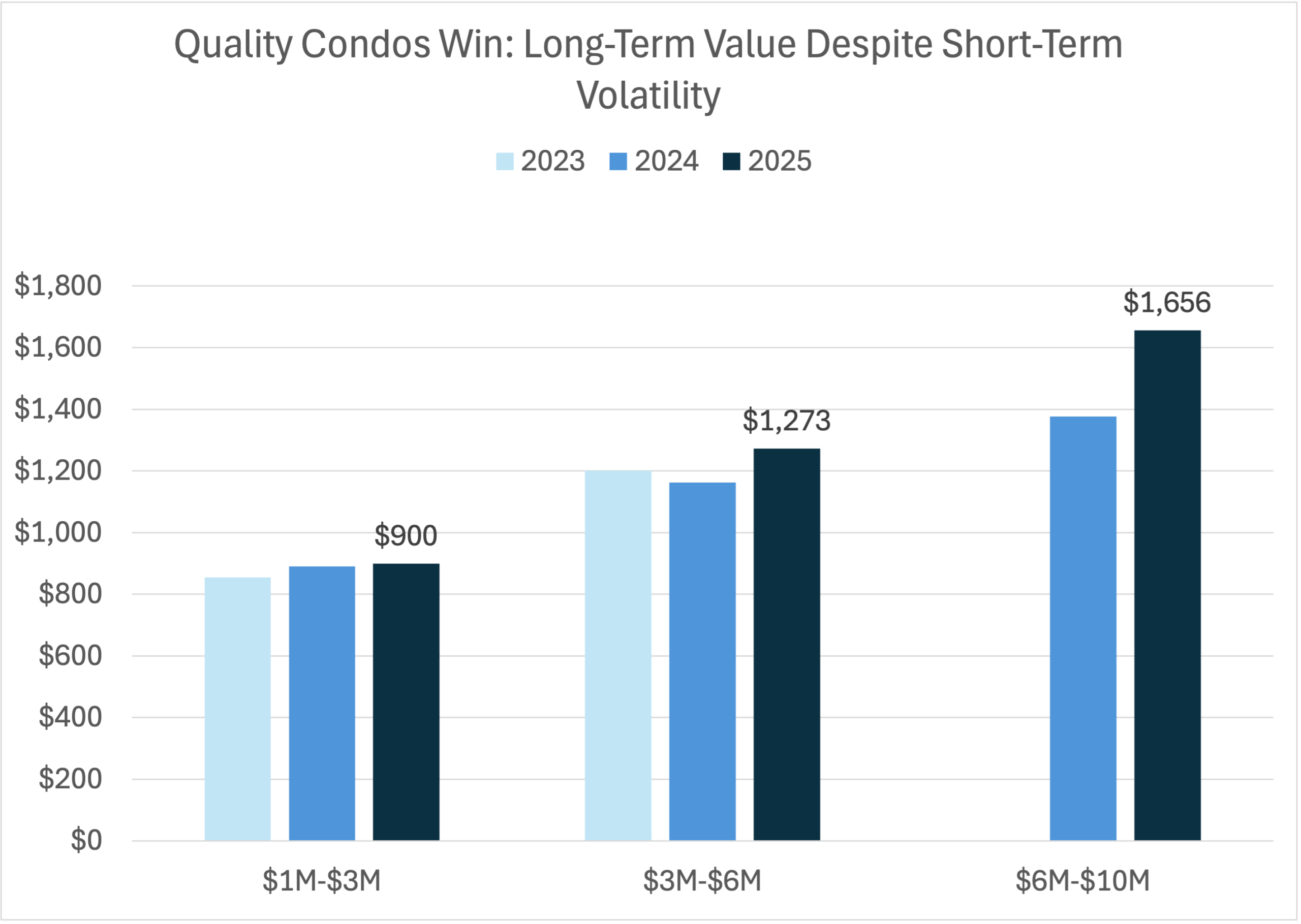
Demand is concentrating in best-in-class product.“In the $3M–$6M tier, sales nearly doubled, pricing reached ~$1,290/SF, and DOM fell. The $1M–$3M core is also moving faster despite higher inventory. Top towers, Four Seasons, Santa Maria, Bristol Tower, outperform on management, design, and location, while dated or overpriced resales (especially versus new development) lag. Brickell is a market of separation. Buyers reward thoughtful layouts, strong building financials, and turnkey presentation; sellers who price to proof still win. The next wave of branded product (St. Regis, Mandarin, Cipriani, Baccarat) keeps the long-term case intact for investors and end-users alike.

  • What to Buy: Bay- or river-facing lines in top-tier towers; branded residences with strong financials and service programs; full-service buildings with proven management.
  • What to Avoid: Dated or generic condos with high assessments, high HOA fees,  or weak resale history; poorly oriented lines facing heavy competition.

4. Fisher Island | When Markets Hesitate, Fisher Island Still Clears

Top 5 Miami neighborhoods to Buy

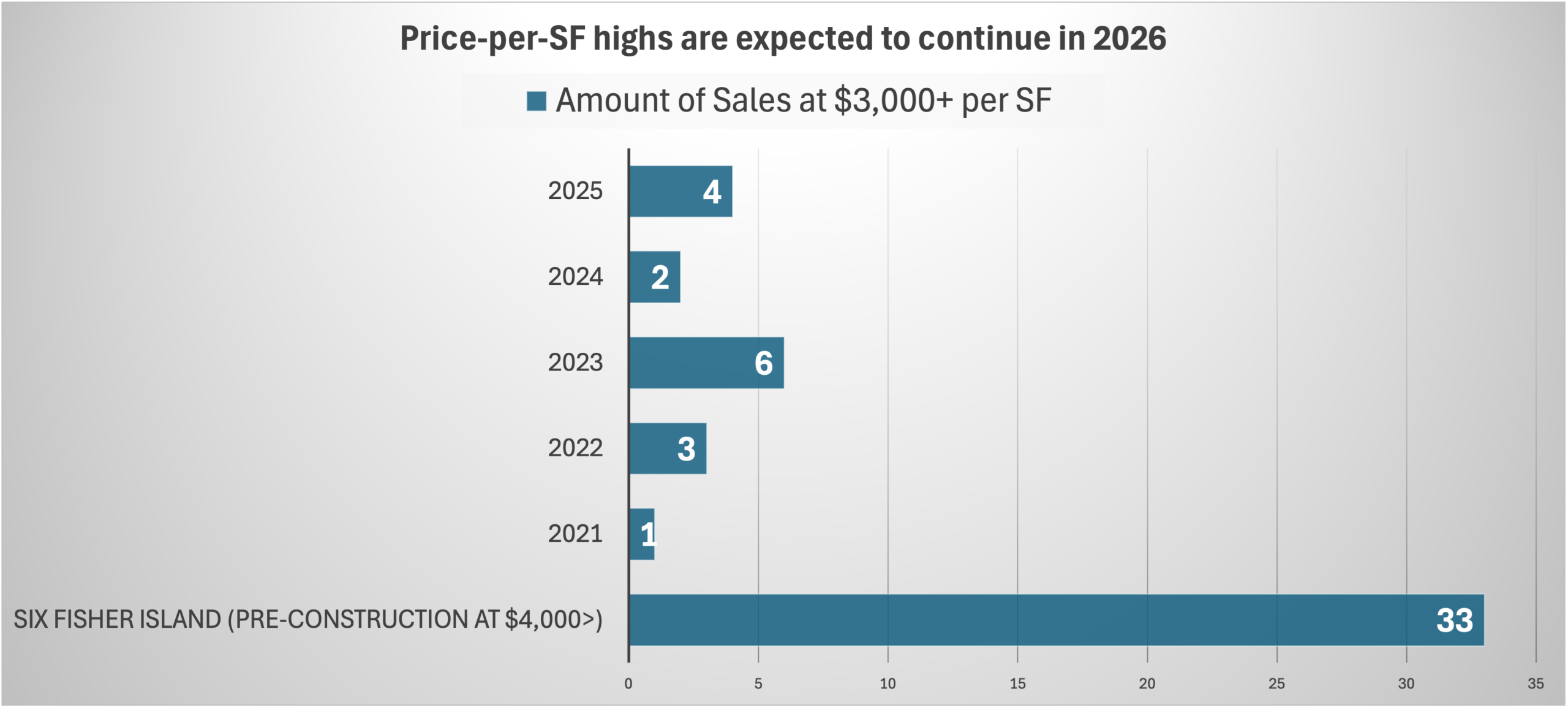
Fisher Island is the most-expensive ZIP in the U.S., and it behaves like it: ultra-private, structurally scarce, and dominated by cash buyers. When the broader market hesitates, Fisher still clears. Buyers pay up for the right line, view, and turnkey delivery, so we expect depth and price-per-SF highs in the best stacks through 2026. Under $10M, choices are few. The $6M–$10M band is exceptionally tight. The $3M–$6M tier sits near a year of supply (small samples mean a single trade can swing the stats). Above $10M, roughly 20 months of supply is perfectly normal for this caliber of product—more “deliberate” than weak. Cadence matches the tiers. Below $6M, listings sell in about a month and within ~5% of ask. Above $6M, expect ~six months and discounts up to ~20%. at the very top. It is more about finding the right price rather than distress. Meanwhile, ultra-luxury absorption off-MLS is real. Six Fisher (from ~$15M) is 65% sold (34 units). This demand is not fully capture by the MLS,  underscoring the island’s enduring draw for privacy-seeking UHNW buyers.

What to Buy: Renovated/turnkey residences with unobstructed bay/ocean corridors in buildings with robust reserves and no upcoming special assessments
What not to Buy: Older product with assessments coming up, product with no water or obstructed water views. Please be aware that on Fisher Island construction/renovation is only allowanced half of the year

3. Trophy Pockets of Miami Beach: A Pause Before the Upswing

Top 5 Miami neighborhoods to Buy

Miami Beach’s appeal starts with a beachfront, walkable lifestyle on a finite coastline with protected views and gated-island privacy. Add dining, culture, marinas, year-round outdoor living, and no state income tax. Layer in the expected rate declines. Add migration from NYC socio-political tensions, California displacements and new European Migration flows, and your buyer pool widens.

Miami Beach Homes

Homes in the trophy enclaves (Venetian Islands, North Bay Road, Palm/Star/Hibiscus, La Gorce, Sunset Islands) continue to set the pace, with 8 sales at $4,000/SF+ and 20 at $3,000/SF+ this year, proving that prime, turnkey, view-protected waterfront homes still clear at premium prices. Demand is anchored by cash-heavy end-users and structural scarcity. $1M–$3M runs near ~10 months of inventory (balanced), while most other brackets hover around ~20 months (buyer-leaning) with 10–14% average discounts and ~130 days on market. Yet the $10M+ tier moves faster (~3.5 months), proving A-plus, view-protected, turnkey waterfront homes still clear quickly even when headlines hesitate. Limited new supply preserves scarcity, and the same macro tailwinds (lower rates, NYC/CA inflows) support depth at the top. Therefore Miami Beach is in the Top 5 Miami neighborhoods to Buy in 2026

What to Buy: Buy turnkey bayfront homes on exceptional lots; avoid compromised orientation or inferior lots that won’t hold the line on resale.
What to Avoid: Older Homes on the water unless the price justifies to tear them down and rebuilt them (look at market caps for the market)
Miami Beach Condos

The condos aren’t slowing, they’re sorting. Buyers are consolidating into South of Fifth prime floor plans and branded, high-design towers that lift comps rather than flood supply. That’s why the $3M–$6M tier is absorbing faster as sellers meet the market. The $1M–$3M bracket is inventory-heavy but value-rich for renovated, well-located units; $6M–$10M offers real negotiation windows without price capitulation; and $10M+ splits as luxury new development captures most pending deals while legacy units lag unless it’s truly turnkey.

What to buy: South of Fifth condos with protected views and healthy floor plans as well as some of the very well considered brand new condos in the Beach
What to Avoid : Old product near the water with rising HOA fees or “almost-there” renovations that won’t beat new-build comps.

2. Coconut Grove | A Solid Contestant for End Users and Families

Top 5 Miami neighborhoods to Buy

Unlike investor-driven markets, the Grove attracts wealthy families. They value elite schools, proximity to Brickell’s financial hub, green parks, and the Grove’s unique lifestyle. This end-user focus explains why, despite heavier inventory in certain brackets, the Coconut Grove market keeps outperforming on velocity and price resilience. Add in the tailwind of lower interest rates at the entry-luxury levels, plus a steady influx of global wealth from Europe, California, and New York, and you have a recipe for sustained strength. Simply put: Coconut Grove combines the most consistent end-user demand with transactional depth. That’s why it remains one of our top picks for 2026—and why it continues to outperform broader Miami trends.

Coconut Grove Homes

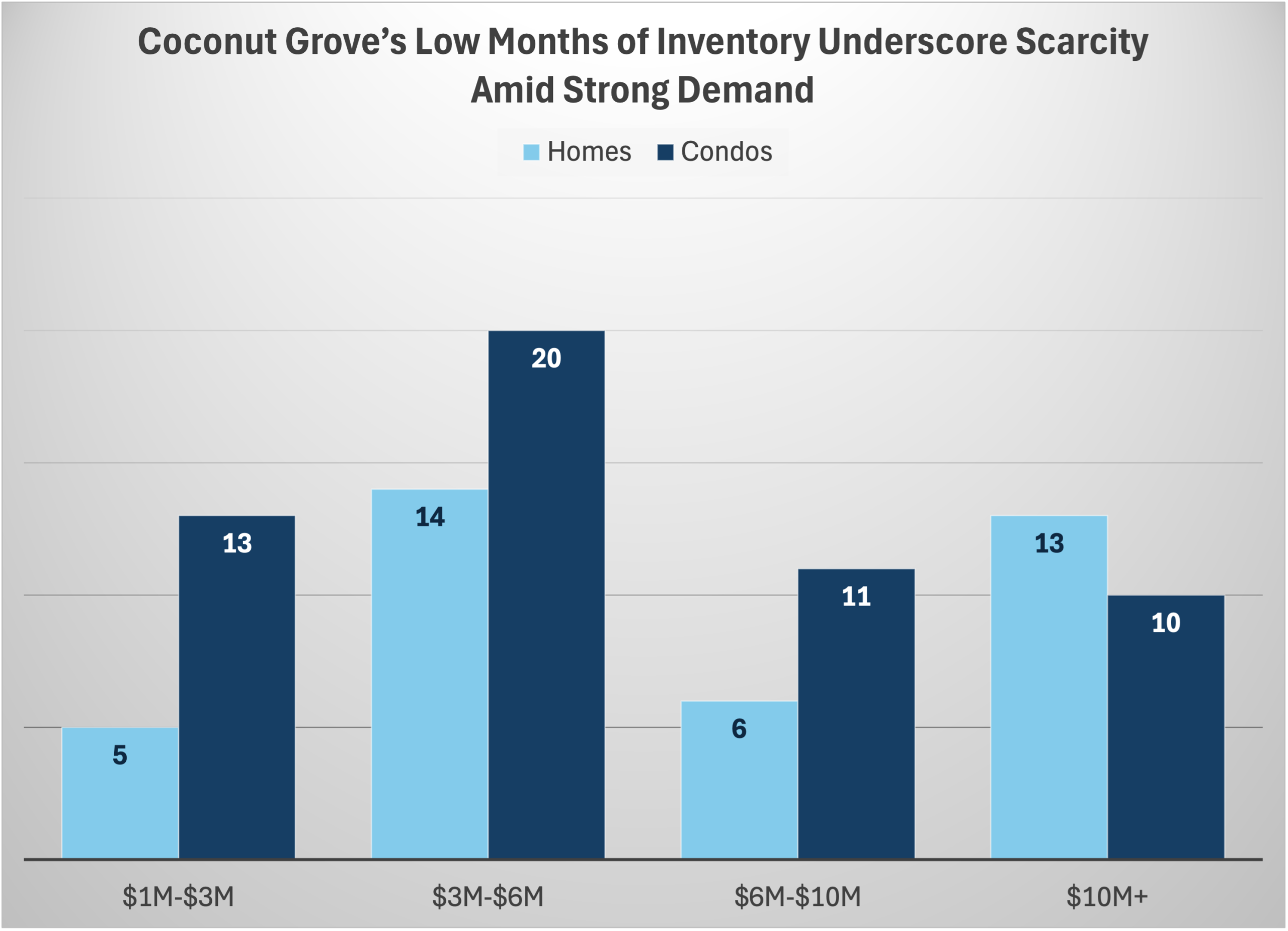
Homes under $6M are absorbed in just 2.5 months on average, a pace that rivals the strongest submarkets in Miami. Even where inventory looks heavier, such as the $3M–$6M range with 14 months, the discounts and days on market reveal an important truth: buyers here are selective, but they’re also willing to pay top dollar when the property meets their expectations. That dynamic creates a floor of stability few neighborhoods can claim.

What to buy: Renovated Single Family homes east of Main Hwy and homes in gated communities
What not to buy: Dated homes in flood-prone areas and homes on busy streets.

Coconut Grove Condos

Coconut Grove’s condo market is small (≈10% of local housing) and end-user driven, creating structural scarcity. Add bay views, oversized floor plans, and strong security, and you get a highly desirable, under-supplied segment where prime lines in buildings like Park Grove and Grove at Grand Bay routinely trade around $2,500–$3,800/SF. Well-priced condos under $6M typically sell in 70–80 days; upper tiers are selective but steady. Unlike other Miami areas, the Grove has posted 6–15% YoY gains across many segments. Inventory has inched up, but remains modest versus Brickell’s far larger pipeline; with only ~461 units slated over the next 3–4 years, growth here does not equal oversupply.

What to Buy: Newer or fully modernized buildings with strong financials, wide floor plans, and premium water views—particularly in trophy buildings like Park Grove, Vita, and Grove at Grand Bay.
What to Avoid: Outdated units with compromised layouts or views, especially if priced too aggressively.

1 East Coral Gables: Scarcity, Prestige, and Speed

Top 5 Miami neighborhoods to Buy

East Coral Gables (east of US1) stands out as one of Miami’s strongest and most resilient markets heading into 2026. The area benefits from a rare mix of scarcity and end-user demand, which keeps inventory levels tight across most price brackets. Homes here don’t sit idle: in the mid-market ($3M–$6M), properties are absorbed in just two months on average, clear evidence that this segment is firmly in seller’s market territory. Even at the ultra-luxury level ($10M+), where inventory runs at 21 months, supply is historically low and trending downward compared to prior years. Discounts are shrinking across nearly every price band, and in most cases, homes are selling in under four months.

The “why” is simple: East Gables attracts wealthy families and global buyers who value proximity to Miami’s top schools, major business hubs, and an abundance of parks and green space. Gables Estates being named the most expensive neighborhood in the U.S. only highlights the area’s global prestige. Buyers from New York, California, and Europe continue to funnel in, seeking safety, lifestyle, and long-term value. With interest rates easing, entry-luxury demand is expected to accelerate, while the ultra-wealthy remain steady players at the high end.

East Coral Gables doesn’t just outperform on numbers; it offers a rare blend of livability, prestige, and transactional depth that few neighborhoods in Miami can match. That combination makes it one of the  Top 5 Miami neighborhoods to buy.

What to Buy: Wide-frontage waterfront homes with clean orientation; new builds or fully modernized estates.
What to Avoid: Older, unrenovated homes on compromised lots or with poor positioning.

KPIs to Watch

Don’t just watch prices, read the market through a few clear lenses. Start with Months of Inventory (MOI) by tier (healthy is in the low-teens) and Days on Market (DOM) plus time to contract for speed. Check pricing power via list price-to-sale price spreads and whether renovated comps are setting new prices/SF records. Verify building health through HOA reserves and any upcoming assessments. Track pipeline and demand by watching resales in similar buildings and construction milestones on brand towers. Then layer in real-world drivers: new offices, a new wave of migrating families, and the path of interest rates. It’s bullish when Months of inventory stays tight, Days on market shortens, price discounts compress toward ≤5%, renovated comps print higher prices/SF, reserves look solid, projects hit milestones on time, corporate moves land, migration is strong, and rates drift lower. Grow cautious if inventory climbs toward ~20%+ by tier, DOM lengthens, discounts widen (~10–14%+), comps stall, HOA/cap-ex risk rises, or construction timelines slip. The market is always moving and if you want to follow the health Top 5 Miami neighborhoods to Buy or any other neighborhood this section is quintessential.

Connect with the David Siddons Group

I hope you have enjoyed reading our Top 5 Miami Neighborhoods Set to Outperform in 2026. If you want to know more about the top 5 Miami neighborhoods to buy a house or a condo contact me at 305.508.0899 or schedule a meeting via the Calendar App below.

FAQ

These are the most commonly Miami Real Estate Related questions

What should relocation buyers know before buying real estate in Miami?

HOME BUYERS

Relocation buyers looking at homes in Miami should understand that choosing the right house is less about the property itself and more about location, schools, and long-term value. Many buyers make the mistake of focusing on price or finishes, while the real driver of value is the neighborhood and micro-location. Older homes often represent better value, but may also be part of a future redevelopment cycle. Newer homes command premiums, but don’t always sell faster if pricing is ahead of the market. Commute time, school access, and community dynamics are critical and often underestimated. The key is to evaluate homes not just as lifestyle purchases, but as long-term assets within a very localized market.

Sources:
https://luxlifemiamiblog.com/relocating-to-miami/
https://luxlifemiamiblog.com/relocating-to-miami-with-a-family/

CONDO BUYERS:
Relocation buyers should understand that Miami is a highly segmented, building-driven market, not a uniform one. Pricing can vary significantly between similar properties depending on building quality, layout, and financial health. Many buyers assume newer construction equals better investment, but that is often not the case. Factors like HOA fees, reserves, and rental policies can materially impact long-term value and liquidity. Negotiation opportunities often exist, especially in slower segments, but require precise market knowledge. The key is to evaluate micro-markets and individual buildings, not just neighborhoods or price per square foot.

Sources:
https://luxlifemiamiblog.com/miami-real-estate-market-report/
https://luxlifemiamiblog.com/new-construction-miami-guide/

What are the best areas for relocating families with children

For families relocating to Miami with young children, the most recommended neighborhoods are Coral Gables, Coconut Grove, and Pinecrest. Coral Gables offers the best balance of top schools, safety, and long-term value. Coconut Grove is ideal for younger families seeking walkability, greenery, and a lifestyle-driven environment. Pinecrest provides larger homes, excellent schools, and better value for space, making it ideal for growing families. The key driver across all three is access to strong schools and primary residential stability. Relocation decisions are less about new construction and more about long-term livability and resale strength.

Sources:
https://luxlifemiamiblog.com/best-neighborhoods-miami/
https://luxlifemiamiblog.com/what-are-the-best-family-neighborhoods-in-miami-in-2023/

Are new construction condos in Miami a good investment?

New construction condos in Miami can be a good investment—but only if you understand that not all buildings perform the same. According to the David Siddons Group, many buyers assume “new = better,” but in reality, performance depends on pricing, layout, building quality, and long-term demand.  Some new developments set future price benchmarks and can drive long-term appreciation, especially in top-tier projects.  However, many are priced aggressively at launch, and buyers relying on marketing instead of data often overpay.
The market is highly segmented, meaning two new buildings next to each other can perform very differently.
The best opportunities typically come from selecting the right building early or negotiating correctly in later phases.
In short: new construction is not automatically a good investment—it becomes one only with building-level analysis and disciplined entry pricing.

Sources:
https://luxlifemiamiblog.com/how-to-buy-a-luxury-condo-in-miami/
https://luxlifemiamiblog.com/category/independent-new-construction-condo-reviews/
https://luxlifemiamiblog.com/beyond-clickbait-real-insights-into-miamis-luxury-condo-market/

Why is buying a Miami condo riskier than buyers think?

Buying a Miami condo is often riskier than buyers expect because the true risks are at the building level—not visible in the listing price. Many buyers focus on finishes and views, while overlooking HOA reserves, insurance exposure, and potential special assessments. In reality, two identical units in different buildings can perform completely differently over time. Rising HOA fees and stricter regulations are also increasing the true cost of ownership, especially in older buildings. Liquidity can be affected by factors like financial health, rental policies, and ongoing repairs. The key risk is not the condo itself—but buying into the wrong building without proper due diligence.

Sources:
https://luxlifemiamiblog.com/how-to-buy-a-luxury-condo-in-miami/
https://luxlifemiamiblog.com/miami-condo-market-risks/

What are Miami's Safest Areas?

The safest areas in Miami are typically Coral Gables, Coconut Grove, Pinecrest, Key Biscayne, and Ponce-Davis. These neighborhoods stand out due to low density, strong community presence, and high concentration of full-time residents, which directly impacts safety. In Miami, safety is highly localized, meaning micro-location and specific streets matter more than zip codes. Areas with top schools and family-driven demand tend to maintain stronger safety profiles over time. Gated communities and low-traffic residential streets further enhance security. Ultimately, the safest areas are defined less by price and more by stability, schools, and residential character.

Which Miami Areas Still offer Great Value (Budget Friendly alternatives to Coral Gables and Pinecrest)

If you’re looking for better value than Coral Gables or Pinecrest, the answer (in true Siddons style) is not “go cheaper”—it’s go one layer outside the obvious markets.

The strongest value plays are:

  • Schenley Park → closest substitute to Coral Gables at ~20% discount while maintaining similar character and location
  • Biltmore Heights → almost identical feel to the Gables but ~25–30% cheaper on a $/SF basis
  • Glenvar Heights → central location with larger lots and ~25% pricing advantage vs South Miami/Gables
  • Baptist / Galloway (Kendall) → Pinecrest-style living (space, schools, land) at up to ~30% lower pricing

The pattern is consistent:
👉 Buyers are shifting west and slightly off-market to gain land, scale, and pricing efficiency. You don’t find value by going to a “cheaper neighborhood”—you find it by identifying adjacent micro-markets that offer the same lifestyle fundamentals without the brand premium.

Sources:
https://luxlifemiamiblog.com/best-value-neighborhoods-miami/
https://luxlifemiamiblog.com/category/miami-neighborhoods/

Is NOW a good time to buy in Miami?

In 2026, the answer is yes—but only if you understand what part of the market you’re buying into. Miami is no longer one market; it has split into multiple segments behaving very differently. From a David Siddons perspective, this is a selective buyer’s window, not a broad “good time” headline. Some segments—especially condos with rising inventory—are offering negotiation opportunities and better entry points. 

At the same time, prime single-family homes and top-tier new construction continue to hold value or even trade near record levels.

Buyers who rely on timing the market often miss the point—success in Miami today comes from selecting the right micro-market and asset, not waiting for a crash.  If you are disciplined on pricing, building quality, and location, this market offers opportunity. If you are not, it is easy to overpay. 2026 is a good time to buy in Miami for informed buyers—because the market is fragmented, negotiation exists, and strategy matters more than ever.

Sources:
https://luxlifemiamiblog.com/miami-real-estate-market-report-q1-2026/
https://luxlifemiamiblog.com/market-reports/

Are Miami real estate prices going down in 2026?

No—but that’s the wrong way to look at it. Miami is not one market anymore, so prices are not moving in one direction. In 2026, the market is split into two: ultra-luxury, scarcity-driven areas (like waterfront and top-tier neighborhoods) are still holding or even rising, while mid-tier condos and oversupplied segments are flat or correcting. What we’re seeing is price divergence, not a crash—some properties are gaining value while others are quietly adjusting downward. Rising inventory and more selective buyers are putting pressure on pricing in certain segments, especially older condos or buildings with weaker fundamentals.
At the same time, global wealth and cash buyers continue to support pricing at the top end of the market. So the real answer: prices aren’t broadly dropping—they’re being repriced based on quality, location, and supply.

Miami Real Estate Market Report Q1 2026

Should I buy a house or a condo when relocating to Miami?

The decision comes down to lifestyle first, investment second—and most relocation buyers get that backwards. If you want space, privacy, schools, and long-term family living, a single-family home in areas like Coral Gables or Coconut Grove is typically the stronger choice. If you prioritize walkability, low maintenance, and proximity to business districts, a condo in Brickell or waterfront markets makes more sense.
From an investment perspective, homes tend to be more stable, while condos are more building-dependent and cyclical. Most relocation clients underestimate how much building quality, HOA structure, and future costs impact condo performance. The right answer isn’t “house vs condo”—it’s which asset fits your lifestyle AND holds value within its micro-market.


 How do I choose the right Miami neighborhood for my lifestyle?

Choosing the right neighborhood in Miami comes down to how you live day-to-day, not just where prices are. Relocation buyers should first define priorities: walkability, schools, commute, or waterfront lifestyle.
For example, Coconut Grove fits walkable, family-oriented living, while Brickell suits urban, high-rise lifestyles. Buyers often make the mistake of focusing on price per square foot instead of lifestyle fit and long-term livability. Each neighborhood operates like its own micro-market, so the “best” area depends on your daily routine and long-term goals. The key is to align lifestyle, location, and market fundamentals, not just aesthetics or newness.


https://luxlifemiamiblog.com/best-neighborhoods-miami/

Why are Miami condo prices so different between buildings?

Miami condo pricing varies widely because value is determined at the building level, not just by location. Two buildings next to each other can have major differences in financial health, reserves, HOA fees, and management quality. Buyers also pay premiums for better layouts, views, amenities, and newer construction—but not all “new” buildings perform equally. Factors like rental policies, upcoming assessments, and building reputation can significantly impact resale value. This is why price per square foot alone is misleading in Miami’s condo market. The real driver of value is how that specific building competes within its micro-market over time.

Sources:
https://luxlifemiamiblog.com/how-to-buy-a-luxury-condo-in-miami/
https://luxlifemiamiblog.com/category/independent-new-construction-condo-reviews/

WHY WORK WITH DAVID? THINGS YOU SHOULD KNOW...

For all our analytics we are agents driving some very unique and advanced tech. We Provide a granular and custom experience that empower our clients with the insight and tools to understand the most complex behaviors of any local markets.

  • Analytical

    Over 100 reports produced to date

  • Knowledgeable

    Over 1800 published articles and counting

  • Experienced

    Over $2 billion in real estate sales

    Reviews
David Siddons
blog

Related Articles