

















- Best of All
- Best Miami Luxury Condos
- Most popular
- Relocating to Miami
- Private Schools
- Investments
- Gated communities
- Waterfront information
- Luxury homes
- Luxury Condos
- New Construction Condos in South Florida
- Independent Pre-Construction condo reviews for Miami
- Independent Pre-Construction condo reviews for Fort Lauderdale
The Best and Worst Condos in Fort Lauderdale for 2025
Fort Lauderdale condos aren’t all playing in the same league. In 2025, a few towers are smashing price records, while others can barely move inventory. To cut through the hype, we analyzed every major building, tracking price per square foot, resale speed, HOA fees, and owner-to-renter ratios. The outcome? A revealing look at the neighborhood’s true winners and losers, and the surprising gaps shaping Fort Lauderdale’s most exclusive stretch of coastline.
Objectives
This report reviews all 127 Fort Lauderdale condos in 2025 to spotlight the true winners and losers. In a market where perception often clouds reality, buyers and sellers need an advisor who is both deeply informed and fully connected. No one researches, markets, or reaches the audience quite like we do.
For Buyers
We cut through the noise to show you what’s worth buying, and what to avoid. Fort Lauderardale’s abundance of options can overwhelm even savvy buyers. By linking this analysis to our larger library of neighborhood reports, we help you focus your search. Most buyers tour several areas before choosing where to plant roots; our reports streamline that journey.
For Sellers
We give you a clear, honest view of your market—what’s in demand, what’s lagging, and where your property fits. This insight is vital for pricing, timing, and positioning your home to stand out.
For Everyone
Think of this as a launchpad, not a final word. The real value comes when we dig into your unique situation. That’s why I’ve included a Calendly link at the bottom of this report, so you can easily schedule a call. Whether you’re buying or selling, we’re here to help you make better decisions.

Top 3 Best Performing Condos (2025 Fort Lauderdale)
- Auberge Beach Residences: Still the city’s gold standard at $1,495/SF, with ultra-luxury demand, low rental ratio, and unmatched beachfront exclusivity sustaining top-tier values.
- Paramount Residences: A strong modern contender at $1,077/SF offering flow-through layouts, investor flexibility, and luxury amenities without Auberge’s price tag.
- L’Hermitage: A stable mid-luxury classic at $865/SF known for consistent demand, low rental ratio, and balanced ownership community preserving long-term value.
Top 3 Worst Performing Condos (2025 Fort Lauderdale)
- Galt Ocean Club: Values collapsed from $525 to $364/SF as aging infrastructure, high turnover, and weak buyer confidence erode stability.
- Galt Towers: Down to $318/SF with slow absorption and chronic price reductions highlighting the struggle of 1960s stock to stay relevant.
- Ocean Summit: Hovering at $426/SF with long days on market and looming assessments showing how older oceanfront towers face mounting headwinds.
The 3 Best Performing Condos in Fort Lauderdale

1.Auberge
Auberge Beach Residences continues to dominate the ultra-luxury segment in 2025 with an impressive average price per square foot of $1,495. While this reflects a decline from $1,678 in 2024, it still leads the Fort Lauderdale market by a wide margin. Units here are moving in just 50 days on average, which is remarkable considering their premium pricing and HOA fees of $1.92 per square foot. Buyers are clearly willing to absorb higher carrying costs to access Auberge’s unmatched brand prestige, prime beachfront location, and full-service luxury amenities.
More than just a residence, Auberge offers a lifestyle that blends resort-style living with the exclusivity of private ownership. Residents enjoy expansive oceanfront terraces, floor-to-ceiling glass, a world-class spa, two beachfront swimming pools, fine dining curated by the Auberge brand, and personalized concierge services. Its architecture emphasizes open layouts and seamless indoor-outdoor living, creating a sanctuary in the heart of Fort Lauderdale Beach.
With only 8% of units rented, Auberge avoids the transient feel of investor-heavy towers and maintains a stable ownership profile, an important factor in preserving long-term value. This combination of exclusivity, brand prestige, and irreplaceable beachfront frontage ensures Auberge’s position at the top of the market.
- Buyer takeaway: Expect to pay a premium (compared to the rest of the Fort Lauderdale market), but you’re buying into long-term stability and a globally recognized brand.
- Seller takeaway: You’re in a position of strength. Auberge units that are well-finished and marketed correctly can achieve record prices, this is the key. Residences currently on the market have longer days on market (236) with $1,616 as the average price per square foot. This is 8% above the closed sales PPSF, yet well within the discount window. Key takeaways: finishes and marketing matter to achieve a quick sale.
2. Paramount
Paramount Residences earns its place among Fort Lauderdale’s top performers as a strong luxury contender, with a 2025 average price per square foot of $1,077. While below Auberge’s ultra-luxury tier, this pricing sits well above mid-range peers and firmly establishes Paramount in the city’s premium segment. Units are averaging 93 days on market, a solid performance for its category, and its 17% rental rate demonstrates both investor demand and liquidity for those seeking flexible ownership options.
Completed in 2017, Paramount remains relatively new and has quickly built a reputation for contemporary architecture and a lifestyle-first approach. Each of the 95 residences offers expansive flow-through layouts, private elevator entry, oversized terraces, and floor-to-ceiling glass framing sweeping ocean and Intracoastal views. Residents enjoy beachfront service, resort-style pool, state-of-the-art fitness center, spa, and personalized concierge offerings, positioning Paramount as a modern alternative to Fort Lauderdale’s more established towers.
- Buyer takeaway: Paramount offers solid upside potential and investor flexibility. It’s a prime choice for those seeking luxury without Auberge-level pricing.
- Seller takeaway: Demand is strong, but competition exists. Sellers should showcase high-end finishes and city views to stand out.
3. L’Hermitage
L’Hermitage rounds out Fort Lauderdale’s top three performers as a proven mid-luxury building that continues to deliver stability and value. With an average price per square foot of $865 in 2025, it doesn’t chase the ultra-luxury towers on price but instead stands out for its resilience and consistent demand. Units here average 87 days on market, reflecting steady absorption, while HOA fees of $1.39 per square foot remain comfortably below many of the newer luxury peers. Completed in 1997, L’Hermitage remains one of Fort Lauderdale’s most recognizable oceanfront addresses. Its twin towers and expansive grounds offer more than 650 feet of direct beachfront, giving it a scale few competitors can match. The property is designed for resort-style living, with a private beach pavilion, tropical landscaped pools, tennis courts, spa facilities, a state-of-the-art fitness center, and concierge and valet services. Its reputation for quality management and long-term upkeep provides confidence to buyers wary of rising assessments in other aging buildings.
Another factor driving its strength is balance. With only 8% of units rented, L’Hermitage fosters a strong owner-resident community, which helps preserve values and reduce the volatility often seen in more investor-driven towers. Buyers consistently gravitate toward the building for its combination of prime beachfront location, proven reputation, and manageable carrying costs, making it one of the most reliable options in the mid-luxury tier.
- Buyer takeaway: A reliable mid-luxury building offering beachfront living with less volatility than newer, flashier towers.
- Seller takeaway: Strong brand recognition supports valuations, but updating interiors is essential to compete with newer inventory.
The 3 Worst Performing Condos in Fort Lauderdale
Upon reviewing Fort Lauderdale’s condominium market, the most concerning performance trends are concentrated along Galt Ocean Mile, a stretch of high-rise buildings that line the beachfront between Oakland Park Boulevard and NE 14th Court. While this corridor offers buyers some of the most affordable direct-ocean residences in the city, its appeal often masks underlying structural and financial challenges. The majority of these towers were constructed between 1959 and 1975, placing them among the oldest residential high-rises on the Fort Lauderdale coastline. Age alone would not be disqualifying, but in an oceanfront setting, decades of exposure to salt-laden air, humidity, and storm activity accelerate deterioration. Even with ongoing cycles of concrete restoration, rebar replacement, impact-window installation, and façade upgrades, these efforts amount to corrective maintenance on buildings that have already endured half a century of environmental stress.
From a financial perspective, older coastal buildings often face elevated homeowner association (HOA) fees, special assessments, and prolonged construction cycles—all of which deter buyers and suppress resale values relative to newer or better-capitalized peers. The recent state-mandated structural integrity reserve studies have intensified scrutiny, exposing funding gaps in many associations and creating additional uncertainty for buyers. Against this backdrop, several Galt Ocean Mile buildings stand out for consistently underperforming in terms of price per square foot, time on market, and buyer demand. Below, we highlight the three most notable cases and analyze why they continue to lag behind the broader Fort Lauderdale condo market.

1. Galt Ocean Club (1963 | 216 Units)
Galt Ocean Club has experienced some of the steepest volatility on the Mile. After peaking near $525 per SF, average pricing has fallen back to $364 PSF in 2025, erasing much of its prior gains. Days on market are notably long, units often linger for six months to nearly a year—and resale velocity remains sluggish. The building’s 13% turnover rate is higher than peers, signaling that owners may be seeking exits due to mounting costs. With its $1.04 PSF HOA fees, residents face the same pressure of aging infrastructure, but the volatility in values suggests buyer confidence is particularly low here. While some upgrades have been implemented, the persistent drag on pricing points to structural challenges not easily remedied by cosmetic changes.
- Advice for Sellers: This is a price-sensitive buyer pool. Listings that push beyond recent comparable sales are likely to stall. Sellers should aim for competitive pricing upfront to capture limited demand rather than risk sitting stale on the market.
- Advice for Buyers: Galt Ocean Club offers some of the lowest entry points on the ocean, but proceed with caution. Look closely at the building’s financial reserves and upcoming projects before committing. This may be an opportunity for buyers willing to accept risk in exchange for lower long-term cost of ownership.
2. Galt Towers (1967 | 262 Units)
Galt Towers is another case study of how older oceanfront stock struggles to hold value. Built in 1967, its pricing peaked at $430 per SF before sliding back to $318 PSF in 2025, among the lowest averages on the Mile. Even with its $1.07 PSF HOA fees, typical for the corridor, buyers are hesitant, and absorption rates remain weak. Units here routinely take three to six months to sell, with most transactions requiring price adjustments along the way.
- Advice for Sellers: Highlight any in-unit renovations aggressively in marketing, as buyers here are looking for signs of modernized living within an older shell. Competitive pricing is critical—overpricing will guarantee extended time on the market.
- Advice for Buyers: Galt Towers may provide the deepest discounts on the Galt Mile, but it’s not for the faint of heart. Review assessments, reserves, and the building’s long-term capital improvement plan before purchase. This is best suited for buyers prioritizing location and value over immediate appreciation.
3. Ocean Summit (1965 | 229 Units)
Ocean Summit represents the challenges many Galt Mile buildings face: an aging structure with modest updates, coupled with a softening resale market. Built in 1965, the property’s average pricing hovers around $356–$430 per square foot in recent years before holding at $426 PSF in 2025. Despite its direct oceanfront location, listings here spend extensive time on the market, sometimes over 100 days, indicating buyer hesitation. The building’s HOA fees at $1.08 per square foot are in line with peers, but upcoming assessments tied to Florida’s reserve study requirements are creating additional headwinds. Ocean Summit illustrates how ocean exposure and aging systems can weigh heavily on values even when cosmetic improvements are in place.
- Advice for Sellers: Be realistic about pricing. Buyers are factoring in not just the cost of the unit but also the likelihood of future assessments. Consider small pre-listing improvements to make your unit more competitive.
- Advice for Buyers: This building can offer entry-level oceanfront pricing, but budget conservatively. Expect higher HOA fees and the possibility of new assessments over the next decade. It’s best suited for cash buyers or long-term owners willing to ride out cycles of capital improvements.
Why Some Condos Outperform While Others Lag
The Fort Lauderdale condo market in 2025 clearly shows a widening gap between buildings that inspire confidence and those that struggle to keep pace. Outperformers like Auberge, Paramount, and L’Hermitage share common traits: strong branding, modern or well-maintained infrastructure, and proven financial stability. Buyers at Auberge are paying nearly $1,500 per square foot—the highest in the city—because they trust its reputation, amenities, and exclusivity. At Paramount, a newer luxury tower, investors are active thanks to modern design and high rental demand, while end-users value its lifestyle appeal. L’Hermitage, though older than these two, continues to thrive because of its large scale, established reputation, and consistent management. These buildings reassure buyers that their capital is secure, even in a shifting market.
By contrast, underperformers like Galt Ocean Club, Galt Towers, and Ocean Summit highlight the risks of aging infrastructure, high assessments, and weaker branding. Galt Ocean Club tells the story starkly: a $390 PPSF in 2025, down from $525 just a year earlier, with units sitting more than nine months on the market. Galt Towers shows similar struggles, with the lowest PPSF at $318, where buyers price in the expectation of ongoing repairs and rising insurance. Ocean Summit, built in 1965, has stalled around $426 PPSF with long DOM, signaling buyer hesitation.
The lesson is clear: condos with prestige, modernity, or proven stability command premiums and move faster, while those with uncertainty are forced to keep values low. In today’s regulatory and financial climate, trust and transparency drive performance, and the gap b
Future Outlook: What’s Next for Fort Lauderdale Condos
Right now, Fort Lauderdale has about nine months of condo inventory, which makes the market balanced. Buyers have options, and sellers still have leverage. But this balance is fragile. If mortgage rates drop even a little, demand could jump and quickly clear out supply—especially in newer, well-run luxury buildings like Auberge, Paramount, and L’Hermitage.
Older buildings tell a different story. Florida’s new condo laws require strict inspections, higher reserves, and more transparency, while insurance costs keep climbing. That means owners in aging towers—like Galt Ocean Club, Galt Towers, and Ocean Summit—face assessments and slower sales, even if rates fall. Lenders hesitate to lend in situations of ongoing repairs and disclosed upcoming assessments.. Buying into these older building works best for cash buyers seeking a beachfront lifestyle and are willing to forego value upsides.
In short: the next move in interest rates could create a two-speed market. High-performing buildings will see faster sales and firmer prices, while weaker ones will lag behind due to ongoing repairs and assessments. Buyers should focus on financially solid condos. Sellers in strong buildings can hold firm, but those in older stock may need to price aggressively and be upfront about assessments.
Actionable Advice
- For Buyers: Prioritize buildings with strong reserves, modern upgrades, and brand reputation. Don’t be swayed by “cheap” pricing in older condos without factoring in assessments.For
- Sellers: If you’re in a top-performing building, highlight your building’s strengths to justify higher pricing. If you’re in a struggling building, act quickly, price realistically, and be prepared to offer concessions.
- For Investors: Focus on condos with balanced rental activity and liquidity (like Paramount). Avoid exposure to older stock where assessments and risk erode returns.
In every instance, contact the Fort Lauderdale expert with the David Siddons Group, Elaine Tatum. For more actionable advice, read our blog and follow the Better Decisions Podcast at luxlifemiamiblog.com
FAQ
These are the most commonly Miami Real Estate Related questions
What should relocation buyers know before buying real estate in Miami?
HOME BUYERS
Relocation buyers looking at homes in Miami should understand that choosing the right house is less about the property itself and more about location, schools, and long-term value. Many buyers make the mistake of focusing on price or finishes, while the real driver of value is the neighborhood and micro-location. Older homes often represent better value, but may also be part of a future redevelopment cycle. Newer homes command premiums, but don’t always sell faster if pricing is ahead of the market. Commute time, school access, and community dynamics are critical and often underestimated. The key is to evaluate homes not just as lifestyle purchases, but as long-term assets within a very localized market.
Sources:
https://luxlifemiamiblog.com/relocating-to-miami/
https://luxlifemiamiblog.com/relocating-to-miami-with-a-family/
CONDO BUYERS:
Relocation buyers should understand that Miami is a highly segmented, building-driven market, not a uniform one. Pricing can vary significantly between similar properties depending on building quality, layout, and financial health. Many buyers assume newer construction equals better investment, but that is often not the case. Factors like HOA fees, reserves, and rental policies can materially impact long-term value and liquidity. Negotiation opportunities often exist, especially in slower segments, but require precise market knowledge. The key is to evaluate micro-markets and individual buildings, not just neighborhoods or price per square foot.
Sources:
https://luxlifemiamiblog.com/miami-real-estate-market-report/
https://luxlifemiamiblog.com/new-construction-miami-guide/
What are the best areas for relocating families with children
For families relocating to Miami with young children, the most recommended neighborhoods are Coral Gables, Coconut Grove, and Pinecrest. Coral Gables offers the best balance of top schools, safety, and long-term value. Coconut Grove is ideal for younger families seeking walkability, greenery, and a lifestyle-driven environment. Pinecrest provides larger homes, excellent schools, and better value for space, making it ideal for growing families. The key driver across all three is access to strong schools and primary residential stability. Relocation decisions are less about new construction and more about long-term livability and resale strength.
Sources:
https://luxlifemiamiblog.com/best-neighborhoods-miami/
https://luxlifemiamiblog.com/what-are-the-best-family-neighborhoods-in-miami-in-2023/
Are new construction condos in Miami a good investment?
New construction condos in Miami can be a good investment—but only if you understand that not all buildings perform the same. According to the David Siddons Group, many buyers assume “new = better,” but in reality, performance depends on pricing, layout, building quality, and long-term demand. Some new developments set future price benchmarks and can drive long-term appreciation, especially in top-tier projects. However, many are priced aggressively at launch, and buyers relying on marketing instead of data often overpay.
The market is highly segmented, meaning two new buildings next to each other can perform very differently.
The best opportunities typically come from selecting the right building early or negotiating correctly in later phases.
In short: new construction is not automatically a good investment—it becomes one only with building-level analysis and disciplined entry pricing.
Sources:
https://luxlifemiamiblog.com/how-to-buy-a-luxury-condo-in-miami/
https://luxlifemiamiblog.com/category/independent-new-construction-condo-reviews/
https://luxlifemiamiblog.com/beyond-clickbait-real-insights-into-miamis-luxury-condo-market/
Why is buying a Miami condo riskier than buyers think?
Buying a Miami condo is often riskier than buyers expect because the true risks are at the building level—not visible in the listing price. Many buyers focus on finishes and views, while overlooking HOA reserves, insurance exposure, and potential special assessments. In reality, two identical units in different buildings can perform completely differently over time. Rising HOA fees and stricter regulations are also increasing the true cost of ownership, especially in older buildings. Liquidity can be affected by factors like financial health, rental policies, and ongoing repairs. The key risk is not the condo itself—but buying into the wrong building without proper due diligence.
Sources:
https://luxlifemiamiblog.com/how-to-buy-a-luxury-condo-in-miami/
https://luxlifemiamiblog.com/miami-condo-market-risks/
What are Miami's Safest Areas?
Which Miami Areas Still offer Great Value (Budget Friendly alternatives to Coral Gables and Pinecrest)
If you’re looking for better value than Coral Gables or Pinecrest, the answer (in true Siddons style) is not “go cheaper”—it’s go one layer outside the obvious markets.
The strongest value plays are:
- Schenley Park → closest substitute to Coral Gables at ~20% discount while maintaining similar character and location
- Biltmore Heights → almost identical feel to the Gables but ~25–30% cheaper on a $/SF basis
- Glenvar Heights → central location with larger lots and ~25% pricing advantage vs South Miami/Gables
- Baptist / Galloway (Kendall) → Pinecrest-style living (space, schools, land) at up to ~30% lower pricing
The pattern is consistent:
👉 Buyers are shifting west and slightly off-market to gain land, scale, and pricing efficiency. You don’t find value by going to a “cheaper neighborhood”—you find it by identifying adjacent micro-markets that offer the same lifestyle fundamentals without the brand premium.
Sources:
https://luxlifemiamiblog.com/best-value-neighborhoods-miami/
https://luxlifemiamiblog.com/category/miami-neighborhoods/
Is NOW a good time to buy in Miami?
Are Miami real estate prices going down in 2026?
No—but that’s the wrong way to look at it. Miami is not one market anymore, so prices are not moving in one direction. In 2026, the market is split into two: ultra-luxury, scarcity-driven areas (like waterfront and top-tier neighborhoods) are still holding or even rising, while mid-tier condos and oversupplied segments are flat or correcting. What we’re seeing is price divergence, not a crash—some properties are gaining value while others are quietly adjusting downward. Rising inventory and more selective buyers are putting pressure on pricing in certain segments, especially older condos or buildings with weaker fundamentals.
At the same time, global wealth and cash buyers continue to support pricing at the top end of the market. So the real answer: prices aren’t broadly dropping—they’re being repriced based on quality, location, and supply.
Should I buy a house or a condo when relocating to Miami?
The decision comes down to lifestyle first, investment second—and most relocation buyers get that backwards. If you want space, privacy, schools, and long-term family living, a single-family home in areas like Coral Gables or Coconut Grove is typically the stronger choice. If you prioritize walkability, low maintenance, and proximity to business districts, a condo in Brickell or waterfront markets makes more sense.
From an investment perspective, homes tend to be more stable, while condos are more building-dependent and cyclical. Most relocation clients underestimate how much building quality, HOA structure, and future costs impact condo performance. The right answer isn’t “house vs condo”—it’s which asset fits your lifestyle AND holds value within its micro-market.
How do I choose the right Miami neighborhood for my lifestyle?
Why are Miami condo prices so different between buildings?
Miami condo pricing varies widely because value is determined at the building level, not just by location. Two buildings next to each other can have major differences in financial health, reserves, HOA fees, and management quality. Buyers also pay premiums for better layouts, views, amenities, and newer construction—but not all “new” buildings perform equally. Factors like rental policies, upcoming assessments, and building reputation can significantly impact resale value. This is why price per square foot alone is misleading in Miami’s condo market. The real driver of value is how that specific building competes within its micro-market over time.
Sources:
https://luxlifemiamiblog.com/how-to-buy-a-luxury-condo-in-miami/
https://luxlifemiamiblog.com/category/independent-new-construction-condo-reviews/
WHY WORK WITH DAVID? THINGS YOU SHOULD KNOW...
For all our analytics we are agents driving some very unique and advanced tech. We Provide a granular and custom experience that empower our clients with the insight and tools to understand the most complex behaviors of any local markets.
-
Analytical
Over 100 reports produced to date
-
Knowledgeable
Over 1800 published articles and counting


Related Articles

Edgewater Real Estate Market Q1 2026

Selling Your Home in Miami?
Bal Harbour & Surfside Real Estate Market Q1 2026
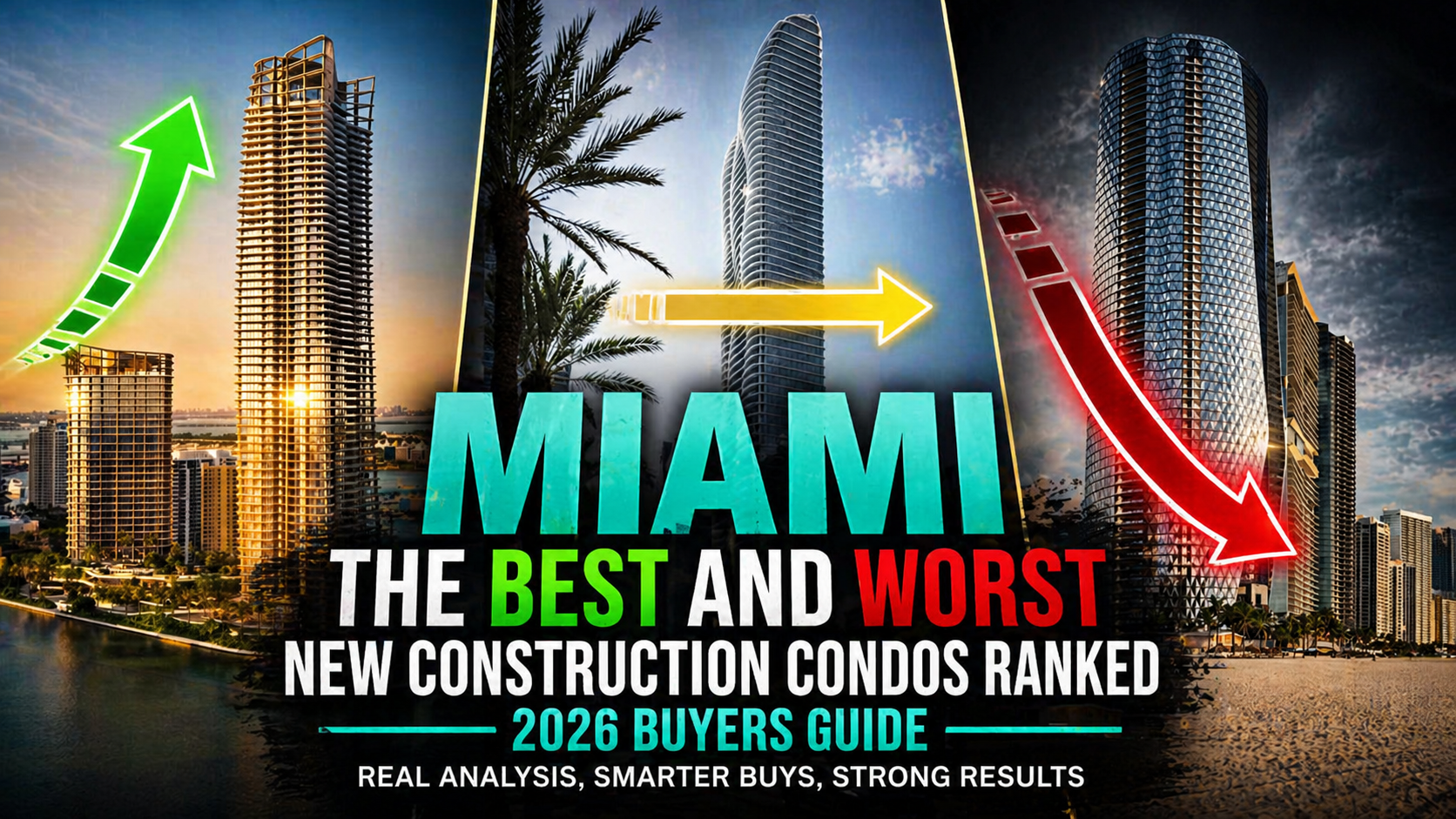
Ranking The Best and Worst Miami New Construction Condos for 2026

Coral Gables Real Estate Market Q1 2026
Kendall Luxury Real Estate Market Update Q1 2026
Miami Real Estate Market Report Q1 2026: The Two-Market Reality Driving Prices

Sunny Isles Real Estate Market Q1 2026

Who Is the Best Real Estate Agent in Miami for New Construction Condos? (2026 Data-Driven Guide)

How to Buy a Luxury Condo in Miami (2026 Playbook for Smart Buyers)
Pinecrest Real Estate Market Update Q1 2026

Aventura Real Estate Market Report Q1 2026

Brickell Real Estate Market Report Q1 2026
Coconut Grove Real Estate Market Q1 2026 (Updated April 2026)
Please fill in your details and David Siddons will contact you

Search related videos

Are St. Regis Sunny Isles Residences Worth the Brand Premium?
Coral Gables Market Report 2025: What the Headlines Aren’t Telling You!
How David Siddons’ Power Team Drives Miami’s Luxury Market
Mid‑Year 2025 Coconut Grove Report: The Truth About What’s Selling Now
Brickell Mid‑Year Market Report 2025 | Is Brickell’s Luxury Market in Trouble?
Pinecrest Mid-Year Market Report 2025 | What’s Selling, What’s Sitting & Why
Miami Beach Condo Market Mid-Year Report 2025 | What Buyers & Sellers Need to Know
How to Lose $1M in The Miami Condo market | Top Mistakes That Cost Miami Condo Buyers Millions
The Well Project EXPOSED Coconut Grove’s Hottest Units
Miami Real Estate in 2025 Is NOT What You Think 😱 | Midyear Must Knows for Buyers & Sellers!
7 Things You Should Never Say to a Real Estate Agent in Miami!
Landmark Victoria Park Residence in Fort Lauderdale: Inside 420 NE 11th Ave 🌴✨
Luxury Living on 2355 S. Miami Ave | Fully Furnished 4-Bed Home w/ Resort-Style Pool 🏊
Is Mandarin Oriental Residences Miami a Smart Condo Investment? Prices, Floorplans, Views & Finishes


- Get our Newsletter
- Subscribe
- No Thanks
Get the latest news from Miami Real Estate News
Close
Edit Search
Close
Share this property
Recomend this to a friend, just enter their email below.
Close
Your email was sent successfully
Close
 COMPARE WITH CONDOGEEKS