

















Best and Worst Performing Condos in Edgewater in 2025

Methodology

Edgewater has quickly evolved into one of Miami’s most dynamic condo markets offering everything from new construction towers with record-setting price-per-square-foot values to older buildings struggling with inventory and rising maintenance costs. In this report, we break down the best and worst-performing condos in Edgewater using real sales data, year-over-year price-per-square-foot trends, and inventory statistics to highlight which buildings are truly holding their value, and which are falling behind. If your building isn’t included, contact us for a detailed performance analysis.

The Best and Worst Condos in Edgewater

The Best Performing Condos in Edgewater

The Best and Worst Condos in Edgewater

1 Elysee

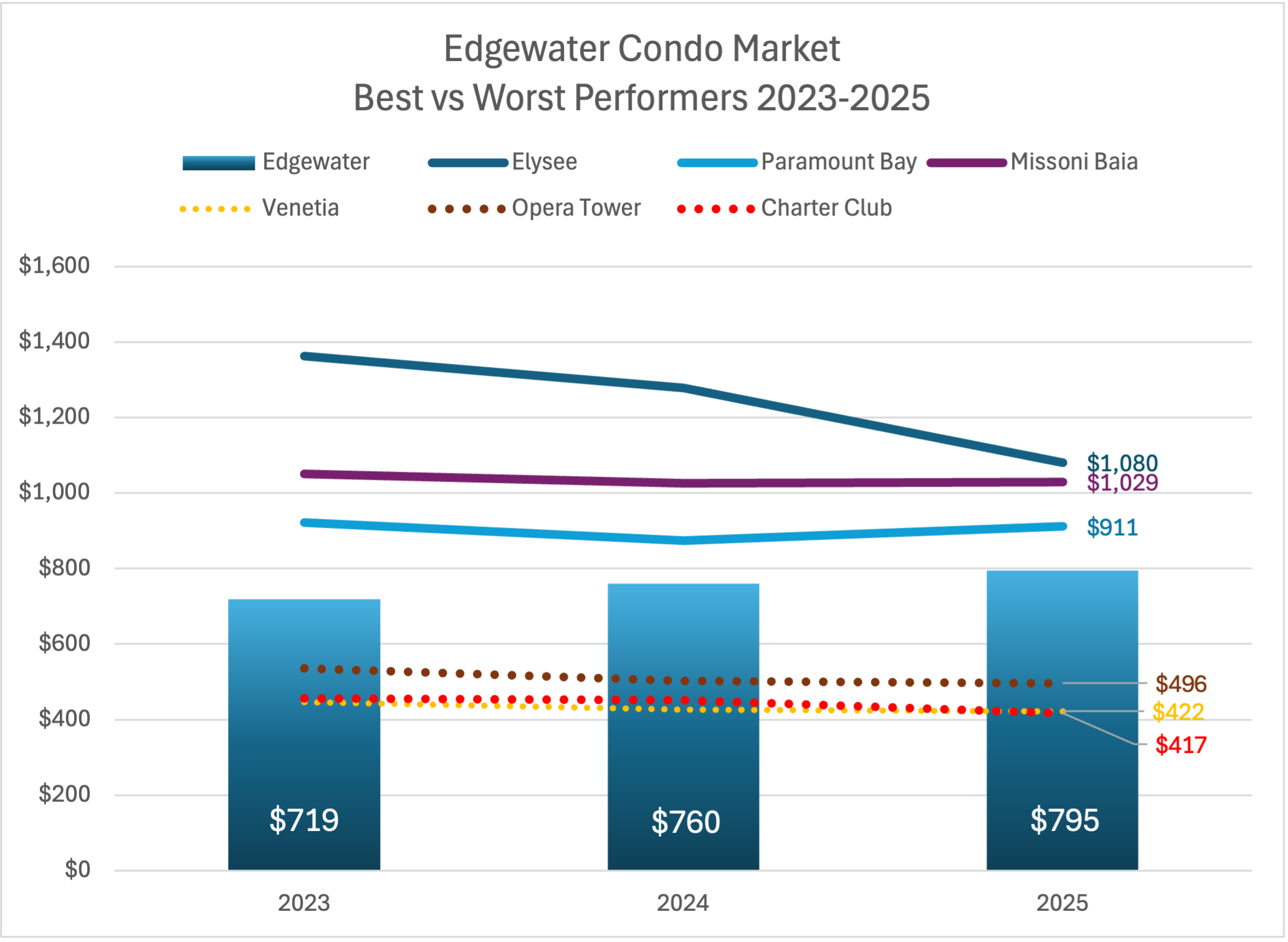
Elysee stands as one of Edgewater Miami’s most exclusive and architecturally distinct condominiums. Completed in 2021, the 57-story tower offers only 100 expansive corner residences, each with unobstructed bay and city views and larger square footage per unit than any other building in the neighborhood. Its interiors, designed by Jean-Louis Deniot, introduce refined, Parisian-inspired elegance with private elevators, 10- to 11-foot ceilings, oversized terraces, and high-end finishes. Residents enjoy over 10,000 square feet of amenities across three floors, including a resort-style pool deck, Bay Lounge with chef’s kitchen and private dining room, sunrise pool and fitness center, spa with sauna and steam rooms, library, and sky lounge. Elysee attracts primarily end-users and second-home owners seeking privacy and a true boutique living experience in the heart of a rapidly developing district close to the Design District, Midtown, and Miami Beach. Prices range from approximately $2.6 million to $4.5 million, or $980 to $1,200 per square foot. Between 2021 and 2023, Elysee saw prices soar about 60%, from $850 to over $1,360 per square foot, before a modest 6% correction in 2024 as resale supply increased and the market cooled. In 2025, the average price per square foot sits around $1,120, reflecting normalization but still well above 2021 levels. Median days on market over the past year are 112, with months of inventory fluctuating between three and sixteen since delivery. HOA fees average about $2 per square foot, higher than the Edgewater norm of $1.25 to $1.50, largely due to the building’s limited number of owners sharing costs. Elysee remains predominantly owner-occupied, with only ten leases recorded in the past year, underscoring its end-user appeal. The only forthcoming project likely to compete with Elysee is Villa Miami, where prices start at $4.5 million and reach up to $10 million.

2. Paramount Bay

Paramount Bay, set directly on the bayfront in the heart of Miami’s vibrant Edgewater neighborhood, is a 47-story tower featuring 338 luxury residences. Each home showcases high ceilings, floor-to-ceiling glass, and deep terraces with sweeping bay or skyline views. Residences range from two to five bedrooms and span approximately 1,200 to over 4,400 square feet, with many units boasting premium finishes and thoughtful layouts. Since its 2010 delivery, numerous owners have modernized their interiors, resulting in notable price variations based on renovation quality. Amenities are resort-style and extensive, including two heated infinity-edge pools positioned for sunrise and sunset, cabanas and landscaped lounging areas, a two-level glass-walled fitness center overlooking the bay, a full spa with sauna and steam rooms, and a striking three-story grand lobby. Paramount Bay’s prime location adds to its appeal, offering residents easy access to Margaret Pace Park, the Design District, Midtown, Wynwood, and quick connections to Downtown Miami and Miami Beach—balancing serene waterfront living with urban convenience. Prices start around $900,000 for smaller two-bedroom residences and rise to $2.5 million, with select penthouses reaching roughly $4 million. Current prices per square foot range from $750 to $1,000. Between 2021 and 2022, Paramount Bay saw an 11% rise in values as post-pandemic demand returned, followed by a mild 3–4% dip in 2023 as supply increased. In 2024, values rebounded about 10%, largely due to premium trades on higher floors with bay views, before softening slightly in 2025 to an average of $970 per square foot—still above 2021 levels but reflective of market stabilization. The median days on market over the past year stand at 148, and months of inventory have fluctuated from as low as two months in 2021–2022 to about fifteen months more recently. HOA fees average $1.65 per square foot, just above the neighborhood norm of $1.25 to $1.50. The building remains primarily owner-occupied, though there is a stable base of long-term tenants, with 19 units leased in the past year and only six currently listed for rent. Among future competitors, Casa Bella is the closest in price point and location; however, its inland position gives Paramount Bay a distinct edge as the more established and directly waterfront option in Edgewater.

3 Missoni Baia

Missoni Baia, completed in 2023, is one of Edgewater’s most architecturally striking and design-focused residential towers, rising 57 stories along Biscayne Bay with 249 residences ranging from one to five bedrooms. Each home features floor-to-ceiling glass and deep terraces designed to maximize unobstructed water views, embodying the tower’s refined, design-driven identity. As Edgewater’s newest completed luxury development, Missoni Baia combines contemporary architecture with the fashion brand’s distinctive aesthetic, setting a new benchmark for waterfront living. Spanning over 30,000 square feet, the amenities rival those of a five-star resort and include an Olympic-length lap pool, a resort-style bayfront pool deck, a wellness and spa area with hammam and sauna, a state-of-the-art gym with bay views, a kids’ playroom, media and game rooms, a residents’ lounge, and tennis courts overlooking the bay. Positioned at the northern edge of Edgewater, residents enjoy quick access to the Miami Design District, Midtown, and Wynwood, placing Missoni Baia in one of Miami’s most dynamic and desirable urban settings. Entry-level pricing begins around $650,000 for one-bedroom units without direct water views, increasing to $2.5 million for two-bedroom bayfront residences and up to $4.2 million for high-floor and penthouse units. Upon its 2023 launch, resale activity averaged roughly $1,020 per square foot, consistent with top-tier, design-branded towers. Prices held steady in 2024 with a modest 1% uptick as the building transitioned from developer closings to early resales, and in 2025 the average price per square foot remains near $1,035—reflecting a stable, end-user-driven market with minimal volatility. Median days on market over the past year are 92, and months of inventory have decreased from 39 months at delivery to roughly five months today. HOA fees average $1.70 per square foot, above Edgewater’s $1.25 to $1.50 average, justified by Missoni’s extensive amenity offering and new construction quality. The building has a higher proportion of investor-owned units than its neighbors, leading to significant rental activity as the property continues to mature into one of Edgewater’s most refined and desirable waterfront addresses.
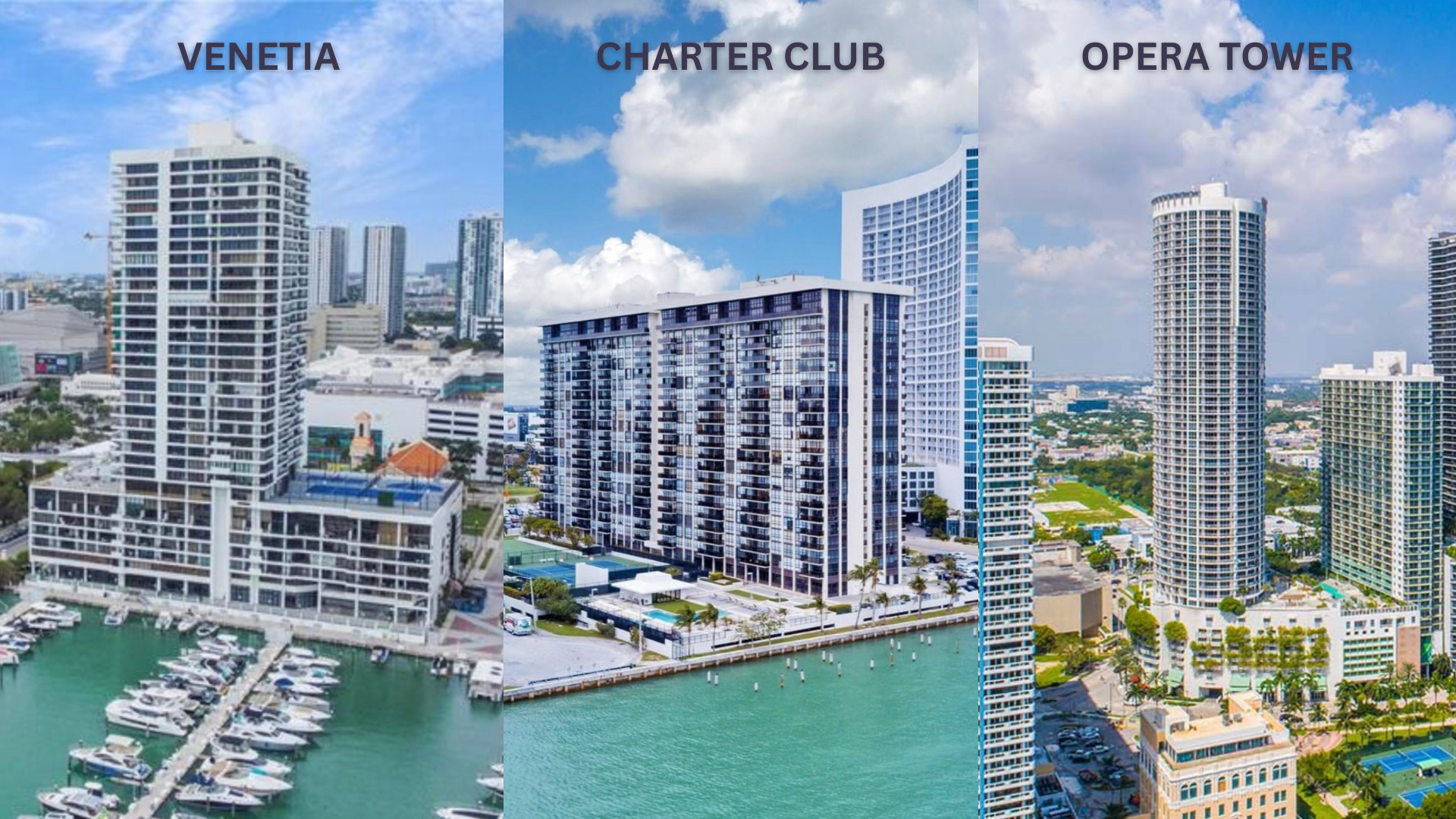
The 3 Worst Performing Condos in Edgewater

The Best and Worst Condos in Edgewater

1. The Venetia

The Venetia, built in 1980, is one of Edgewater’s oldest high-rises and has struggled to compete with newer luxury towers. Its aging construction, outdated systems, and ongoing 40- and 50-year recertification requirements have led to frequent repairs and special assessments, which discourage many buyers. The building’s mixed-use model, combining condo-hotel units and short-term rentals, results in high turnover and limits its appeal for end users seeking a stable, residential environment. While it benefits from a bayfront location, proximity to major causeways brings heavy traffic noise and reduces walkability compared with newer northern Edgewater developments. High HOA fees relative to its value, along with limited amenities, further depress demand and keep resale prices below neighborhood averages. Over the past five years, Venetia has seen modest but uneven price growth, rising roughly 13% between 2021 and 2023 to about $427 per square foot, before declining in 2024 and 2025 to around $380 per square foot, close to pre-2021 levels. This reflects flat long-term appreciation and ongoing volatility tied to assessments, building age, and shifting buyer preferences toward newer inventory. Median days on market over the past year were 111, with most units selling well below asking price, and months of inventory in 2025 have ranged from nine to seventeen. HOA fees average $1.35 per square foot, not including special assessments of $500–$600 per month per unit. The building remains largely investor-owned, with many units rented at low rates of $2,000 to $3,000 per month, underscoring its limited long-term value compared with Edgewater’s newer luxury towers.

2. Opera Tower

Opera Tower, built in 2007, is one of Edgewater’s most recognizable high-rises but has struggled to perform compared with newer luxury buildings. The property has faced reputation challenges over the years, including management disputes, maintenance issues, and a transient, hotel-like environment. Its zoning allows short-term rentals and Airbnb-style stays, which contribute to high turnover, inconsistent upkeep, and limited appeal for long-term residents. While the central location near Margaret Pace Park and Biscayne Bay is attractive, many buyers view Opera Tower as heavily investor-driven with minimal community feel and elevated wear-and-tear. Over the past five years, the building saw strong appreciation between 2021 and 2023, with prices per square foot rising from roughly $355 to $535, fueled by post-pandemic demand and investor activity. Beginning in 2024, values softened slightly as resale activity stabilized and competition from newer Edgewater developments increased, with a modest decline of about 5.9% through 2025. Median days on market over the past year were 205, and months of inventory in 2025 have ranged from seven to thirteen, with 71 units currently listed for sale. HOA fees average $1.95 per square foot, well above the neighborhood average despite the building not being considered luxury. The owner mix remains heavily investor-focused due to the flexibility for short-term rentals, limiting price growth potential compared with more exclusive residential towers nearby.

3. The Charter Club

The Charter Club Condominium is one of Edgewater’s weaker-performing buildings, challenged by age, upkeep costs, and competition from newer luxury towers. Built decades before the area’s modern condo boom, the property lacks high-end finishes, resort-style amenities, and contemporary designs that today’s buyers expect. Many units have dated interiors and smaller balconies, and while some offer partial bay views, they fall short of the unobstructed vistas available in newer Biscayne Bay towers. Rising maintenance fees and potential expenses tied to recertification further depress resale value. The building has a high percentage of investor-owned and rental units, creating frequent turnover, limited community stability, and a transient atmosphere that discourages long-term residents. Between 2021 and 2023, Charter Club saw strong growth, with prices per square foot rising nearly 37% due to post-pandemic demand and Miami’s broader condo boom. However, beginning in 2024, appreciation stalled as buyers gravitated toward newer luxury developments, and over the last two years, prices have gradually declined about 9%. Median days on market in the past year were 217, with months of inventory in 2025 ranging from six to twelve. HOA fees average $0.84 per square foot, well below neighborhood norms, but do not include special assessments of $50,000 to $100,000 per unit. The building remains heavily investor-driven, with approximately 75 units rented in the past year, and while it still appeals to price-sensitive buyers seeking larger layouts and bayfront access, its dated reputation limits long-term appreciation compared with Edgewater’s newer luxury towers.

Conclusions

The Edgewater condo scene shows a clear split between the new and the old. Modern and newer buildings like continue to attract strong buyer interest with their design, amenities, and waterfront lifestyle, even as the market cools a bit. Meanwhile, older buildings that are heavily investor concentrated are feeling the pressure of age, high costs, and investor-heavy ownership, which has slowed their growth. As the neighborhood keeps evolving, buyers are clearly leaning toward newer, well-managed condos that offer both luxury living and long-term value.

Trends in Best Performing Condos:

  • Direct Bayfront Living: True waterfront locations with unobstructed Biscayne Bay views, large terraces, and floor-to-ceiling glass.
  • End-User Demand & Stability:Primarily owner-occupied or second-home buyers drive demand, keeping resale values steady and reducing volatility.
  • Strong but Stabilizing Price Growth:Each experienced significant appreciation post-delivery, now stabilizing around $900–$1,200 per sqft.
  • Premium HOA Fees Reflect Exclusivity:Slightly higher HOA costs are justified by boutique scale, high service levels, and exceptional amenities.

Trends in Worst Performing Condos:

  • Aging Buildings & Recertification Costs:Older properties facing expensive 40- or 50-year recertifications, ongoing repairs, and frequent special assessments that eat at equity and buyer confidence. Compared to newer luxury towers, these condos lack updated finishes and resort-style amenities compared to competition in the market.
  • High Carrying Costs vs. Value:HOA fees, especially when combined with assessment charges, are disproportionately high relative to property value, further deterring buyers.
  • High Investor & Rental Ratios:Each building has a heavy concentration of investor-owned units and some short-term rentals, creating transient atmospheres, high turnover, and weaker end-user appeal.
  • Long Market Times & Elevated Inventory:Prolonged days on market (110–220+) and months of inventory ranging from 6–17 reflect weak demand and low resale momentum.

Connect with The David Siddons Group


Thinking of buying or selling in Edgewater? I’ve analyzed every major building in these markets and can offer you a private strategy session to ensure you’re on the winning side. Don’t gamble with a million-dollar decision,  I’ll help you separate true value from hidden risk. Whether you’re buying or selling, timing and building choice are everything. With years of experience guiding clients through Miami’s luxury condo market, I’ll make sure you protect and grow your investment.

Before you commit to a building, commit to a call — and get the insider’s edge you need to make the right move.
📞 Call me directly at (305) 508-0899 or schedule a meeting using the link below.

FAQ

These are the most commonly Miami Real Estate Related questions

What should relocation buyers know before buying real estate in Miami?

HOME BUYERS

Relocation buyers looking at homes in Miami should understand that choosing the right house is less about the property itself and more about location, schools, and long-term value. Many buyers make the mistake of focusing on price or finishes, while the real driver of value is the neighborhood and micro-location. Older homes often represent better value, but may also be part of a future redevelopment cycle. Newer homes command premiums, but don’t always sell faster if pricing is ahead of the market. Commute time, school access, and community dynamics are critical and often underestimated. The key is to evaluate homes not just as lifestyle purchases, but as long-term assets within a very localized market.

Sources:
https://luxlifemiamiblog.com/relocating-to-miami/
https://luxlifemiamiblog.com/relocating-to-miami-with-a-family/

CONDO BUYERS:
Relocation buyers should understand that Miami is a highly segmented, building-driven market, not a uniform one. Pricing can vary significantly between similar properties depending on building quality, layout, and financial health. Many buyers assume newer construction equals better investment, but that is often not the case. Factors like HOA fees, reserves, and rental policies can materially impact long-term value and liquidity. Negotiation opportunities often exist, especially in slower segments, but require precise market knowledge. The key is to evaluate micro-markets and individual buildings, not just neighborhoods or price per square foot.

Sources:
https://luxlifemiamiblog.com/miami-real-estate-market-report/
https://luxlifemiamiblog.com/new-construction-miami-guide/

What are the best areas for relocating families with children

For families relocating to Miami with young children, the most recommended neighborhoods are Coral Gables, Coconut Grove, and Pinecrest. Coral Gables offers the best balance of top schools, safety, and long-term value. Coconut Grove is ideal for younger families seeking walkability, greenery, and a lifestyle-driven environment. Pinecrest provides larger homes, excellent schools, and better value for space, making it ideal for growing families. The key driver across all three is access to strong schools and primary residential stability. Relocation decisions are less about new construction and more about long-term livability and resale strength.

Sources:
https://luxlifemiamiblog.com/best-neighborhoods-miami/
https://luxlifemiamiblog.com/what-are-the-best-family-neighborhoods-in-miami-in-2023/

Are new construction condos in Miami a good investment?

New construction condos in Miami can be a good investment—but only if you understand that not all buildings perform the same. According to the David Siddons Group, many buyers assume “new = better,” but in reality, performance depends on pricing, layout, building quality, and long-term demand.  Some new developments set future price benchmarks and can drive long-term appreciation, especially in top-tier projects.  However, many are priced aggressively at launch, and buyers relying on marketing instead of data often overpay.
The market is highly segmented, meaning two new buildings next to each other can perform very differently.
The best opportunities typically come from selecting the right building early or negotiating correctly in later phases.
In short: new construction is not automatically a good investment—it becomes one only with building-level analysis and disciplined entry pricing.

Sources:
https://luxlifemiamiblog.com/how-to-buy-a-luxury-condo-in-miami/
https://luxlifemiamiblog.com/category/independent-new-construction-condo-reviews/
https://luxlifemiamiblog.com/beyond-clickbait-real-insights-into-miamis-luxury-condo-market/

Why is buying a Miami condo riskier than buyers think?

Buying a Miami condo is often riskier than buyers expect because the true risks are at the building level—not visible in the listing price. Many buyers focus on finishes and views, while overlooking HOA reserves, insurance exposure, and potential special assessments. In reality, two identical units in different buildings can perform completely differently over time. Rising HOA fees and stricter regulations are also increasing the true cost of ownership, especially in older buildings. Liquidity can be affected by factors like financial health, rental policies, and ongoing repairs. The key risk is not the condo itself—but buying into the wrong building without proper due diligence.

Sources:
https://luxlifemiamiblog.com/how-to-buy-a-luxury-condo-in-miami/
https://luxlifemiamiblog.com/miami-condo-market-risks/

What are Miami's Safest Areas?

The safest areas in Miami are typically Coral Gables, Coconut Grove, Pinecrest, Key Biscayne, and Ponce-Davis. These neighborhoods stand out due to low density, strong community presence, and high concentration of full-time residents, which directly impacts safety. In Miami, safety is highly localized, meaning micro-location and specific streets matter more than zip codes. Areas with top schools and family-driven demand tend to maintain stronger safety profiles over time. Gated communities and low-traffic residential streets further enhance security. Ultimately, the safest areas are defined less by price and more by stability, schools, and residential character.

Which Miami Areas Still offer Great Value (Budget Friendly alternatives to Coral Gables and Pinecrest)

If you’re looking for better value than Coral Gables or Pinecrest, the answer (in true Siddons style) is not “go cheaper”—it’s go one layer outside the obvious markets.

The strongest value plays are:

  • Schenley Park → closest substitute to Coral Gables at ~20% discount while maintaining similar character and location
  • Biltmore Heights → almost identical feel to the Gables but ~25–30% cheaper on a $/SF basis
  • Glenvar Heights → central location with larger lots and ~25% pricing advantage vs South Miami/Gables
  • Baptist / Galloway (Kendall) → Pinecrest-style living (space, schools, land) at up to ~30% lower pricing

The pattern is consistent:
👉 Buyers are shifting west and slightly off-market to gain land, scale, and pricing efficiency. You don’t find value by going to a “cheaper neighborhood”—you find it by identifying adjacent micro-markets that offer the same lifestyle fundamentals without the brand premium.

Sources:
https://luxlifemiamiblog.com/best-value-neighborhoods-miami/
https://luxlifemiamiblog.com/category/miami-neighborhoods/

Is NOW a good time to buy in Miami?

In 2026, the answer is yes—but only if you understand what part of the market you’re buying into. Miami is no longer one market; it has split into multiple segments behaving very differently. From a David Siddons perspective, this is a selective buyer’s window, not a broad “good time” headline. Some segments—especially condos with rising inventory—are offering negotiation opportunities and better entry points. 

At the same time, prime single-family homes and top-tier new construction continue to hold value or even trade near record levels.

Buyers who rely on timing the market often miss the point—success in Miami today comes from selecting the right micro-market and asset, not waiting for a crash.  If you are disciplined on pricing, building quality, and location, this market offers opportunity. If you are not, it is easy to overpay. 2026 is a good time to buy in Miami for informed buyers—because the market is fragmented, negotiation exists, and strategy matters more than ever.

Sources:
https://luxlifemiamiblog.com/miami-real-estate-market-report-q1-2026/
https://luxlifemiamiblog.com/market-reports/

Are Miami real estate prices going down in 2026?

No—but that’s the wrong way to look at it. Miami is not one market anymore, so prices are not moving in one direction. In 2026, the market is split into two: ultra-luxury, scarcity-driven areas (like waterfront and top-tier neighborhoods) are still holding or even rising, while mid-tier condos and oversupplied segments are flat or correcting. What we’re seeing is price divergence, not a crash—some properties are gaining value while others are quietly adjusting downward. Rising inventory and more selective buyers are putting pressure on pricing in certain segments, especially older condos or buildings with weaker fundamentals.
At the same time, global wealth and cash buyers continue to support pricing at the top end of the market. So the real answer: prices aren’t broadly dropping—they’re being repriced based on quality, location, and supply.

Miami Real Estate Market Report Q1 2026

Should I buy a house or a condo when relocating to Miami?

The decision comes down to lifestyle first, investment second—and most relocation buyers get that backwards. If you want space, privacy, schools, and long-term family living, a single-family home in areas like Coral Gables or Coconut Grove is typically the stronger choice. If you prioritize walkability, low maintenance, and proximity to business districts, a condo in Brickell or waterfront markets makes more sense.
From an investment perspective, homes tend to be more stable, while condos are more building-dependent and cyclical. Most relocation clients underestimate how much building quality, HOA structure, and future costs impact condo performance. The right answer isn’t “house vs condo”—it’s which asset fits your lifestyle AND holds value within its micro-market.


 How do I choose the right Miami neighborhood for my lifestyle?

Choosing the right neighborhood in Miami comes down to how you live day-to-day, not just where prices are. Relocation buyers should first define priorities: walkability, schools, commute, or waterfront lifestyle.
For example, Coconut Grove fits walkable, family-oriented living, while Brickell suits urban, high-rise lifestyles. Buyers often make the mistake of focusing on price per square foot instead of lifestyle fit and long-term livability. Each neighborhood operates like its own micro-market, so the “best” area depends on your daily routine and long-term goals. The key is to align lifestyle, location, and market fundamentals, not just aesthetics or newness.


https://luxlifemiamiblog.com/best-neighborhoods-miami/

Why are Miami condo prices so different between buildings?

Miami condo pricing varies widely because value is determined at the building level, not just by location. Two buildings next to each other can have major differences in financial health, reserves, HOA fees, and management quality. Buyers also pay premiums for better layouts, views, amenities, and newer construction—but not all “new” buildings perform equally. Factors like rental policies, upcoming assessments, and building reputation can significantly impact resale value. This is why price per square foot alone is misleading in Miami’s condo market. The real driver of value is how that specific building competes within its micro-market over time.

Sources:
https://luxlifemiamiblog.com/how-to-buy-a-luxury-condo-in-miami/
https://luxlifemiamiblog.com/category/independent-new-construction-condo-reviews/

WHY WORK WITH DAVID? THINGS YOU SHOULD KNOW...

For all our analytics we are agents driving some very unique and advanced tech. We Provide a granular and custom experience that empower our clients with the insight and tools to understand the most complex behaviors of any local markets.

  • Analytical

    Over 100 reports produced to date

  • Knowledgeable

    Over 1800 published articles and counting

  • Experienced

    Over $2 billion in real estate sales

    Reviews
David Siddons
blog

Related Articles