



















- Best of All
- Best Miami Luxury Condos
- Most popular
- Relocating to Miami
- Private Schools
- Investments
- Gated communities
- Waterfront information
- Luxury homes
- Luxury Condos
- New Construction Condos in South Florida
- Independent Pre-Construction condo reviews for Miami
- Independent Pre-Construction condo reviews for Fort Lauderdale
The Reasons Why A Buyer’s Agent Can Never be Replaced
Why A Good Buyer’s Agent Can Out Perform Technology and Tech Based Brokerages
At a panel hosted by the National Association of Real Estate Editors, insiders agreed the future of buyer’s agents is uncertain, due to legal scrutiny and technology. While homebuyers will continue to want trusted advisors, buyer’s agents may operate differently than they do today, or even disappear entirely as we know them in the U.S., depending on several factors, panelists said.
This article (Based on input from Inman News), explains the different reasons of this uncertainty, but also offers our opinion on why we agree or do not agree with the panelists.
Possible Threat to Buyer’s Agent: Technology
Technology has already diminished the role of buyer’s agents to some extent. Many aspiring homeowners use listing portals (Zillow, Trulia etc) to find the homes they buy themselves, rather than relying on Realtors.
Why We Think This Wont Affect the Use of a Buyer Agent
Many people look for properties on Zillow, Trulia, realtor.com and so forth. It is true, those systems have the complete lists of properties for sale and you can find the homes that are within your budget. But if you think that that is the only thing a realtor does: to find you a list of properties, then you have probably always worked with the wrong real estate agent. How do you know the price of the property is right? How do you know what you should pay in order not to overpay?
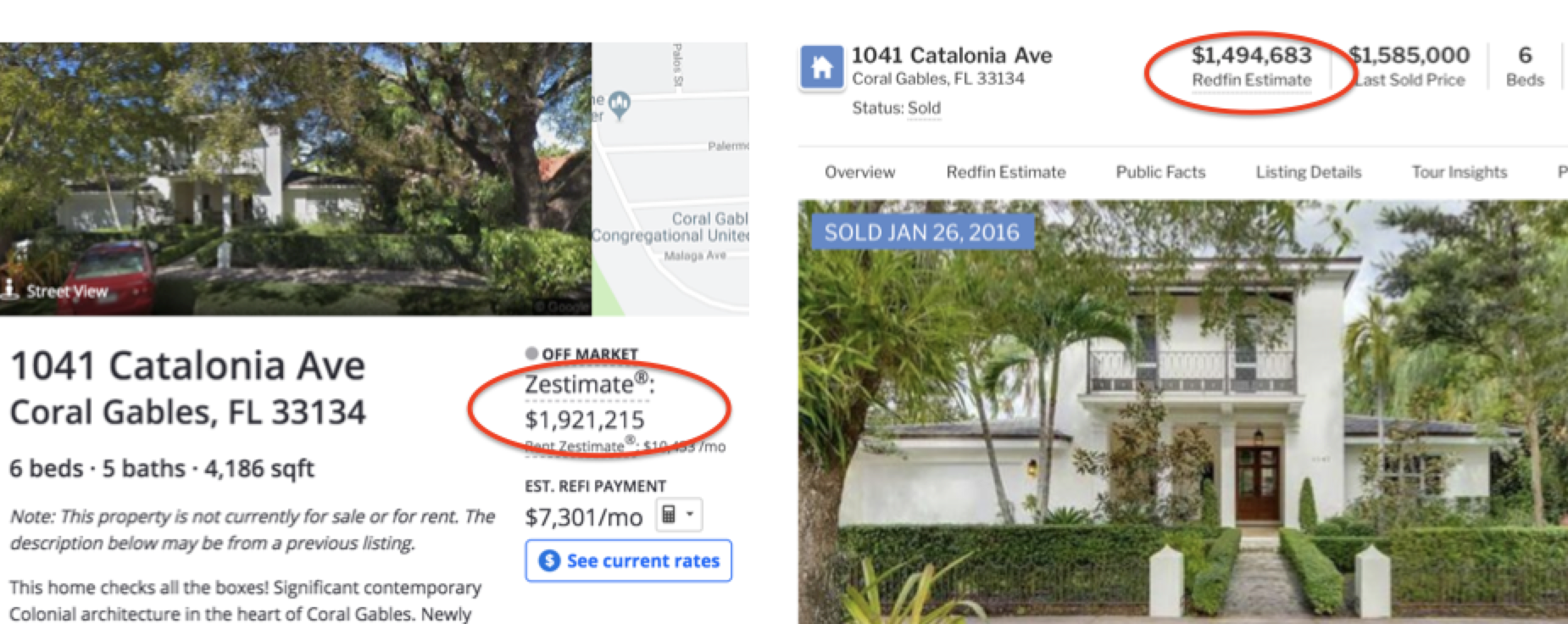
Yes, Zillow and competing sites offers you an estimate, but that estimate is often very far off, which is to be expected from a computerized system that has not seen the home’s finishes or knows the area’s specifics. Also I invite you to type one address into different real estate portals and see how much their estimates differ from one another (I saved you some time, see picture below)
Does Zillow tell you the average prices per SF in the area in the last years? Do they take new developments into account that might increase or decrease the value of homes in that area? Do they have experience with the best insurance companies, the best inspection officers, the best lawyers? If any issue occurs with the deal, do they send someone to help you with that issue? As experienced realtors we analyze the market on a daily basis. We know likewise properties that sold in the same area (inside and outside) making us experts in providing you with the right price for a home. We offer you forecasts and can compare different areas, condo projects and homes with one another. Because of our experience we can make a hard deal happen, we have saved tons of deals where without an experienced agent the buyer would have missed out on their dream home.
Possible Threat to Buyer’s Agent:The Class- Action lawsuit against the MLS
A massive class-action lawsuit argues against leading brokerages and franchisors including Realogy, RE/MAX, Keller Williams and HomeServices of America, as well as the National Association of Realtors (NAR) industry trade group, that commission sharing imposes an anticompetitive restraint. The plaintiffs claim that without the MLS rule requiring commission sharing, buyer’s agents would compete more by offering lower rates and other business models. This would be the case if buyers had to compensate their agents directly — a logical result if commission sharing were banned. In the case buyers would compensate their agents directly, new brokerage models would start to exists such as discount, limited-service options that have sputtered in the past, such as those once offered by Xome. According to the workshop outcome, buyers paying their own agent would increase the transparency on the [buy-side] commission rate and given the costs, buyers might then reconsider the use of a buyer’s agent
Why We Think This Wont Affect the Use of a Buyer Agent
The Miami real estate market is already very competitive, although there are different levels of agents. Is it fair that the seller pays the commission for both agents? Maybe it isn’t fair and maybe costs should be divided between the two parties (In the end you will save that money when you sell, so you break even). Whoever pays the buyer’s agent should respect a decent percentage. Creating a market in which buyers can decide how much they feel like paying by using a stronger negotiation position might destabilize the market and those who will work for 1% (often the least experienced) might get more business.
A good realtor is worth every penny. I respect people not wanting to pay 3% for a realtor who just provides them with a list of properties and has no clue how to handle problems or advice the buyers on the right price. If you want to take that risk then go ahead, you actually don’t even need a realtor in that case. But those experienced agents like myself and many other top producers who work hard every day and really add value to the client’s investments should not be squeezed out of a commission. It takes time and effort to know a market, to know the numbers, to advice clients on the best prices, to forecast where the market is heading, to solve contractual problems or disagreement with the sellers and that comes with a price tag.
Possible Threat to Buyer’s Agent: Pocket Listings
Some MLS alternatives, like pocket listing networks, are gaining traction.
Why We Think This Wont Affect the Use of a Buyer Agent
Pocket listings are listings held by a listing agent, which are never advertised on the MLS or pages like Trulia. These pocket listings are getting more and more desired with sellers. This however does not mean you do not need a buyer’s agent. This gives you a good reason to engage with a good buyer’s agent with an extended network. Everyone can find listings on the MLS, but it takes an experienced, well connected agent to find pocket listings. The top level of agents share pocket listings via emails or text messages. If you are not working with an agent or not on that agent’s database, how would you ever know about that pocket listing? We know about all of Miami’s top player’s pocket listings and even better; we find our clients homes that aren’t even listed. We have our clients choose from all homes, not just what is on the market. How do we do this? We reach out to owners to see if they are willing to sell and we are successful at it.
Possible Threat to Buyer’s Agent: Tech-Powered Brokerages
A few tech-powered brokerages are providing options that cut out buyer’s agents. Venture capital-backed REX, for example, is bypassing the MLS, with a policy of never paying commissions to buyer’s brokers and Redfin recently unveiled Redfin Direct, a service that guides buyers through making offers on Redfin listings without representation.
REX states it still will cooperate with outside agents, asking the home buyers to pay their buyer agent with cash or through the financing of the home. Buyers without agents, meanwhile, are assigned to “an independent REX Buyer’s Agent” to negotiate with the seller’s REX agent. “While negotiations in the REX office can sometimes get a little adversarial, it is only because every agent understands that it’s their duty to provide passionate representation on both sides of the transactions,” REX assures unrepresented buyers on its website.
Experienced agents are no strangers to this kind of rhetoric. Many startup brokerages have launched wars of aggression against the industry claiming they are there to liberate consumers. None of them have gained and held significant territory by working entirely outside the MLS. REX claims to be the exception to this rule — the “first licensed residential real estate brokerage to successfully circumvent the outmoded Multiple Listing Service (MLS) real estate agent model, making home transactions more affordable, convenient and transparent”
REX says it pulls this off largely by using artificial intelligence to identify potential buyers and then trying to lure them to listings with web-based ads. But it also markets its listings through some of the same listing portals that most agents use to reach potential buyers, such as Zillow.
Why We Think This Wont Affect the Use of a Buyer Agent
Using an online brokerage without any representation is something I’ll never understand. Redfin just enables you to make an offer without any help. Clearly creating a standard offer isn’t heart surgery, but what if there is more at stake? Don’t you want to know how much the property is worth? What the future will bring to that area? One should never forget that online brokerages are computerized systems and even if there is a human behind the system; where does that person live? Do they even know where Coral Gables is, do they know about the specific gated communities in Coconut Grove? If you are buying in Miami and the agent is in Washington how does that “Agent aka Call Center Employee” know the local market, the future developments, the insides and finishes of the homes? They will never actually see the home, and seeing a home in pictures vs in real life makes all the difference.
Ask yourself this; Would you invest in the stock market via a computerized system that doesn’t have all the facts? No, you probably wouldn’t, so why would you use that system to make probably the most important investment of your life?
A system like Rex where the seller and buyer are represented by the same company also doesn’t sound too convincing. Why would they want the best for you if they also represent the seller? Besides that why would anyone list with them if they know buyers will prefer to buy another home where their buyer’s agent is paid for by the seller.
Whether you pay when you sell or when you buy, at one point we need to pay for brokerage services. These online companies are not proposing a new model to make the market more transparent, they are looking to profit from sellers who do not want to pay a commission.
Finally we are dealing a lot with relocating families. Buyers who do not even know the city they are moving to. Buyers who want the extended experience and insights into the best schools, the commute times, and where to live to be close to the best schools, social activities etc. This all requires local, in-the-field-knowledge, that can never be provided by a centralized brokerage somewhere else in the country.
If you want to buy a cooky cutter home in a street where all homes look exactly the same and the market has been steady for over a decade, then maybe you can buy without an agent or by using a discount agent. But in dynamic, luxury markets like Miami where property values are always changing and properties are unique and harder to put a value on, without a doubt you need a buyer’s realtor.
FAQ
These are the most commonly Miami Real Estate Related questions
What should relocation buyers know before buying real estate in Miami?
HOME BUYERS
Relocation buyers looking at homes in Miami should understand that choosing the right house is less about the property itself and more about location, schools, and long-term value. Many buyers make the mistake of focusing on price or finishes, while the real driver of value is the neighborhood and micro-location. Older homes often represent better value, but may also be part of a future redevelopment cycle. Newer homes command premiums, but don’t always sell faster if pricing is ahead of the market. Commute time, school access, and community dynamics are critical and often underestimated. The key is to evaluate homes not just as lifestyle purchases, but as long-term assets within a very localized market.
Sources:
https://luxlifemiamiblog.com/relocating-to-miami/
https://luxlifemiamiblog.com/relocating-to-miami-with-a-family/
CONDO BUYERS:
Relocation buyers should understand that Miami is a highly segmented, building-driven market, not a uniform one. Pricing can vary significantly between similar properties depending on building quality, layout, and financial health. Many buyers assume newer construction equals better investment, but that is often not the case. Factors like HOA fees, reserves, and rental policies can materially impact long-term value and liquidity. Negotiation opportunities often exist, especially in slower segments, but require precise market knowledge. The key is to evaluate micro-markets and individual buildings, not just neighborhoods or price per square foot.
Sources:
https://luxlifemiamiblog.com/miami-real-estate-market-report/
https://luxlifemiamiblog.com/new-construction-miami-guide/
What are the best areas for relocating families with children
For families relocating to Miami with young children, the most recommended neighborhoods are Coral Gables, Coconut Grove, and Pinecrest. Coral Gables offers the best balance of top schools, safety, and long-term value. Coconut Grove is ideal for younger families seeking walkability, greenery, and a lifestyle-driven environment. Pinecrest provides larger homes, excellent schools, and better value for space, making it ideal for growing families. The key driver across all three is access to strong schools and primary residential stability. Relocation decisions are less about new construction and more about long-term livability and resale strength.
Sources:
https://luxlifemiamiblog.com/best-neighborhoods-miami/
https://luxlifemiamiblog.com/what-are-the-best-family-neighborhoods-in-miami-in-2023/
Are new construction condos in Miami a good investment?
New construction condos in Miami can be a good investment—but only if you understand that not all buildings perform the same. According to the David Siddons Group, many buyers assume “new = better,” but in reality, performance depends on pricing, layout, building quality, and long-term demand. Some new developments set future price benchmarks and can drive long-term appreciation, especially in top-tier projects. However, many are priced aggressively at launch, and buyers relying on marketing instead of data often overpay.
The market is highly segmented, meaning two new buildings next to each other can perform very differently.
The best opportunities typically come from selecting the right building early or negotiating correctly in later phases.
In short: new construction is not automatically a good investment—it becomes one only with building-level analysis and disciplined entry pricing.
Sources:
https://luxlifemiamiblog.com/how-to-buy-a-luxury-condo-in-miami/
https://luxlifemiamiblog.com/category/independent-new-construction-condo-reviews/
https://luxlifemiamiblog.com/beyond-clickbait-real-insights-into-miamis-luxury-condo-market/
Why is buying a Miami condo riskier than buyers think?
Buying a Miami condo is often riskier than buyers expect because the true risks are at the building level—not visible in the listing price. Many buyers focus on finishes and views, while overlooking HOA reserves, insurance exposure, and potential special assessments. In reality, two identical units in different buildings can perform completely differently over time. Rising HOA fees and stricter regulations are also increasing the true cost of ownership, especially in older buildings. Liquidity can be affected by factors like financial health, rental policies, and ongoing repairs. The key risk is not the condo itself—but buying into the wrong building without proper due diligence.
Sources:
https://luxlifemiamiblog.com/how-to-buy-a-luxury-condo-in-miami/
https://luxlifemiamiblog.com/miami-condo-market-risks/
What are Miami's Safest Areas?
Which Miami Areas Still offer Great Value (Budget Friendly alternatives to Coral Gables and Pinecrest)
If you’re looking for better value than Coral Gables or Pinecrest, the answer (in true Siddons style) is not “go cheaper”—it’s go one layer outside the obvious markets.
The strongest value plays are:
- Schenley Park → closest substitute to Coral Gables at ~20% discount while maintaining similar character and location
- Biltmore Heights → almost identical feel to the Gables but ~25–30% cheaper on a $/SF basis
- Glenvar Heights → central location with larger lots and ~25% pricing advantage vs South Miami/Gables
- Baptist / Galloway (Kendall) → Pinecrest-style living (space, schools, land) at up to ~30% lower pricing
The pattern is consistent:
👉 Buyers are shifting west and slightly off-market to gain land, scale, and pricing efficiency. You don’t find value by going to a “cheaper neighborhood”—you find it by identifying adjacent micro-markets that offer the same lifestyle fundamentals without the brand premium.
Sources:
https://luxlifemiamiblog.com/best-value-neighborhoods-miami/
https://luxlifemiamiblog.com/category/miami-neighborhoods/
Is NOW a good time to buy in Miami?
Are Miami real estate prices going down in 2026?
No—but that’s the wrong way to look at it. Miami is not one market anymore, so prices are not moving in one direction. In 2026, the market is split into two: ultra-luxury, scarcity-driven areas (like waterfront and top-tier neighborhoods) are still holding or even rising, while mid-tier condos and oversupplied segments are flat or correcting. What we’re seeing is price divergence, not a crash—some properties are gaining value while others are quietly adjusting downward. Rising inventory and more selective buyers are putting pressure on pricing in certain segments, especially older condos or buildings with weaker fundamentals.
At the same time, global wealth and cash buyers continue to support pricing at the top end of the market. So the real answer: prices aren’t broadly dropping—they’re being repriced based on quality, location, and supply.
Should I buy a house or a condo when relocating to Miami?
The decision comes down to lifestyle first, investment second—and most relocation buyers get that backwards. If you want space, privacy, schools, and long-term family living, a single-family home in areas like Coral Gables or Coconut Grove is typically the stronger choice. If you prioritize walkability, low maintenance, and proximity to business districts, a condo in Brickell or waterfront markets makes more sense.
From an investment perspective, homes tend to be more stable, while condos are more building-dependent and cyclical. Most relocation clients underestimate how much building quality, HOA structure, and future costs impact condo performance. The right answer isn’t “house vs condo”—it’s which asset fits your lifestyle AND holds value within its micro-market.
How do I choose the right Miami neighborhood for my lifestyle?
Why are Miami condo prices so different between buildings?
Miami condo pricing varies widely because value is determined at the building level, not just by location. Two buildings next to each other can have major differences in financial health, reserves, HOA fees, and management quality. Buyers also pay premiums for better layouts, views, amenities, and newer construction—but not all “new” buildings perform equally. Factors like rental policies, upcoming assessments, and building reputation can significantly impact resale value. This is why price per square foot alone is misleading in Miami’s condo market. The real driver of value is how that specific building competes within its micro-market over time.
Sources:
https://luxlifemiamiblog.com/how-to-buy-a-luxury-condo-in-miami/
https://luxlifemiamiblog.com/category/independent-new-construction-condo-reviews/
WHY WORK WITH DAVID? THINGS YOU SHOULD KNOW...
For all our analytics we are agents driving some very unique and advanced tech. We Provide a granular and custom experience that empower our clients with the insight and tools to understand the most complex behaviors of any local markets.
-
Analytical
Over 100 reports produced to date
-
Knowledgeable
Over 1800 published articles and counting


Related Articles

Killian Drive: Kendall’s Luxury New Construction Corridor Hits $1,000/SF

Pinecrest’s 4 Best Streets in 2026

The 5 Best Luxury Streets in Miami’s Gated Communities

The Real Estate Team Behind the Agent: Why Systems Matter More Than Star Power

Selling a Home in Pinecrest: Why Some Homes Sell for $1,500/SF and Others Sit

We Built the Largest YouTube Audience of Any Miami Real Estate Team.

Empty Nesters in Miami: What Comes After the Big Family Home?

Palmetto Bay Has Almost No Inventory. So Why Are Homes Still Sitting?

Coconut Grove’s Best New Penthouse for Sale in 2026: The Well Penthouses Explained

Which Schools Serve Palmetto Bay? A Guide to Public School Boundaries

Beyond the Developer Finish

Ritz-Carlton Residences Pompano Beach Resale: The Opportunity After Closing

Kendall Real Estate vs. Coral Gables Real Estate: More Land, More House, Same Budget
The 5 Best Streets in Coconut Grove: A Buyer’s Guide from the Agents Who Sell Them
Please fill in your details and David Siddons will contact you

Search related videos

Experience the Success Stories: Rave Reviews from a Top Coral Gables Real Estate Agent! Listings
The Truth About Miami Real Estate: Buyers, Sellers, and the Market podcast
What Makes Anyone a Really Good Miami Real Estate Agent? StandOutAsARealtor
We Do What They Can’t Wedowhattheycant
The David Siddons Group | What we do and what makes us stand out as Miami Realtors StandOutAsARealtor
What our Clients have to say about the David Siddons Group | Part 6 | Joao Alvarez and Rita Tavares Testimonial
What our Clients have to say about the David Siddons Group | Part 5 | Buyer and Seller Testimonial
What our Clients have to say about the David Siddons Group | Part 4 | Buyer and Seller Testimonial
What our Clients have to say about the David Siddons Group | Part 3 | Buyers and Sellers Testimonial
What our Clients have to say about the David Siddons Group | Part 2 | Buyer and Seller Testimonial
What our Clients have to say about the David Siddons Group | Part 1 | Buyer and Seller Testimonial
Top Realtors in Miami – The David Siddons Group TopRealtorsinMiami


- Get our Newsletter
- Subscribe
- No Thanks
Get the latest news from Miami Real Estate News
Close
Edit Search
Close
2 of 14
Share this property
Recomend this to a friend, just enter their email below.
Close
Your email was sent successfully
Close
 COMPARE WITH CONDOGEEKS